The [Menu] button (atop the vertical black bar) reveals widgets like the Search box. Typing just the [Enter] key into the Search box is a way to browse WordPress blogs.
We add 2 lines to a haiku by Nozawa Boncho in response to
There are many images for the Biblical six days of creation, and one exuberant stained glass window is particularly apt for illustrating this post’s pair of haiku. When God finally rested, did He just chill out?
The following photo of comes from the Witterings blog, which also has a fascinating discussion and beautiful closeup photos of the window’s details.
When God finally rested, did He just chill out? In response to
Typing just [Enter] key into the Search box makes it easy to browse WordPress blogs like this one. Here, the [Menu] button (atop the vertical black bar) reveals widgets like the Search box.
Blood & Gold End This Series
Here are links to all posts in this project of reviewing and supplementing the splendid book
Yogi Berra’s Paradox
Sometimes bad English is good English that’s good because it’s bad.
Blood & Gold End This Series
Apart from a concern about the examples on 2 late pages in the book, I could applaud those pages until my hands bleed.
There are 8 lines that start with “A time to” in the famous Bible passage Ecclesiastes 3:1-8. I want to add another such line, anywhere in the series.
To every thing there is a season, and a time to every purpose under the heaven:
…
A time to comply and a time to resist; a time to obey rules, and a time to defy rules;
…
One of the strengths of Lynch’s book is the way page 274 (hardcover) notes that
even the schoolmarmish rules can be valuable in the right context
and later that the point of studying English in school is not
correct English but appropriate English—English suited to the occasion
(where I have replaced italics by boldface, which is better for emphasis in sans-serif fonts).
One of the book’s few weaknesses is in the examples of being suited to the occasion that Lynch uses. While they are appropriate, the lack of any other examples may be misleading.
I believe there are some occasions where some of the rules are genuinely helpful for clear communication with a sincere and attentive audience. I use [sincere] to describe people who want to know what somebody has to say. (They are not just looking for excuses to pounce.) I use [attentive] to indicate that they are not so hung up on assorted inane rules that violations are ipso facto distracting. (If U know any better words, please suggest them.) After reading the entire book, I am confident that Lynch and I are in general agreement, with some wiggle room for agreeing to disagree about which rules suit which occasions with sincere and attentive audiences. The examples of suitability that Lynch uses could give a different impression.
The example of a job interview (between the passages quoted above) and a hasty reading of pages 274 and 275 (hardcover) could mislead students. Young people tend to be rebellious and skeptical of authority. Rightly so. They also tend to be utopian and simplistic about what rebellion might accomplish and whether other people are good guys or bad guys. Students do “need to become proficient in the standard form of the language” for grubby reasons like job interviews and access to “the corridors of power” and the sad fact that being sincere does not imply being attentive. (Sometimes men need to wear neckties and women need to wear high heels, tho both would rather not.) Apart from wishing that Lynch had been more explicit about not-so-grubby reasons for proficiency with some of the rules, I could applaud pages 274 and 275 until my hands bleed.
With curly braces around a place where I paraphrase a longer stretch of text, this section ends with more excerpts from those eloquent pages.
Clarity has to remain paramount; anything that interferes with clarity or precision of expression is a genuine obstacle to communication …
{What Samuel Johnson said about a wise Tory and a wise Whig} can be said of the two camps of language commentators—a wise prescriptivist and a wise descriptivist will agree, despite all the differences in their modes of thinking. The problem is that the people shouting loudest about language are rarely wise. The more extreme prescriptivists routinely make the mistake of assuming that standard English, which usually means the language of a certain class from the previous generation, is the only acceptable English. The more extreme descriptivists make the mistake of assuming there’s nothing special about standard English, that it’s merely one variety among many. A balanced approach would acknowledge that change happens … and that we should all learn to stop worrying and love language change.
But that approach would also recognize that … readers come with various hang-ups, preconceptions, and biases … A good writer, therefore, won’t wantonly split infinitives—not because infinitives can’t be split, not because it’s some moral outrage, and certainly not because the English language needs to be protected, but simply because split infinitives might distract readers who’ve been taught that they’re wrong. At the same time, a good writer won’t let these rules get in the way of real communication. Grace and clarity should always trump pedantry.
Amen to that. I will bandage my hands and be right back.
Example 8.1: Safety First
Consider the convention of putting the full name and address of the recipient at the start of a professional or business letter, which was a big nuisance in the hard-copy world of my youth. That standard convention struck me as a silly rule because the recipient would know their own name and address. I got into the habit of avoiding the nuisance.
One day I sent a professional letter to a colleague (call him Joe Jones), with a CC to another colleague (call him Joe Smith) who might be interested. My letter had just “Dear Joe:” after my letterhead and the date. The line saying “CC: Joe Smith” was at the end of the longish letter, so Smith was confused for a while by text that seemed to be putting what Jones had said in Smith’s mouth. Glad my tone was friendly and polite!
In today’s world (with Ctrl-C and Ctrl-V and printing from soft copy), the rule that letters “should” start with the recipient’s full name and address is no longer such a nuisance. Apart from contexts where starting that way would be pompous, I would rather make obeying the rule habitual than try to obey it only when needed and then accidentally miss a needed case.
In the same spirit, I tend to write rather formally, as with [is not] rather than [isn’t] (let alone [ain’t]). But not always. Sometimes [is not] would be stilted. Sometimes the zing of a rarely used [ain’t] is wanted. So be it.
Example 8.2: Going for Gold
As Part 3 and Part 5 and Part 6 have noted, standard English (plus a few rules against things that are “correct” but confusing) can help in communicating with people who are not native speakers (or who are native speakers from a different subculture). Standard English is not just for grubby things. It’s also for communicating ideas that are new and unexpected, ideas that are counterintuitive but perhaps also true and good and beautiful.
The [Menu] button (atop the vertical black bar) reveals widgets like the Search box. Typing just the [Enter] key into the Search box is good for browsing WordPress blogs.
Yogi Berra’s Paradox
Here are links to all posts in this project of reviewing and supplementing the splendid book
Yogi Berra’s Paradox
Sometimes bad English is good English that’s good because it’s bad.
Blood & Gold End This Series
Apart from a concern about the examples on 2 late pages in the book, I could applaud those pages until my hands bleed.
Whatever hinders communication is bad English to me. While context may keep them from being very harmful, many grammar goofs are indeed bad English. But obfuscation is bad English too. Lynch quotes an example on page 20 (hardcover). The sentence is 136 words long, has no grammar goofs, purports to be a scholarly statement about philosophy, and is laughably unintelligible. It was an unintentional winner in a Bad Writing Contest.
Another example of bad English that may be “correct” from a language prig’s viewpoint is use of the word [nauseous]. See Example 5.1 in Part 5 in this series. Likewise for use of the word [inflammable]. See Example 5.2.
Is bad grammar always bad English? Not quite. Lynch quotes Bartolomeo Vanzetti’s statement before his 1927 death sentence on page 21 (hardcover). Lynch rightly admires the “tragic dignity” of Vanzetti’s roughly hewn eloquence.
This post deals with a paradox about bad English. A visual hint is provided by the red squiggle in the image below.
Unless U want to doze off, U might want to drink some coffee (and maybe eat some chocolate) before reading the following cure for insomnia.
Gähnenschlafen’s Law
The relative standings of the participants at the conclusion of a game cannot be predicted with certainty at any time prior to the conclusion. The word [game] should be interpreted very broadly, as any kind of competitive interaction. For example, an illness may be considered to be a game with the patient and healthcare providers on one team, opposed by the illness along with the side effects of medical interventions on the other team. Furthermore, …
Gähnenschlafen’s Law is more familiar and less soporific when stated in another way. Two versions are widely quoted.
Yogi Berra’s Law {The game|It} ain’t over til it’s over.
Please be assured that I fervently admire things like Newton’s Laws and Coulomb’s Law (as well as Murphy’s Law), so I do not use the word [Law] lightly. I have already posted on the importance of Yogi Berra’s Law, and I might haul out Gähnenschlafen’s Law and some coffee if I needed to explain Yogi Berra’s Law to someone who did not understand it quickly. But I doubt that the need would arise. What is happening here? I believe the answer is relevant to some issues addressed in Lynch’s book. Imitating Yogi’s style as well as I can, I will try to state the answer concisely. The examples will (I hope!) clarify
Yogi Berra’s Paradox Sometimes bad English is good English that’s good because it’s bad.
BTW, [Gähnenschlafen] is a name I made up, so as sound funny to anglophones. If U happen to know that [Gähnen] (in German) means what [yawn] means and [schlafen] means what [sleep] means, so much the better. I hope I did not accidentally blunder upon a real German name.
The personal and political miseries of 1781 and 1782–the invasions by the British, the aspersions on his character, and the death of his wife–might well have sent lesser men back to their plantations in bitterness and in anger at the injustice of it all.
Not Jefferson. He chose advance over retreat.
Declarative sentences ordinarily have a subject and a verb. A language prig might complain about punctuating the tiny fragment [Not Jefferson.] like a declarative sentence. But it works here. (A language prig might also complain that I should have written [However,] rather than [But].) I did not notice any other instance of flaky punctuation in the entire book (505 pages hardcover, not counting the notes).
A good way to convey emphasis calmly in speech is to exaggerate the minuscule pauses between words. Occasional flaky punctuation of a short stretch of writing can do the same job, as in
Ain’t. Gonna. Happen.
Don’t overdo it.
Example 7.2: Using Taboo Words
Near the end of Chapter 11, Lynch quotes approvingly from a Lenny Bruce monolog about ethnic slurs, with emphasis on the N-word. Bruce says that
… the word’s suppression gives it the power, the violence, the viciousness …
and suggests that an avalanche of absurd uses of the N-word could sweep away its “meaning” and its nastiness.
I wish life was that simple. Historically, the N-word was used freely and frequently by white people when speaking to or about black people. It was a nasty slur long before becoming something that bigots were shamed into avoiding when a microphone was on.
While the contention that an avalanche of absurd uses of a taboo word can bury it is seriously oversimplified as an antidote to the poison in the N-word, there is a lesson here. Now that some comedians cannot go half a minute w/o a gratuitous use of the F-word, the F-word has lost what little utility it had. Now it is just verbal clutter, no longer taboo (in some circles) but still offensive (to those who are offended by clutter).
An unexpected but appropriate word can be enlightening. Taboo words are unexpected in some contexts. Appropriateness is trickier. Should we opt for a polite way to say the same thing if we can find one that is readily understood? Mostly, yes. But neither [is not] nor [isn’t] would be an adequate replacement for [ain’t] in Yogi Berra’s Law.
Example 7.3: Paradox Lost
Inconsistencies and tautologies are also bad English, most of the time. But they are like flaky punctuation or taboo words. Used rarely in a few well-chosen places, these kinds of bad English can become good English, partly because they may give a little jolt to the reader who has become too complacent while cruising along with good English.
Whether by accident or design, Yogi Berra had a knack for using inconsistency and tautology (as well as [ain’t]) to make a point in a memorable way. Consider #36 in my favorite list of Yogi Berra quotes:
I never said most of the things I said.
The quote is flagrantly inconsistent. As a former wannabe mathematician, I normally loathe inconsistency. But here I feel an urge to interpolate instead, and I succeed:
I never said most of the things people think I said.
In its more general version, Yogi Berra’s Law is #3 on my favorite list. The law’s pronoun [It] has no referent (which is weird outside of weather talk); the taboo word [ain’t] is used; the whole thing is a tautology when taken literally. But even nerds like me do not take it literally. We feel an urge to reinterpret the first use of [over] and arrive at something like Gähnenschlafen’s Law. Instead of directly remembering the wisdom in all the details of Gähnenschlafen’s Law, we can remember Yogi Berra’s Law and adapt it to cope with whatever has just now hit the fan.
Many things that prigs say we should never do are actually things we should rarely do.
We respond to a CDHK episode by revisiting Basho’s old pond to see if his famous frog honors the haiku/senryu distinction. It does not. With all due respect to the Haiku Society of America, neither do I.
(BTW, the [Menu] button atop the vertical black bar reveals the widgets.)
Basho’s haiku illustrates why I respectfully disagree with the Haiku Society of America’s definitions of the words [haiku] and [senryu]. So does my haiku in response to this episode. Yes, “haiku” (not “senryu”) is what I said.
Typing just [Enter] key into the Search box makes it easy to browse WordPress blogs like this one. Here, the [Menu] button (atop the vertical black bar) reveals widgets like the Search box.
What is the Point of Punctuation?
Here are links to all posts in this project of reviewing and supplementing the splendid book
Yogi Berra’s Paradox
Sometimes bad English is good English that’s good because it’s bad.
Blood & Gold End This Series
Apart from a concern about the examples on 2 late pages in the book, I could applaud those pages until my hands bleed.
Speech seems to get along w/o punctuation. (Not quite, as will be seen shortly.) As a classic Victor Borge routine illustrates, it would be ludicrous to add noises to speech that correspond directly to punctuation marks in writing (especially if the noises sound like farts).
On the other hand, speech has air quotes and other gestures. It has pauses and variations in pitch and loudness. Careful punctuation (including capitalization and font weight as well as little marks like [?] and [,]) conveys similar information in a different code. But not all punctuation is careful.
Suppose a biologist writes a book with some new contributions to evolutionary theory. The acknowledgements express gratitude to
my mentors, Darwin and Wallace
While this is ambiguous, knowing what else is in the acknowledgements (and whether the author studied in England when Darwin and Wallace were active) could hide the ambiguity by making one of the following interpretations much more plausible than the other:
my mentors (Darwin and Wallace)
my mentors, Darwin, and Wallace
The serial comma (AKA “Oxford comma”; AKA “Harvard comma”) before [ and] in #2 disambiguates the comma before [ Darwin]. Use it. Want to add a little more info about your mentors? Don’t use a comma at all. The closing parenthesis in #1 makes it clear where the added info ends. Let the reader get mental exercise by grappling with the book’s ideas rather than its syntax.
The serial comma is not really needed when [red, white, and blue] describes the US flag’s colors. It does no harm, and there are better uses for the energy expended in deciding whether it is needed.
The ambiguity of the biologist’s acknowledgement appears in a language joke cited by Lynch; the imaginary author expresses gratitude to
my parents, God and Ayn Rand
and we laugh at the nuttiness of the #1 interpretation. The correctness of the #2 interpretation is so obvious that it is all too easy to dismiss careful punctuation as mere fussiness. It ain’t.
Lynch has little to say about punctuation beyond mildly endorsing the serial comma where needed and hinting that punctuation does not matter much. He remarks that Eats, Shoots & Leaves: The Zero Tolerance Approach to Punctuation by Lynne Truss is amusing and informative. He notes that the pretentious subtitle is “wrong” by some standards (because it has no hyphen between [Zero] and [Tolerance]) that are merely parochial conventions of publishers. I agree with what Lynch says about Truss’s book, but there is more to be said.
Unlike many prescriptivists (and that unfortunate subtitle), Truss really cares about readability and is usually good-humored, as in
Sticklers unite, your have nothing to lose but your sense of proportion, and arguably you didn’t have a lot of that to begin with.
She is also mellow about “matters of style and preference that are definitely not set in stone” (such as whether I should refer to her book as [Truss’ book] or [Truss’s book]). The next example also says a little more about her book.
Example 6.1: Rogue Commas and Periods
The rogue comma in Truss’s title comes from a joke on the back cover, not an actual instance of somebody saying something loony because they sprinkle punctuation marks as mindlessly as inept cooks sprinkle chili pepper flakes. A much more concise version of the joke is posted in Eric Wong’s blog as a to-do list with a line that reads
Throw baby, shower
(People who throw babies on hot humid days can work up a sweat, so showering soon afterwards would be a good idea.) A strength of Truss’s book is that it is not limited to jokes; it has some real examples of such mindlessness and its ill effects. Consider a newspaper quote that appears on page 98 (hardcover):
The society decided not to prosecute the owners of the Windsor Safari Park, where animals, have allegedly been fed live to snakes and lions, on legal advice.
Did the lawyer advise the society (not to prosecute) or the park (to feed live animals to snakes and lions)? The rogue comma makes the quote even more obscure than it would otherwise be. A readable formulation of what I presume was intended would be
On legal advice, the society decided not to prosecute the owners of the Windsor Safari Park, where animals have allegedly been fed live to snakes and lions.
Mindless sprinkling is not new. Consider an 1867 church near where I live. The church has a plaque with its date. Fair enough. From a distance, it appears that there is something like a swallows’ nest adhering to the plaque. Let’s zoom in. Hmmm. Somebody went to the trouble of carving and painting a pointless period to go after the year.
Example 6.2: Missing Commas
I have a book (with pictures of scenic places in Scotland) that was produced during a severe comma shortage in the UK. In particular, it has a comma-deprived caption that says
Attractively set by the River Tweed in the heart of the Tweedale Hills Peebles is justifiably proud of its reputation as a haven for sportsmen.
It was clear that [the Tweedale Hills Peebles is] means the same as either [the Tweedale Hills, Peebles is] or [the Tweedale, Hills Peebles is], with the former seeming more likely. But I could not be sure. Maybe the Tweedale is a region that includes the river. Maybe Hills Peebles is a town in the heart of this region. The book describes a town named [Peebles] elsewhere, so I gather that Peebles is indeed a town in the Tweedale Hills.
People who know Scottish place names could resolve the ambiguity quickly and easily, perhaps w/o even noticing that there is an ambiguity. But I noticed and was a little annoyed. I would have been greatly annoyed if I had really cared about resolving the ambiguity correctly.
A hilarious example of missing commas on a magazine cover is well-known, but the commas on the real cover were photoshopped away in a hoax/joke/prank that went viral. Comparisons of the real and fake covers can be found here and here; the real cover does not say that Rachel Ray cooks her family and her dog.
I would like to update this post with a funny but real example of missing commas. Maybe not so funny as the fake magazine cover, but funnier than [Hills Peebles] as the name of a town. Any suggestions?
Typing just [Enter] key into the Search box makes it easy to browse WordPress blogs like this one. Here, the [Menu] button (atop the vertical black bar) reveals widgets like the Search box.
Ambiguity Sucks!
Here are links to all posts in this project of reviewing and supplementing the splendid book
Yogi Berra’s Paradox
Sometimes bad English is good English that’s good because it’s bad.
Blood & Gold End This Series
Apart from a concern about the examples on 2 late pages in the book, I could applaud those pages until my hands bleed.
This post’s subtitle is slightly oversimplified. Apart from deliberate and obvious ambiguity in language jokes, ambiguity is almost always unwanted and at least a little harmful to clear communication. It can be disastrous. Suppose I write something ambiguous that I interpret one way. Suppose the reader interprets it differently w/o noticing the ambiguity. (Verbal ambiguities tend to be much less obvious than visual ones.) Maybe the reader just writes me off as a jerk. Maybe the reader objects in a way that makes no sense to me because I also do not notice the ambiguity. Maybe we eventually sort it all out after wasting time in an unpleasant exchange; maybe not. Ambiguous language can act as if the artist in the famous duck/rabbit illusion sees only the duck while the viewer sees only the rabbit.
Jastrow, J. (1899). The mind’s eye. Popular Science Monthly, 54, 299-312.
Don’t context and common sense make it obvious how to resolve ambiguities in real life? Yes and no. Speech among native speakers on familiar topics may be safe, especially if the conversation has many redundancies and/or few surprizes. In a casual setting, a hearer who notices an ambiguity can request and get a clarification in real time. Not all settings are casual. Not all ambiguities are noticed. After briefly considering a setting quite unlike casual speech, we will ponder how to cope with ambiguity in the vast middle ground between utterly casual speech and utterly formal prose.
That English has become the global language of science is convenient for anglophones like me. A few centuries ago, I would have needed to read and write in Latin to communicate with colleagues who did not speak English when asking what’s for dinner. Now I can write in English, but I must be mindful that readers may not be native speakers and may not understand slang and topical references (especially if I write something still worth reading some years from now). Common sense will not help readers decide what I really mean if I garble something new and contrary to conventional wisdom.
Blog posts land in a wide swath of middle ground. Some are close to casual speech; some are researched and/or crafted. Some are for venting or sharing a self-explanatory image; some do try to say something new and contrary to conventional wisdom. Much of the care taken by good science writers to avoid ambiguity is also appropriate to some blog posts. Personally, I find it easier (as well as safer) to make being careful habitual rather than decide whether it really matters in each specific case.
This post’s examples deal with lexicographic ambiguity. They are good for displaying how a readabilist perspective differs from a descriptivist or prescriptivist perspective. They are also conveniently short, so I will devote a little space to historical remarks inspired by one of Lynch’s chapters on lexicography.
Chapter 10 begins with a humorous account of the absurdly apocalyptic reaction to the publication of a dictionary in 1961. True, it was not just any dictionary. It was Webster’s Third New International Dictionary (hereafter just “Webster’s 3-rd”), and it was more explicitly descriptive (rather than prescriptive) than its predecessor. As Lynch explains in detail, good dictionaries had always been more descriptive than those who were shocked by Webster’s 3-rd noticed. But Webster’s 3-rd took descriptivism past a tipping point. Was it open to specific objections about how common (and/or harmless?) some mistakes must be, before they should be just be listed as alternative usages w/o being stigmatized in any way? Yes. Was it part of a vast left-wing conspiracy to repopulate the world with licentious ninnies? No. Many critics really were that wacky, as Lynch reminded me.
The furor led to the 1962 publication of a compilation by Sledd and Ebbitt of essays pro and con, with the title Dictionaries and That Dictionary. Reading and reacting to that compilation was the best part of the AP English class that capped my high school education. I came down hard for descriptivism, w/o noticing many amusing ironies that Lynch points out. Some of the alleged crimes of Webster’s 3-rd had already been committed by the revered Webster’s 2-nd, which had been marketed with authoritarian hype that came back to haunt the publisher in the furor over Webster’s 3-rd.
Lynch’s book came out in 2009, much closer on the calendar to 2017 than to 1961. Calendar distance can be misleading. In 2009, the USA was still one of many countries where authoritarian rants could be laughed off. They did not come from the White House.
On pages 223 and 224 (hardcover), Lynch uses 3 words to illustrate how a rival dictionary that began as a knee-jerk prescriptivist alternative to Webster’s 3-rd evolved into a rational one. The same words illustrate the kind of rule a readabilist can recommend.
Consider 3 things I might conceivably say about Donald Trump:
He is nauseating.
He is nauseated.
He is nauseous.
Items #1 and #2 are clear. But what if I said #3? From a correct assumption about my politics (and an incorrect assumption about a fondness for older usages), U could infer that #3 from me means what #1 means. But #3 from somebody else (who likes newer usages and was a dinner guest at the White House) could well mean what #2 means. However loudly prescriptivists might claim that [nauseous] “really” means what [nauseating] means, the word [nauseous] is hopelessly ambiguous in the real world. I cannot imagine any situation where this particular ambiguity would be wanted, so I offer a rule:
Never use the word [nauseous].
Use what clearly says whatever U want to say.
Please be assured that I am well aware of the wisdom in the old saying
Never say [never]!
and once was in a situation where I did want to write ambiguously. But not about tummy troubles.
People for whom English is a second language sometimes say things that native speakers never say. I have a CD of Chinese music with a track list that displays a translation of each track’s title from Chinese into English. One of the translations is [Blue Little Flower]. Before seeing that mistake, I had not noticed that native speakers of English put size before color (as in [Little Red Hen] or [big blue eyes]). The mistaken translation is harmless in the CD track list; I only bring it up to show that nonnative speakers may blunder in ways that native speakers would not.
Suppose I tell the translator that toluene is “inflammable” w/o further explanation. Suppose the translator is familiar with some pairs of adjectives like [accessible]/[inaccessible] and [voluntary]/[involuntary] (and many more between these). Suppose the translator looks up [flammable] in an English/Chinese dictionary, extrapolates from the usual effect on meaning of prefixing [i][n] to an adjective, and thinks it safe to have a smoke in a room reeking of glue fumes. Oops.
Likely? No. Possible? Yes. At best, to say or write [inflammable] wastes a syllable or 2 keystrokes. A tiny downside is certain, a huge downside is possible, and there is no upside (unless U want to write weird poetry).
Never use the word [inflammable].
It may be ambiguous to nonnative speakers.
The [Menu] button (atop the vertical black bar) reveals widgets like the Search box. Typing just the [Enter] key into the Search box is a way to browse WordPress blogs.
Yes, this post is a few days late for JS Bach’s birthday. After 332 years, a few days late is timely enough.
E-mail from WQXR (sent 2017-03-23) alerted me a recent post on the WQXR Blog by James Bennett, II. Bennett’s Here’s a ‘Happy Birthday’ Fit for Bach gives Bach a great nickname and birthday tribute. Here is a short excerpt, along with an image that fits the nickname.
Giovanni Dettori reimagined the birthday song … . His treatment of the hit tune is a 91-bar fugue-fest that proves that no melody is too simple to become something much more complex. We’d like to bet that Bach, Captain Counterpoint himself, would be partial to this arrangement … .
Apart from an ending that sounds like something from the Haydn/Mozart era, Dettori’s fugue is a delightful reworking of the familiar ditty as a Big Fugue-ing Deal in true baroque style to celebrate Bach’s birthday.
After reblogging a post with a haiku about the autumn migration of monarch butterflies, I continue the story with another haiku and a tanka.
(BTW, the [Menu] button atop the vertical black bar reveals the widgets.)
A recent post by Christy Draper on Dancing Echoes honors the start of the epic autumn migration of monarch butterflies with a photo and a haiku, both beautiful. After effectively reblogging that post below, I continue the story with another haiku and a tanka.
When I worked in a building with a glass wall overlooking a broad lawn, I sometimes drew strength from the sight of migrating monarchs trudging thru the air with steady wing beats. They were doing what they had to do, and I returned to doing what I had to do.
Monarch butterflies
migrating to Mexico:
orange wings of will.
~ ~ ~ ~
Tiring as I trudge
toward an unseen distant goal,
I see the monarchs.
Mexico is far away,
but they will get there someday.
Typing just [Enter] key into the Search box makes it easy to browse WordPress blogs like this one. Here, the [Menu] button (atop the vertical black bar) reveals widgets like the Search box.
Why is English Spelling Such a Mess?
Here are links to all posts in this project of reviewing and supplementing the splendid book
Yogi Berra’s Paradox
Sometimes bad English is good English that’s good because it’s bad.
Blood & Gold End This Series
Apart from a concern about the examples on 2 late pages in the book, I could applaud those pages until my hands bleed.
This post’s subtitle is a quote from the book’s Chapter 8, which considers 2 versions of the question. How did English spelling become such a mess? Why is it still such a mess, despite various reform efforts? A major insight into why reform is extremely difficult is also applicable to a wide range of otherwise very different activities (digging in rocky soil; making software run faster; philosophizing; …), so I will devote this post to it. That devotion will make this post a little off-topic for the project, but the general insight is worth the detour and the length. If U trust me about the wide range, U can skim or skip some examples to make it a much shorter read.
There is a tweetable (but crude and cryptic) way to formulate the general insight:
The word [the] is the most misleading word in English.
Huh? My tweetable formulation uses the word [the] twice, with a mention of it in between. The first use (in “The word”) is OK. The second use (in “the most misleading”) is extremely misleading because it presupposes that there is a single word more misleading than any of the other words. Be alert for bullshit whenever U see [the] followed by a superlative. Sadly, the same kind of bullshit lurks in many phrases that start with [the] but have no superlative to raise a red flag. A lot of effort can be wasted on questions of the form [What is the … ?] that cannot be answered at all well w/o refuting an implicit uniqueness assumption smuggled in by [the].
In particular, consider the ultimate goal of spelling reform:
The way we spell a word should match the way we pronounce it.
Oops. Aiming at “the” way we pronounce a word is aiming at multiple moving targets, as Lynch notes. As the author of the play Pygmalion (and thus the godfather of the musical My Fair Lady), spelling reformer George Bernard Shaw was aware that various pronunciations were out there. But he lived at a time when educated Brits like Henry Higgins could be proud of their own pronunciations, disparage those of uneducated Brits like Eliza Doolittle, and ignore those of educated Yanks.
Now that Brittania no longer rules the waves but English has become a global language that plays roles formerly played by Latin and then French, the multiplicity of pronunciations is a bigger obstacle than it was in Shaw’s time (and a much bigger obstacle than it seemed to him).
Isn’t it obvious that multiplicity of pronunciations is a major obstacle to spelling reform? It is now that Lynch has made it item #2 in his list of 7 obstacles. Unless U can rattle off most them w/o peeking at pages 180 to 184 (hardcover edition), please do not dismiss the insight as obvious.
While organized efforts at sweeping reform are unlikely to succeed, minor word-by-word improvements in spelling do happen spontaneously now and then. Lynch notes a few that have already happened. In the examples to follow, I will note a few more that may be happening now. I will also give examples of the wide scope of the insight about the perils of [the].
Example 4.1: Realizing That Superfluous Letters Can Be Dropped
Dropping the superfluous [u] in various words that formerly ended with [o][u][r] (like [color], [honor], [humor], and [valor]) has already happened on my side of The Pond.
There are other minor improvements that do not presuppose mastery of the International Phonetic Alphabet. For example, words whose last 2 sounds are like [eyes] can be spelled somewhat more phonetically with [z] rather than [s], as in [realize] vs [realise]. It is no surprize that prigs will object in some cases, as in [surprize] vs [surprise]. I have stopped caring about which version of each such word is more common on which side of The Pond. Some of the wavy red underlines from spell-checkers can be ignored w/o harming readability.
Example 4.2: Common Shortcuts
While many of the shortcuts used in texting and tweeting are puzzling to outsiders like me, others are self-explanatory, improve the fit with pronunciation, and saw some use before 140 became a magic number. Wish I could be as confident that civilization will persist for another century as I am that (assuming it does persist) spelling changes like
will spread to formal prose. W/o making a big fuss about it, I do my part in promoting these changes.
Example 4.3: Digging in Rocky Soil
Suppose we need to dig a hole in rocky soil with hand tools. A pick and a shovel are in the tool shed. Which is “the” better tool for the job? A few minutes of digging experience reveals that neither is much good w/o the other. Using one creates an opportunity to use the other. Tho often debased as a euphemism for layoffs in announcements of corporate mergers, [synergy] is an honorable word for the way a pick and shovel complement each other. Similar synergies are important elsewhere, as the next example sketches.
Example 4.4: Making Software Run Faster
The instructions followed directly by a computer are mincing little steps for tiny little feet. Writing out the long sequence of steps needed to do anything interesting is a tedious and error-prone job, so computer software is usually written in artificial “high-level” languages that are closer to how people would tell each other about an algorithm to compute whatever needs to be computed. The computer programs that translate software from the relatively intelligible high-level languages down to the mincing little “low-level” steps are called “compilers” (despite the fact that compiling is not what they do).
Early compilers had a bigger problem than a misleading name. They produced code (sequences of low-level instructions) that ran much slower than the code skilled people could eventually produce, after agonies of debugging. How do we build compilers that can translate an algorithm written in a high-level language into correct code that runs roughly as fast as hand-crafted code for the same algorithm? That was among the hot topics when I started my career in computer science.
Very broadly, the strategy for producing fast code was (and still is) to start with slow code that is presumed to be correct because it is a straightforward translation of a high-level algorithm to low-level code, w/o trying to be clever. (Whether the algorithm itself is correct and whether there are better algorithms were also hot topics. They still are.) The slow code is tweaked here and there, so as to do whatever it has been doing but do it a little faster. While no single tweak accomplishes much, there are many places to tweak. A tweak here can reveal a previously hidden opportunity for another tweak there. Synergy!
Alas, the opportunities for synergy struck me as so obvious that I never figured out how to persuade other compiler researchers. There was a subculture working on one bag of tricks and a subculture working on another bag of tricks. The debates over which bag was “the” one to use struck me as more like medieval theology than science, and I was explicit about the “Pick and Shovel Principle” in a few of the papers I wrote. Did not help. Cutting classes in the school of hard knocks is harder than ignoring sometimes tactless writing by the brash new guy, so the lesson was eventually learned the hard way.
Example 4.5: Philosophizing
Have U noticed a big omission in this post so far? Not a word about writing well after the title. Let’s fix that omission to end this post. I promise to be more on-topic in the next part.
Some philosophers have shown that it is possible to write serious thoughts about deep stuff in a way that is also clear and good-humored. Really. (As other philosophers have shown, it does not just happen.) To keep it short, I will point to just one well-written book (by D.C. Dennett):
Apart from the clunky title, Dennett’s book can be highly recommended, for both what it says and how it says it. Indeed, some of the 77 chapters deserve to be required reading in any college curriculum. Having been a young nerd who was hassled by his elders about getting a “well-rounded liberal education” supposedly obtainable before any serious study of STEM, I do not use the phrase [required reading] lightly.
Dennett’s chapter 43 is among those that deserve to be required. It starts with a variant of a familiar infinite regress:
Which came first, the chicken or the egg?
A careful look at what is flaky about trying to identify “the first mammal” leads to a thoughtful objection to the Socratic quest to nail down things like “the essence” of virtue.
While not so requirement-worthy as chapter 43, Dennett’s chapter 30 provides another good read about [the]. Pick any problem U like and consider the phrase [the solution]. Depending on which problem U pick, there are many possibilities. Maybe there are no solutions at all. Maybe there is a unique solution. (Both provably-none and provably-just-one do happen in pure math.) Maybe there is just one known solution and so many constraints that looking for another is a bad bet. Maybe there are 2 or more known solutions and fretting about which is “the” real solution would be silly. Dennett concocts an amusing quibble-proof example of this last possibility. With a lot less trouble, the way English imports words from other languages provides a quibble-resistant example.
As a word in English, [concerto] has 2 plurals. A minute with Google shows that both [concerti] and [concertos] are widely used by people who know what a concerto is. Asking for “the” plural of [concerto] as a question about an Italian word makes sense; asking for “the” plural of [concerto] as a question about an English word imported from Italian does not. Be wary of [the]!
The [Menu] button (atop the vertical black bar) reveals widgets like the Search box. Typing just the [Enter] key into the Search box is a way to browse WordPress blogs.
The recent Blogoquent Competition calling for a description of life in a single sentence was won by Katrina, whose concise and eloquent entry posted in Calliope Writing struck me as being much like a haiku. Hmmm. One can indeed get a decent haiku by simply adding obbligato line breaks to the winning sentence:
Haiku Draft #1 |Life is a journey |in which nothing is permanent and |everything is precious.
While I do not freak out because this haiku breaks the 5-7-5 Rule and lacks a clear fragment/phrase boundary, I believe that rule violations need better reasons than
That’s what popped into my head.
The competition is over. We are free to use 2 sentences now. A better haiku emerges:
Haiku Draft #2 |Life is a journey. |No things are permanent and |all things are precious.
Hmmm. Do I have an image to illustrate this post? I do, and it suggests another tweak:
Happy Heraclitus |Life flows and splashes. |No things are permanent and |all things are precious.
The [Menu] button (atop the vertical black bar) reveals widgets like the Search box. Typing just the [Enter] key into the Search box is a way to browse WordPress blogs.
It’s true. Cold-brewed coffee tastes better. It also sits better in my aging stomach than hot-brewed. I drink mostly iced coffee anyway, so heating water and then cooling it down offends my sense of frugality. Reading an article on cold brewing in Consumer Reports encouraged me to try it but discouraged me from buying any of the fiddly and pricey gadgets reviewed in the article.
Guess what? It is easy to make really good cold-brewed coffee with cheap gadgets U may already have.
Tho mindful of my carbon footprint and sustainability and such, I dislike permanent mesh coffee filters because they pass sludgy fine particles that paper filters catch. (I would tolerate the nuisance of washing permanent filters if they were more effective.) I also had a generous supply of paper filters and did not want to waste them when I switched to cold brewing.
Apart from a fridge and whatever brand of coffee U like, here is all U need for cold-brewing:
shallow cup
#4 cone filters
coffee measuring scoop
stapler
large covered pitcher (The cover should let U pour with the cover on.)
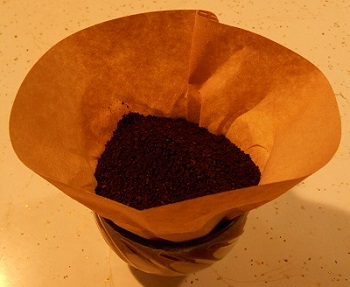
Pull a filter open and use the cup to hold it open. Measure up to 6 scoops into the filter. (Maybe U could fit in more after some practice.) Fold and staple as shown in the photo below. Unless U like weak coffee, do it again with another filter. Yet again, if U like strong coffee.
Put the sealed filters in the bottom of the pitcher and fill to a convenient level from the cold tap. Cover the pitcher and leave it out overnight. (Diffusion thru paper filters is much slower than dripping thru mesh filters.) Refrigerate after that, so the coffee will have more hours to diffuse while cooling down from room temperature.
The same common kind of pitcher cover that would let U pour iced tea or lemonade w/o pouring out ice cubes will also let U pour coffee w/o pouring out the filters. Just leave them in the pitcher until all the coffee is gone.
My 4-quart pitcher has both quart and liter markings; I find it convenient to fill up to the 3-liter mark. For that much water, I use 2 filters, each with 6 scoops of espresso. U could start with amounts like these and experiment to find what works for U.
Given the lead time between when cold-brewing starts and when the coffee is ready, having 2 pitchers in the house is helpful. Buying 2 pitchers still costs less than buying a fiddly cold-brewing gadget.
Typing just [Enter] key into the Search box makes it easy to browse WordPress blogs like this one. Here, the [Menu] button (atop the vertical black bar) reveals widgets like the Search box.
Descriptivism, Prescriptivism, and ????
Here are links to all posts in this project of reviewing and supplementing the splendid book
Yogi Berra’s Paradox
Sometimes bad English is good English that’s good because it’s bad.
Blood & Gold End This Series
Apart from a concern about the examples on 2 late pages in the book, I could applaud those pages until my hands bleed.
One trouble with categories is that so many of the interesting and important people and things in the real world do not fit neatly into them. Tho wary of categories, I feel a need to introduce another one, alongside the descriptivism and prescriptivism (reviewed below) that are commonly used to categorize writings/writers that deal with the English language.
To oversimplify somewhat:
A descriptivist says how people actually use the language.
A prescriptivist says how people should use the language, according to various rules.
The captions under the following images for these attitudes link to notes and credits at the end of this post.
One of the strengths of Lynch’s book is that most of the time it is so fair to both. Lynch is mostly in the descriptivist camp, but he sees merit in some prescriptivist ideas and explores the absurdities of trying to be 100% one or the other. Perhaps some of the more thoughtful people on both sides are implicitly in another category, which I will call [readabilism] until somebody suggests a name I like better that is not already in use. Still being simplistic to get started, here is what I mean by [readabilism].
A readabilist says how people should use the language, so as to communicate clearly. (The caption under the following image links to a note on its relevance.)
Communicating clearly is not the same as abiding by rules. Do U want to be clear? Some of the prescriptivists’ rules are helpful, as is attention to the descriptivists’ findings. Some of the prescriptivists’ rules are harmful, as is being lazy in ways that descriptivists find to be common. As with geometry, there is no royal road to clarity. Various examples will be in later posts. A quick preliminary example appears later in this post.
I am a proud readabilist. I try to write clearly. I fail and try again. Sometimes I succeed. I try to recommend ways to write clearly. I fail and try again. I will recommend a prescriptivist’s rule that seems helpful and disrecommend one that seems harmful. If something seems helpful in one context and harmful in another, I will try to sort things out rather than claim that one size fits all.
Any suggestions of alternative names for readabilism? I was disappointed when Google told me that [lucidism] is already in use as the name of a religion, as is [claritism]. [Communicationism] is a pejorative term for the kind of reductionism that attributes conflicts to failures of communication. I had better grab [readabilism] while I can.
Example 3.1: Split Infinitives
On page 19, Lynch scorches the extreme prescriptivists who make sweeping bogus claims about enhancing clarity for long lists of rules, including inanities like the rule against splitting an infinitive. This rule was made up by prigs with too much free time who were enamored of Latin, a language with no blank space inside an infinitive where anything might be inserted.
Prescriptivists who claim devotion to clarity while peddling such drivel remind me of pseudoconservatives in US politics, who claim devotion to fiscal responsibility while peddling tax cuts for the same tiny fraction of the population that has been siphoning away wealth from everybody else for decades (while the national debt increases).
Tho the rhetoric of extreme prescriptivists may sound readabilist, the conduct is definitely not readabilist. Fretting about where else to put an adverb that wants to follow [to] may not be directly harmful, but it siphons away time and energy from serious work on clarity.
Image Notes and Credits
An antenna from the array in a radio telescope is emblematic of the spirit of descriptivism. Let’s see what is out there (and maybe try to explain it).
The clothes and facial expression of the man making the thumb-down gesture suggest that he is an arrogant jerk. This caricature of prescriptivism is appropriate at this admittedly simplistic stage in the discussion (and at any stage for some extreme prescriptivists). Nuance will come later.
Back in 2013, I photographed a daylily flower in my yard because I wanted to show it to a flower lover in a nursing home. I did not want to be at all arty. I just wanted her to see the flower clearly and completely, w/o puzzling about what I had photographed or about the technologies that let me show her a long-gone flower on my laptop computer. I wanted the wizardry to be transparent and therefore invisible to the casual eye.
The clear view (thru the photo to see the daylily) is emblematic of the spirit of readabilism. While it is OK if the reader pauses briefly a few times to admire how well an idea has been conveyed, the reader should never need a shovel to unearth ideas buried by obscure writing.
Wish I knew how. Some of the ways being tried look promising to me; some look counterproductive. In roughly descending order of promise, I list 10 of them and add my own idiosyncratic comments.
(BTW, the [Menu] button atop the vertical black bar reveals the widgets.)
Sad emojis mark for the 3 counterproductive items that end the list. Pressed for time? Read #1 and #2 (the most promising items); then skip ahead to #9 and #10 (the most counterproductive items).
First, let me say where I am coming from. In ancient times (before the phrase liberal Republican became an oxymoron), progressives could be Republicans. Tho imperfect, that option made sense for pragmatic progressives who disliked deficits, knew how the road to Hell is paved, and would not kowtow to “conservative Democrats” (white racists in what was then the “Solid South”) for the sake of party unity. In ancient times, I was a Republican. Now I am a Sanders/Warren Democrat who also donates to the Working Families Party. That imperfect option is the best available for me today.
America has changed a lot more than I have. Many changes for the better are in imminent danger of being undone. Many changes for the worse accelerated when George W Bush became POTUS, were slowed but not stopped under Obama, and have accelerated drastically under Donald Trump. Paranoia is not one of my faults; I hope I am mistaken in seeing a clear and present danger to liberal democracy itself (on top of 4+ years of monumentally bad governance) in the Age of Trumpery.
Tea Party Tactics
The all-too successful efforts of the Tea Party to obstruct Obama’s agenda included many tactics that could also be used by honorable people to obstruct Trump’s. Some progressive former Congressional staffers have compiled the Indivisible Guide for badgering legislators. In addition to many helpful refinements of what I already vaguely knew, the guide has an insight so jolting that I will discuss it separately, after this list.
Voting Rights
There are many ways to prevent elections from throwing the bums out. Savvy modern tyrants need not be so crude as to refuse to hold elections or refuse to let any serious opponents campaign. Republican state legislators have raised gerrymandering to a high art, passed voter ID laws carefully tailored to depress voting by “conservatives” much less than voting by other groups, and so on. Election administrators can open fewer polling places in areas where the “wrong” kind of voters are common.
One of the many ways that the ACLU defends civil liberties is by filing lawsuits against such shenanigans. Please support the ACLU and anybody else who defends voting rights. For more on subtle ways that voting rights can be hollowed out behind a facade of democracy, see While Democrats Chase Russians, Republicans Keep Rigging Elections by Richard Eskow.
State & Local Elections
Far too many progressives act as if voting for POTUS once every 4 years would suffice to make good things happen. Government in the USA is not that simple. Pseudoconservatives also pay attention down-ballot and in off years. It shows. Our fragmented system makes it extremely difficult for POTUS alone to get much done that is worth doing. Down-ballot results in one election can also have nasty consequences up-ballot in the next one.
Boycotting Trump-branded Stuff
Tho Trump’s claim to be a “successful businessman” is a wild exaggeration, he does care about money. The website #GRABYOURWALLET lists many casinos, hotels, products, and retailers. With careful reading of the website’s spreadsheet, U can separate the retailers who actively push Trump-branded products (or otherwise support Trump) from those who just sell them along with various competitive products. Boycotting the retailers who just sell them is counterproductive.
Protest Marches
They seem to have mobilized and heartened opposition, but I cannot help wondering how many of those who march and shout now were perfectionists then, when many progressive purists refused to hold their noses and support the only alternative to Trump who could have won on 2016-11-08. I hope nobody thinks that denouncing Trump in a raucous crowd is as good as thwarting him.
My big worry is that protest marches will become old news and that some protestors will try to freshen them up by marching w/o permits, snarling traffic, provoking cops to overreact, and so on. The resulting legal battles will divert resources from the defense of voting rights.
Ridiculing Trump
Intense and well-deserved ridicule did not keep Trump out of the White House. It is hard to ridicule Trump w/o also ridiculing his supporters. I must confess to having sometimes yielded to temptation on this point. But anything that is perceived as ridicule will only delay the awakening of those Trump voters who are not bigots or plutocrats but who had good cause to feel abandoned by smug neoliberals and turned to Trump in desperation.
On the other hand, years of relentless attacks on Hillary Clinton eventually built up an exaggerated and indelible image of dishonesty. (Tho far from being a paragon of integrity, HRC is relatively honest, as pols go. The last paragon at the presidential level was Abraham Lincoln, whose honesty did not preclude being calculating and shrewd.) Maybe years of apt and varied ridicule can accomplish something beyond catharsis for snipers like me.
Fact Checking
Copious documentation of staggering mendacity did not keep Trump out of the White House. That those who ridicule Trump are more likely to amuse each other than erode his support is sad but not shocking. That much of the electorate does not give a rat’s ass for truth is another story. As with ridicule, I see some small hope that years of hammering away may eventually break thru.
Calls for Impeachment 😦
The question is not whether Trump deserves to be impeached and convicted. He does. So what? Impeachment and conviction cannot happen unless both the House and the Senate are flipped. Suppose that unlikely event happens in 2018. Trump’s term would be served out by Mike Pence, whose agenda is just as vile. By being less abrasive than Trump, Pence might be even more effective in pushing for bad laws and lulling people into accepting thinly veiled fascism.
Centrism 😦 😦
Obviously, the Democratic Party must somehow reach out to the Reagan Democrats who came back for Obama but did not stay back for Clinton. How to do that is controversial. Despite my own broadly centrist inclinations, I believe it would be a huge mistake now to take any more advice from Third Way or anybody else who thinks Dems can win by sounding at all like decaffeinated Republicans. Dems need a coherent progressive alternative that seriously addresses Rust Belt concerns, not an echo of Republican quackery pasted onto support for LGBTQ/reproductive rights and sanity about guns. While I do support those rights and that sanity, I am starting to understand why they have so little traction.
Normalizing Trump 😦 😦 😦
Exhortations to come together after a bitterly contested election are a venerable American tradition, dating back to Jefferson’s inaugural address in 1801. Still in shock on 2016-11-09, I reblogged an eloquent one. At the same time, I reblogged a very different reaction that was also eloquent. It was a struggle to work out my own subtler response with a look back to 1814.
Looking back not quite so far as 1814, I recall that paranoid slave owners violently rejected the results of the 1860 election. That did not end well. Looking just a little ways back, I recall my own anger at McConnell’s nauseating pledge to subordinate governing to making Obama a 1-term POTUS, after Obama won in 2008 w/o any help from vote suppression or Russian meddling.
Putting this item last in the list was painful, but not as painful as seeing Trump confirm a truckload of grim expectations (bigotry; chaos; corruption; …) within a month of inauguration. A wait-and-see attitude did make sense on 2016-11-09. It does not make sense today. Will the sane and decent people in the USA wait until it is too late to avoid covert fascism behind a facade of democracy?
What is the jolting insight mentioned in list item #1? When opposing a nasty Trump initiative that advances a subversive hidden agenda, do not (repeat—not!) try be constructive by offering a better way to deal with whatever problem the Trump initiative purports to address. Keep the opposition to Trump broadly based and unified, focused on the vileness of the snake oil and not distracted by internal debates about what should be done instead of swallowing snake oil.
I come from the very collegial culture of STEM and can remember when American politics was less adversarial and more collegial than it is now, tho never as collegial as STEM. (Yes, there are rivalries in STEM and maybe still a few chances to do some good by reaching across the aisle in politics.) Tho jolting and saddening, the advice to oppose w/o trying to be constructive is wise.
Does my claim in list item #9 that “Dems need a coherent progressive alternative that seriously addresses Rust Belt concerns” contradict that advice? No. Context is crucial. Trying to prevent a particular criminal folly by those currently in office is one context. Trying to elect officials who are much less likely to engage in criminal folly is another context.
Image published in the US before 1923 and public domain in the US
In some ways, the American Experiment is back in 1778: hanging by a thread (in what Thomas Paine rightly said were “times that try men’s souls”). Many images of Valley Forge would be appropriate; I especially like the well-known painting by Edwin Austin Abbey of Baron von Steuben instructing George Washington’s pickup army in carefully selected European tactics/techniques that would help it win.
Washington’s eye for talent looked beyond billionaires who had donated lavishly. Washington did not tweet jabs at “Krauts” while assuming that anybody who sounded like a Hessian was on the other side. Washington saw that an immigrant from Prussia could kick ass for the cause. The rest is history.
Typing just [Enter] key into the Search box makes it easy to browse WordPress blogs like this one. Here, the [Menu] button (atop the vertical black bar) reveals widgets like the Search box.
Babies, Names, and Snobs
Here are links to all posts in this project of reviewing and supplementing the splendid book
Yogi Berra’s Paradox
Sometimes bad English is good English that’s good because it’s bad.
Blood & Gold End This Series
Apart from a concern about the examples on 2 late pages in the book, I could applaud those pages until my hands bleed.
Sorry, but we need a short digression on ways to name a word so we can talk about it. Some details here will also contribute later to the overall project.
Failure to distinguish using a word from talking about it can lead to confusion, as in the following dialog:
Mother : What did you learn in school today?
Small Child : Teacher showed us how to make babies.
Mother : What? WHAT?
Small Child : Drop the Y and add IES.
In casual speech, we can insert “the word” in a few places. That is clunky in extended writing. There are 2 common ways to do the job in writing: quote marks and italics. Using quote marks works well in short documents, but it can be confusing in longer ones that also use quote marks for actual quotations and/or for sarcasm, as in
After an ad blitz from the National Rifle Association rescued his failing campaign, Senator Schmaltz “bravely” defended the right of crazy people to buy assault weapons.
Maybe we should follow Lynch and use the convention popular among those who are most fastidious about the difference between using a word and discussing it: those who often call it the “use/mention distinction” and put words being mentioned (rather than used) in italics. I do not mind doing w/o italics for emphasis because I prefer bold anyway, but italics are also used for titles and for foreign words temporarily imported into English. I want those uses, and I found that Lynch’s use of italics for multiple purposes in quick succession invited confusion.
There is a simple way to give any word or phrase a name that works well here and in many other contexts, tho not universally. Wrap it in square brackets (or curly braces). Choose the wrapper U never (well, hardly ever) use for some other purpose in the current document and run with it. If both wrappers are OK, use square brackets and give the Shift key a rest.
Now I can avoid confusion, even if I want to be emphatic, be sarcastic, and mention words (marking some as foreign), all in the same sentence:
Some snobs flaunt their “education” by saying [Weltanshauung] when [worldview] is all they need.
While not so disgusting as Senator Schmaltz, the flaunting snobs are enemies of clarity. An enemy of my friend is my enemy too, and clarity is both a very dear friend and a concept crucial to amicable resolution of some of the tensions that Lynch explores so ably. So I want to be especially clear and hope U will forgive the digression into metametalanguage. Will put a quick reminder of the square brackets convention early in each subsequent post. The next one will get down to business.
The [Menu] button (atop the vertical black bar) reveals widgets like the Search box. Typing just the [Enter] key into the Search box is a way to browse WordPress blogs.
Why am I glad that 2017 is the Year of the Rooster in the East Asian Lunar Calendar? Because I quickly found an image of a smirking rooster for this post. Thank U, Ariadna Ada Sysoeva/Shutterstock.com. Why did I want such an image? Read on, if U dare.
Despite not owning a gun, I sometimes shoot myself in the foot. It is a common tendency among progressives. Case in point: boycotting retailers like Walmart and Amazon that carry Trump-branded products w/o pushing them, not just boycotting the products themselves and those who push them. We continue with appropriate made-up names.
Consider a retailer, say Walazon, that carries several lines of women’s fashions, including IvankyPanky and Togs-4-Progs. The former is Trump-branded. The latter makes good stuff in union shops and donates 5% of operating profits to worthy causes.
Furious at Donald Trump’s travesty of a presidency, progressives want to hit him and his where it hurts. Some of us decide to boycott Walazon until they stop selling IvankyPanky clothes. It is more likely that we will hit us and ours.
Here’s why.
Suppose progressive women stop buying from Walazon. Kellyanne Conway and her ilk still buy IvankyPanky clothes (often from Walazon), while Walazon’s Togs-4-Progs sales dwindle. The computers and people who do data analytics at Walazon are interested in sales (not politics), at least during working hours. They notice that IvankyPanky is selling much better than Togs-4-Progs. Guess which brand gets the ax when management decides that Walazon is spread too thin.
On the other hand, suppose progressive women who like Togs-4-Progs continue to shop at Walazon, despite its willingness to sell IvankyPanky clothes to those benighted enough to buy them. Togs-4-Progs comes out with an edgy collection of T-shirts that display the words
TRUMP SUCKS
PUTIN’S
(in various fonts and trendy colors) over a picture of an arrogant smirking rooster. The shirts sell like ice cream in July. The computers and people who do data analytics at Walazon notice that Togs-4-Progs is selling much better than IvankyPanky, despite Kellyanne Conway blasting thru her credit limit. Guess which brand gets the ax when management decides that Walazon is spread too thin.
Want to make capitalist economies work more humanely? It might help to pay more attention to how they work, period.






 •
•