haiku

Oneness of High and Low

The [Menu] button (atop the vertical black bar) reveals widgets like the Search box.  Typing just the [Enter] key into the Search box is a way to browse WordPress blogs.
The oneness emphasized in
Carpe Diem Theme Week “The Songs of Milarepa”
(2) “flying clouds”

encourages becalmed sailors.

becalmed-ship

© Nilspr | Dreamstime.com

Heralds in the Sky
 Flying clouds reveal
 unseen wind above limp sails.
 The crew dares to hope.

haiku, love, photography

Haunted Without Ghosts

Typing just [Enter] key into the Search box makes it easy to browse WordPress blogs like this one.   Here, the [Menu] button (atop the vertical black bar) reveals widgets like the Search box.

My haiku in response to Ghosts ~ Pic and a Word Challenge #92 is third in a trilogy that began with 2 in the original version of a previous post.
Edith-1981

Widower’s Song #3
 Ghosts do not haunt me.
 Remembered joys can often
 overcome regrets.

STEM, tanka

Becalmed — Then and Now

The [Menu] button (atop the vertical black bar) reveals widgets like the Search box.  Typing just the [Enter] key into the Search box is a way to browse WordPress blogs.
Strictly speaking, this post is not a response to Becalmed ~ Pic and a Word Challenge #91 because I used neither the challenge photo nor an image that I made.  By posting after the challenge closed, I hope to acknowledge the inspiration w/o having a pingback look too much like a bungled response.

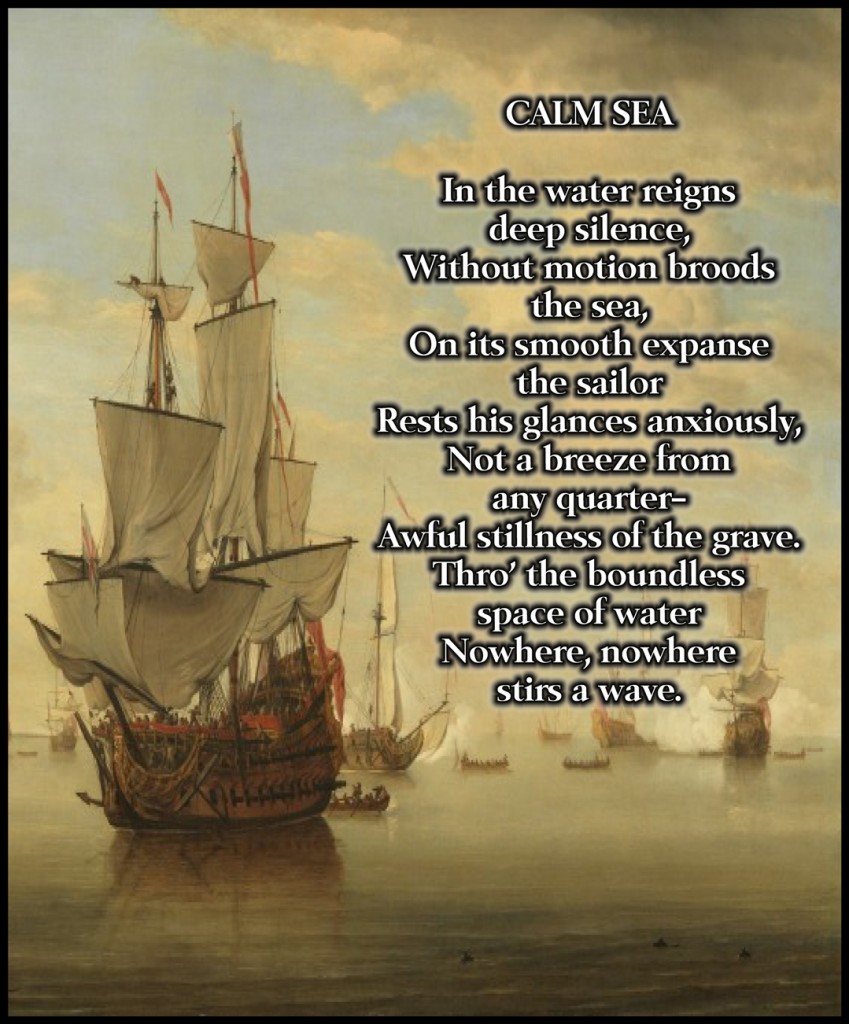
For sailors on the open sea in the past, to be becalmed was always a hardship and sometimes a disaster, as described in Goethe’s poem Meerestille (or Calm Sea).  I got the image and English translation dislayed in this post from a website celebrating German Romantic literature.  U can read another English translation of Goethe’s poem here.

My tanka expresses yesterday’s fears in today’s language.

calm-sea_849x1024

Becalmed in Olden Times
|Viking longships moved
|with oars pulled by aching arms.
|Oarless ships stood still.
|Oarless crews waited for wind,
|while food and water ran low.

As the photo and poem in the challenge so aptly illustrate, to be becalmed can be a pleasant experience nowadays.  Admire the crescent moon and furl the sails.  Start the engine and head for home.  Be confident of getting there.

My tanka expresses yesterday’s fears in today’s language, lest we forget how high we have climbed and how far we could fall, in technology if not in poetry.

haiku, math, photography, tanka

Willing to Muddle Thru

This post muddles thru the abstract/concrete conflict with a mostly abstract tanka inspired by the mostly concrete poetry in 2 posts by others.  At least in visual art, the distinction between abstract and concrete is somewhat muddled anyway (and not just because of photography).
(BTW, the [Menu] button atop the vertical black bar reveals the widgets.)

curtain-complex

Like the conflict between living in the moment and planning for the future, abstract/concrete (or general/specific) is a conflict that can only be managed, not avoided or resolved.  Trying to be 100% one or the other does not work.  We must muddle thru, preferably with awareness that what works for one person at one time will not work for all people at all times.  This post muddles thru the abstract/concrete conflict with a mostly abstract tanka inspired by excerpts from the mostly concrete poetry in 2 posts by others.

Consider the first of 4 stanzas posted in {underground (20170523)}:

© Crow
i have learned the hard way
that just because something
has been buried does not mean
it’s dead

It could stand alone as a fine short poem.  It also inspired the fourth of 7 short stanzas posted (along with an interesting biographical sketch of the 17-th century painter Caravaggio) in {Caravaggio Dreams}:

© Poet Rummager
Do you not see what I’ve buried deep,
has dug itself out to find me?

Maybe it’s because of my math background that I felt these excerpts were more powerful standing alone than in their original contexts, with concrete details about zombie cannibals and Norse gods (Crow) and a dream encounter with Caravaggio (Poet Rummager).  While I do prefer cremation to internment and do appreciate Caravaggio’s pioneering of expressive chiaroscuro, I found all those details distracting.  I was moved by the quoted stanzas despite what went with them.

One of the virtues of haiku poetry is that there is scant room for anything irrelevant, so I tried putting my takeaway into a haiku.  But I found that format a little too restrictive.  What happened after whatever was buried deep had dug itself out?  My haiku left open the possibility that it might have just toddled happily away, w/o the ominous implications of the first line from Crow’s stanza and the last 3 words from Poet Rummager’s stanza.  Wanting my poetry to be forthrightly ominous rather than ambiguous, I extended the abstract haiku to a tanka with (as it happens) concrete imagery in the 2 added lines.

Empty Grave
I buried something
that was not already dead.
It dug itself out.
~ ~ ~ ~
It shook like a wet dog and
followed my scent to find me.

it-dug-itself-out

© Doddis | Dreamstime.com

Tho a uniform level of abstraction might be nice, I can live with the muddle.  At least in visual art, the distinction between abstract and concrete is somewhat muddled anyway (and not just because of photography).

curtain-simple

flowers, humor, photography

Nonconformist

The [Menu] button (atop the vertical black bar) reveals widgets like the Search box.  Typing just the [Enter] key into the Search box is a way to browse WordPress blogs.

nonconformist-sun_820x663

Update [2018-11-06]

My photo is 100% serendipitous.  Click here to see Cee Neuner’s beautifully colored and composed photo of (assisted?) nonconformity among mums.

haiku, humor, language

Are short words better than long?

Yes, but not always.  It depends on what U want to do.
(BTW, the [Menu] button atop the vertical black bar reveals the widgets.)

Here is a little silliness with self-reference in response to [Diminutive ~ Pic and a Word Challenge #90], which displays a good use of a long word.

tiny

Wanting Five
 Ah, “diminutive”!
 Big word for “tiny” fills out
 first line of haiku.

Hmmm.  Would anybody want a long synonym for “tiny” in a 5-7-5 haiku?  Nah.

BTW, self-reference in language really is a big deal, as explained (among other places) here and here.  It has also been joked about in other haiku.  Some examples are here and here.

(reblog), haiku, photography, tanka

Seize the Sunrise

My tanka responding to a challenge posted by Patrick Jennings is a riff on the splendid photo he provided, with hills that seem to go on forever in both time and space.

Originally posted by Patrick Jennings in
[Evanescent ~ Pic and a Word Challenge #89]:

himalayan-foothills-sunrise-kunjapuri-devi-temple-rishikesh-uttarakhand-india-copy

View original

Seize the Sunrise
Evanescent dawn.
Do hills endure forever?
No, but long enough.
~ ~ ~ ~
Art subverts time with pixels;
the moment also endures.

haiku, photography, tanka

Forward, toward Light

Should we honor ancient masters by following in their footsteps?  No.   We should honor them by pressing forward and building on their work.
(BTW, the [Menu] button atop the vertical black bar reveals the widgets.)

© Adjei Agyei-Baah

ancient road…

the trails of the masters

absorbed in fallen leaves

© Mellow Curmudgeon

Footprints fade but insights shine,

lighting the path forward now.

sunlit-path

In some ways, a century ago is already ancient.  Photography’s pioneers worked with nasty chemicals in darkened rooms to produce grayscale prints.  Modern photographers can (and should!) honor them by pressing forward and building on their work in our digital world of colored pixels, using grayscale (or partial desaturation) only as appropriate for specific images.

haiku, photography, tanka

Spunky Flowers

In response to a CDHK challenge, this post completes a tan renga in praise of dandelions.  Yes, dandelions.  They are spunky flowers, not weeds.
(BTW, the [Menu] button atop the vertical black bar reveals the widgets.)

As my earlier post in praise of dandelions noted, the same spunk that frustrates prissy gardeners also thrusts green and gold into the grayest and grimmest of our cityscapes.  I like that tradeoff, so I am glad I can respond to

© Ogiwara Seisensui
dandelion dandelion
on the sandy beach
spring opens its eyes
© Mellow Curmudgeon
Glowing suns rise golden from
sand and lawns and sidewalk cracks.

DandelionViolets

enlightenment, fiction, haiku, humor

Miracle: Satori from an MBA

A cascade of tongue-in-cheek posts and comments came to an abrupt end with a serious thought, but I recovered enough to continue semiseriously, with a short story about weirdness in the who and how of sudden enlightenment.
– Gray button (upper left corner) reveals widgets, –
– above post (on phone) or beside it (on desktop). –
It started so gaily.
A tongue-in-cheek haiku post about writer’s block led to
 a t…-in-c… comment that led to
 a t…-in-c… haiku post about Genesis that led to
 a t…-in-c… comment that seemed to
 merit a t…-in-c… reply.

But the volleyball hit the floor before I could whack it upward.

That last comment in the cascade included a question about a haiku titled Thus Saith the Lord:

What made U the lucky poet whom God speaks thru?

While the comment’s “U” is me and my claim to prophecy was indeed tongue-in-cheek (and perceived as such by the commenter), I could not get past the fact that many people do claim (seriously and stridently) to speak for God.  Many of those who are serious and strident are also willing to coerce people they cannot convince.  Many of those who are willing to coerce are also willing to kill people they cannot coerce.

lesson-learnedNON SEQUITUR © 2014 Wiley Ink
(ANDREWS MCMEEL SYNDICATION)
Reprinted with permission. All rights reserved.

While I could not just keep it tongue-in-cheek, I still saw the wisdom in Oscar Wilde’s remark that life is too important to be taken seriously.  So I continued semiseriously, with a draft for a weird story to end the original 2017 version of this post.  I have removed the draft here because the story has been thoroughly revised and now appears in an anthology of weird stories as Satori from a Consulting Gig.  The revised story was also posted to this blog, after I created an appropriate illustration.

I blanked out part of a comment from 2017 that appears below, so as to leave it for the story to reveal the who and how of a weird instance of satori.

haiku, music

The Paulownia’s Second Life

The [Menu] button (atop the vertical black bar) reveals widgets like the Search box.  Typing just the [Enter] key into the Search box is a way to browse WordPress blogs.

We add 2 lines to a haiku by Nozawa Boncho in response to

from the paulownia
without a breath of wind–
falling leaves

silent now, the tree will sing
(thanks to the koto maker)

enlightenment, haiku, humor

Genesis

There are many images for the Biblical six days of creation, and one exuberant stained glass window is particularly apt for illustrating this post’s pair of haiku.  When God finally rested, did He just chill out?

The following photo of comes from the Witterings blog, which also has a fascinating discussion and beautiful closeup photos of the window’s details.

6-days

When God finally rested, did He just chill out?  In response to

(with some inspiration from The Write Idea | Six days), here are 2 haiku dealing with that question.

First Sabbath
 After 6 hectic days,
 writer’s block dissipated.
 God wrote a haiku.

Thus saith the Lord:
 The world I made
 is bigger and better than
 dogmas can describe.

– Gray button (upper left corner) reveals widgets, –
– above post (on phone) or beside it (on desktop). –
education, humor, language, photography

Writing Well – Part 8

Typing just [Enter] key into the Search box makes it easy to browse WordPress blogs like this one.  Here, the [Menu] button (atop the vertical black bar) reveals widgets like the Search box.

Blood & Gold End This Series

Here are links to all posts in this project of reviewing and supplementing the splendid book

The Lexicographer’s Dilemma by Jack Lynch.

  1. Introduction
    What does the rise of “proper” English have in common with a physics conundrum about gravity?
  2. Babies, Names, and Snobs
    We name words by wrapping them in square brackets to avoid overloading more common conventions.
  3. Descriptivism, Prescriptivism, and ????
    We add a new ISM to the familiar duo of attitudes toward English language usage: readabilism.
  4. Why is English Spelling Such a Mess?
    An insight into the difficulty of spelling reform has wide-ranging significance, far beyond spelling.
  5. Ambiguity Sucks!
    Ambiguity is almost always at least a little harmful to clear communication. It can be disastrous.
  6. What is the Point of Punctuation?
    Careful punctuation helps avoid unwanted ambiguity.
  7. Yogi Berra’s Paradox
    Sometimes bad English is good English that’s good because it’s bad.
  8. Blood & Gold End This Series
    Apart from a concern about the examples on 2 late pages in the book, I could applaud those pages until my hands bleed.

There are 8 lines that start with “A time to” in the famous Bible passage Ecclesiastes 3:1-8.  I want to add another such line, anywhere in the series.

To every thing there is a season, and a time to every purpose under the heaven:

A time to comply and a time to resist; a time to obey rules, and a time to defy rules;

One of the strengths of Lynch’s book is the way page 274 (hardcover) notes that

even the schoolmarmish rules can be valuable in the right context

and later that the point of studying English in school is not

correct English but appropriate English—English suited to the occasion

(where I have replaced italics by boldface, which is better for emphasis in sans-serif fonts).

One of the book’s few weaknesses is in the examples of being suited to the occasion that Lynch uses.  While they are appropriate, the lack of any other examples may be misleading.

I believe there are some occasions where some of the rules are genuinely helpful for clear communication with a sincere and attentive audience.  I use [sincere] to describe people who want to know what somebody has to say.  (They are not just looking for excuses to pounce.)  I use [attentive] to indicate that they are not so hung up on assorted inane rules that violations are ipso facto distracting.  (If U know any better words, please suggest them.)  After reading the entire book, I am confident that Lynch and I are in general agreement, with some wiggle room for agreeing to disagree about which rules suit which occasions with sincere and attentive audiences.  The examples of suitability that Lynch uses could give a different impression.

The example of a job interview (between the passages quoted above) and a hasty reading of pages 274 and 275 (hardcover) could mislead students.  Young people tend to be rebellious and skeptical of authority.  Rightly so.  They also tend to be utopian and simplistic about what rebellion might accomplish and whether other people are good guys or bad guys.  Students do “need to become proficient in the standard form of the language” for grubby reasons like job interviews and access to “the corridors of power” and the sad fact that being sincere does not imply being attentive.  (Sometimes men need to wear neckties and women need to wear high heels, tho both would rather not.)  Apart from wishing that Lynch had been more explicit about not-so-grubby reasons for proficiency with some of the rules, I could applaud pages 274 and 275 until my hands bleed.

With curly braces around a place where I paraphrase a longer stretch of text, this section ends with more excerpts from those eloquent pages.

Clarity has to remain paramount; anything that interferes with clarity or precision of expression is a genuine obstacle to communication …

{What Samuel Johnson said about a wise Tory and a wise Whig} can be said of the two camps of language commentators—a wise prescriptivist and a wise descriptivist will agree, despite all the differences in their modes of thinking.  The problem is that the people shouting loudest about language are rarely wise.  The more extreme prescriptivists routinely make the mistake of assuming that standard English, which usually means the language of a certain class from the previous generation, is the only acceptable English.  The more extreme descriptivists make the mistake of assuming there’s nothing special about standard English, that it’s merely one variety among many.  A balanced approach would acknowledge that change happens … and that we should all learn to stop worrying and love language change.

But that approach would also recognize that … readers come with various hang-ups, preconceptions, and biases … A good writer, therefore, won’t wantonly split infinitives—not because infinitives can’t be split, not because it’s some moral outrage, and certainly not because the English language needs to be protected, but simply because split infinitives might distract readers who’ve been taught that they’re wrong.  At the same time, a good writer won’t let these rules get in the way of real communication.  Grace and clarity should always trump pedantry.

Amen to that.  I will bandage my hands and be right back.

Example 8.1: Safety First

Consider the convention of putting the full name and address of the recipient at the start of a professional or business letter, which was a big nuisance in the hard-copy world of my youth.  That standard convention struck me as a silly rule because the recipient would know their own name and address.  I got into the habit of avoiding the nuisance.

One day I sent a professional letter to a colleague (call him Joe Jones), with a CC to another colleague (call him Joe Smith) who might be interested.  My letter had just “Dear Joe:” after my letterhead and the date.  The line saying “CC: Joe Smith” was at the end of the longish letter, so Smith was confused for a while by text that seemed to be putting what Jones had said in Smith’s mouth.  Glad my tone was friendly and polite!

In today’s world (with Ctrl-C and Ctrl-V and printing from soft copy), the rule that letters “should” start with the recipient’s full name and address is no longer such a nuisance.  Apart from contexts where starting that way would be pompous, I would rather make obeying the rule habitual than try to obey it only when needed and then accidentally miss a needed case.

In the same spirit, I tend to write rather formally, as with [is not] rather than [isn’t] (let alone [ain’t]).  But not always.  Sometimes [is not] would be stilted.  Sometimes the zing of a rarely used [ain’t] is wanted.  So be it.

Example 8.2: Going for Gold

gold-1-round
As Part 3 and Part 5 and Part 6 have noted, standard English (plus a few rules against things that are “correct” but confusing) can help in communicating with people who are not native speakers (or who are native speakers from a different subculture).  Standard English is not just for grubby things.  It’s also for communicating ideas that are new and unexpected, ideas that are counterintuitive but perhaps also true and good and beautiful.

baseball, grammar, humor, language

Writing Well – Part 7

The [Menu] button (atop the vertical black bar) reveals widgets like the Search box.  Typing just the [Enter] key into the Search box is good for browsing WordPress blogs.

Yogi Berra’s Paradox

Here are links to all posts in this project of reviewing and supplementing the splendid book

The Lexicographer’s Dilemma by Jack Lynch.

  1. Introduction
    What does the rise of “proper” English have in common with a physics conundrum about gravity?
  2. Babies, Names, and Snobs
    We name words by wrapping them in square brackets to avoid overloading more common conventions.
  3. Descriptivism, Prescriptivism, and ????
    We add a new ISM to the familiar duo of attitudes toward English language usage: readabilism.
  4. Why is English Spelling Such a Mess?
    An insight into the difficulty of spelling reform has wide-ranging significance, far beyond spelling.
  5. Ambiguity Sucks!
    Ambiguity is almost always at least a little harmful to clear communication. It can be disastrous.
  6. What is the Point of Punctuation?
    Careful punctuation helps avoid unwanted ambiguity.
  7. Yogi Berra’s Paradox
    Sometimes bad English is good English that’s good because it’s bad.
  8. Blood & Gold End This Series
    Apart from a concern about the examples on 2 late pages in the book, I could applaud those pages until my hands bleed.

Whatever hinders communication is bad English to me.  While context may keep them from being very harmful, many grammar goofs are indeed bad English.  But obfuscation is bad English too.  Lynch quotes an example on page 20 (hardcover).  The sentence is 136 words long, has no grammar goofs, purports to be a scholarly statement about philosophy, and is laughably unintelligible.  It was an unintentional winner in a Bad Writing Contest.

Another example of bad English that may be “correct” from a language prig’s viewpoint is use of the word [nauseous].  See Example 5.1 in Part 5 in this series.  Likewise for use of the word [inflammable].  See Example 5.2.

Is bad grammar always bad English?  Not quite.  Lynch quotes Bartolomeo Vanzetti’s statement before his 1927 death sentence on page 21 (hardcover).  Lynch rightly admires the “tragic dignity” of Vanzetti’s roughly hewn eloquence.

This post deals with a paradox about bad English.  A visual hint is provided by the red squiggle in the image below.
york-wrapper
Unless U want to doze off, U might want to drink some coffee (and maybe eat some chocolate) before reading the following cure for insomnia.

Gähnenschlafen’s Law

The relative standings of the participants at the conclusion of a game cannot be predicted with certainty at any time prior to the conclusion.  The word [game] should be interpreted very broadly, as any kind of competitive interaction.  For example, an illness may be considered to be a game with the patient and healthcare providers on one team, opposed by the illness along with the side effects of medical interventions on the other team.  Furthermore, …

Gähnenschlafen’s Law is more familiar and less soporific when stated in another way.  Two versions are widely quoted.

Yogi Berra’s Law
{The game|It} ain’t over til it’s over.

yogi-berra-1

Please be assured that I fervently admire things like Newton’s Laws and Coulomb’s Law (as well as Murphy’s Law), so I do not use the word [Law] lightly.  I have already posted on the importance of Yogi Berra’s Law, and I might haul out Gähnenschlafen’s Law and some coffee if I needed to explain Yogi Berra’s Law to someone who did not understand it quickly.  But I doubt that the need would arise.  What is happening here?  I believe the answer is relevant to some issues addressed in Lynch’s book.  Imitating Yogi’s style as well as I can, I will try to state the answer concisely.  The examples will (I hope!) clarify

Yogi Berra’s Paradox
Sometimes bad English is good English
that’s good because it’s bad.

BTW, [Gähnenschlafen] is a name I made up, so as sound funny to anglophones.  If U happen to know that [Gähnen] (in German) means what [yawn] means and [schlafen] means what [sleep] means, so much the better.  I hope I did not accidentally blunder upon a real German name.

Example 7.1: Flaky Punctuation

Consider the last 2 paragraphs in the first section in Chapter 15 of Jon Meacham’s biography of Thomas Jefferson:

The personal and political miseries of 1781 and 1782–the invasions by the British, the aspersions on his character, and the death of his wife–might well have sent lesser men back to their plantations in bitterness and in anger at the injustice of it all.

Not Jefferson.  He chose advance over retreat.

Declarative sentences ordinarily have a subject and a verb.  A language prig might complain about punctuating the tiny fragment [Not Jefferson.] like a declarative sentence.  But it works here.  (A language prig might also complain that I should have written [However,] rather than [But].)  I did not notice any other instance of flaky punctuation in the entire book (505 pages hardcover, not counting the notes).

Routinely.  Punctuating.  Single.  Words.  Or.  Other.  Tiny.  Fragments.  As.  Sentences.  Really.  Is.  Bad.  English.  That.  Could.  Wear.  Out.  The.  Shift.  And.  Period.  Keys.

A good way to convey emphasis calmly in speech is to exaggerate the minuscule pauses between words.  Occasional flaky punctuation of a short stretch of writing can do the same job, as in

Ain’t.  Gonna.  Happen.

Don’t overdo it.

Example 7.2: Using Taboo Words

Near the end of Chapter 11, Lynch quotes approvingly from a Lenny Bruce monolog about ethnic slurs, with emphasis on the N-word.  Bruce says that

… the word’s suppression gives it the power, the violence, the viciousness …

and suggests that an avalanche of absurd uses of the N-word could sweep away its “meaning” and its nastiness.

I wish life was that simple.  Historically, the N-word was used freely and frequently by white people when speaking to or about black people.  It was a nasty slur long before becoming something that bigots were shamed into avoiding when a microphone was on.

While the contention that an avalanche of absurd uses of a taboo word can bury it is seriously oversimplified as an antidote to the poison in the N-word, there is a lesson here.  Now that some comedians cannot go half a minute w/o a gratuitous use of the F-word, the F-word has lost what little utility it had.  Now it is just verbal clutter, no longer taboo (in some circles) but still offensive (to those who are offended by clutter).

An unexpected but appropriate word can be enlightening.  Taboo words are unexpected in some contexts.  Appropriateness is trickier.  Should we opt for a polite way to say the same thing if we can find one that is readily understood?  Mostly, yes.  But neither [is not] nor [isn’t] would be an adequate replacement for [ain’t] in Yogi Berra’s Law.

Example 7.3: Paradox Lost

Inconsistencies and tautologies are also bad English, most of the time.  But they are like flaky punctuation or taboo words.  Used rarely in a few well-chosen places, these kinds of bad English can become good English, partly because they may give a little jolt to the reader who has become too complacent while cruising along with good English.

Whether by accident or design, Yogi Berra had a knack for using inconsistency and tautology (as well as [ain’t]) to make a point in a memorable way.  Consider #36 in my favorite list of Yogi Berra quotes:

I never said most of the things I said.

The quote is flagrantly inconsistent.  As a former wannabe mathematician, I normally loathe inconsistency.  But here I feel an urge to interpolate instead, and I succeed:

I never said most of the things people think I said.

In its more general version, Yogi Berra’s Law is #3 on my favorite list.  The law’s pronoun [It] has no referent (which is weird outside of weather talk); the taboo word [ain’t] is used; the whole thing is a tautology when taken literally.  But even nerds like me do not take it literally.  We feel an urge to reinterpret the first use of [over] and arrive at something like Gähnenschlafen’s Law.  Instead of directly remembering the wisdom in all the details of Gähnenschlafen’s Law, we can remember Yogi Berra’s Law and adapt it to cope with whatever has just now hit the fan.

Many things that prigs say we should never do are actually things we should rarely do.