They both come in tubes.
They are used in the same room.

They should not be
in the same drawer.
They both come in tubes.
They are used in the same room.

They should not be
in the same drawer.
The answer hit me while I pondered an intriguing juxtaposition in
Haiku Poems: Grip (For Samantha) | Poet Rummager
that inspired me to write a haiku:
Squids and Scribblers
Squids squirt ink to flee.
Writers also (sometimes), but
often to confront.
• Image from © Brad Scot Lark | ShutterStock
• Image cropped from © Michele Paccione | ShutterStock
Long after Martin Luther’s time, fundamental institutions have yet again strayed from their missions and been corrupted. Of course, people write (and mesh their words with images) very differently now. Writers depend on the media (rather than a trip to the hardware store) to nail things to doors. But if U listen carefully, U can still hear hammering.

NON SEQUITUR © 2017 Wiley Ink, Inc..
Dist. By ANDREWS MCMEEL SYNDICATION.
Reprinted with permission. All rights reserved.
Numbers ~ Pic and a Word Challenge #106
Plato woke up with a nasty hangover after a symposium that had gone badly for him. Some new sophists who called themselves “natural philosophers” had come to Athens, and the kind of philosophizing they advocated was anything but natural to Plato.
The new sophists spoke about “observations” and “conjectures” and “predictions” rather than abstract reasoning about perfect ideal forms. Plato could tolerate his student Aristotle’s interest in easy casual observations and simple inferences from them, but the new sophists were different. They wanted to measure minute details of how the shadows on the walls of Plato’s metaphorical cave flickered. They would consider anything imaginable as a candidate for “explaining” their observations, even things so fanciful that Homer would never have dared to sing of Odysseus encountering them on his way back to Ithaca.
Instead of trying to establish a conjecture by reasoning to it from first principles, the new sophists wanted to reason from it to a prediction about what they would observe. Conjectures that led to many diverse predictions matching what was actually observed were to be accepted as true, but only until somebody came up with “better” conjectures that yielded more accurate predictions by more elegant reasoning. As one of the brasher “natural philosophers” said,
All knowledge is provisional,
never more than the best we have at the moment.
Flummoxed by such craziness, Plato had been hitting the wine harder than usual. He had passed out just as another “natural philosopher” began replying to the brash one:
Well, that is a little over the top. For example, …
All that was last night, when stars had carpeted an inky black sky. Now the sky was light blue, the sun was shining, and Plato’s head was aching. He winced when he remembered a new sophist’s remark that each star might be something much like the sun but almost inconceivably farther away. That example of a loony conjecture had prompted a nightmare with Athens (and its circling sun) lost in a humongous whirling vortex of innumerable stars (rather than stationary near the center of the universe, as Athens so obviously was).
The cash bar at the symposium had been pricey, and Plato wondered if he still had enough money to buy some willow bark to ease his headache. He put his coins on the nearest flat surface and counted them. Five should be plenty. Then he noticed that three coins had the side with the face of a leader facing upwards, while two coins had the side with the leader’s mansion facing upwards. Suddenly, Plato felt much better. He even felt ready for another encounter with that brash sophist.

Plato’s Challenge
Three plus two was five
before any mind could know.
Where do numbers live?
With what I hope is the usual wry humor, we consider how categorizing things is intrinsically simplistic but sometimes useful. Or not. We start simply and then go up, in importance as well as complexity.
I like watermelon but am far too old to like spitting out the seeds. Of course, I buy seedless watermelons. But what is that off-white speck on one of the chunks of watermelon in my bowl of fruit? A closer look at the chunk shows that it has lots of seeds. Did the supermarket cheat me? No, those seeds are small and soft and immature forever. They will be unnoticed on the way in and on the way out. I wish the body politic could so easily excrete a POTUS that is small and soft and immature forever.
As “may contain occasional seeds” on its produce label hints, a “seedless” watermelon may well have a few serious seeds. They are large and hard and nasty to eat. But they are also large enough and dark enough to be easily seen when on or near the surface of a chunk. I hardly ever let one slip past for an uninvited tour of my extensive collection of tooth crowns and fillings.

Putting watermelons into little bins with the labels [seedless] or [seeded] distorts the literal truth but is easy and useful for my purposes. Plant breeders would need more detail.
Categorization is not always so easy as when buying and selling watermelons.
There are situations where useful categorization is hard. Friend or foe? Right or wrong? We must often proceed despite the knowledge that such tidy-looking categories are misleading.
Happily, some of the problematic contexts (where it is hard to decide which little bin “should” receive something we may feel an urge to categorize) are also contexts where putting things into little bins is a waste of time. Compare something to other things in the same big (and obviously appropriate) bin; do not fret about little bins and dubious claims that things in the same little bin are importantly alike in some ways.
For example, consider the problem of deciding whether a little bin labelled [haiku] or a little bin labelled [senryu] is where a short poem (written in English, not Japanese) belongs. The metaproblem of deciding whether this problem is meaningful is a step up from whether we should categorize watermelons but not so difficult (and steeped in nastiness) as deciding when (if ever) it is meaningful to put people into bins with labels like [black] or [white].
Imported into English from Japanese for good reasons long ago, the English word [haiku] does not mean exactly what the Japanese word [haiku] did mean in Edo Japan or does mean in modern Japan. Most words do not even have exact meanings. Different groups of speakers use the same word in different ways, with varying degrees of similarity.
To me and many other speakers of American English, any poem in haiku form is a haiku (tho not necessarily a good one). For now, we need not fret about what “the” haiku form requires or what is recommended (and often beneficial) but not required. Whether a poem is a haiku (or a quadrille or a sonnet or …) does not depend on its content. The poem’s form alone indicates whether it is a haiku. Tho common, this usage is not universal.
For both [haiku] and [senryu] (as English words about poems in English, with several nods to Japanese usage), the Haiku Society of America adopted the definitions and notes quoted below in 2004. We consider [haiku] first.
HAIKU
Definition: A haiku is a short poem that uses imagistic language to convey the essence of an experience of nature or the season intuitively linked to the human condition.
Notes: Most haiku in English consist of three unrhymed lines of seventeen or fewer syllables, with the middle line longest, though today’s poets use a variety of line lengths and arrangements. In Japanese a typical haiku has seventeen “sounds” (on) arranged five, seven, and five. (Some translators of Japanese poetry have noted that about twelve syllables in English approximates the duration of seventeen Japanese on.) Traditional Japanese haiku include a “season word” (kigo), a word or phrase that helps identify the season of the experience recorded in the poem, and a “cutting word” (kireji), a sort of spoken punctuation that marks a pause or gives emphasis to one part of the poem. In English, season words are sometimes omitted, but the original focus on experience captured in clear images continues. The most common technique is juxtaposing two images or ideas (Japanese rensô). Punctuation, space, a line-break, or a grammatical break may substitute for a cutting word. Most haiku have no titles, and metaphors and similes are commonly avoided. (Haiku do sometimes have brief prefatory notes, usually specifying the setting or similar facts; metaphors and similes in the simple sense of these terms do sometimes occur, but not frequently. A discussion of what might be called “deep metaphor” or symbolism in haiku is beyond the range of a definition. Various kinds of “pseudohaiku” have also arisen in recent years; see the Notes to “senryu”, below, for a brief discussion.)
I applaud the way the HSA keeps the definition of haiku form very short and broad, then discusses some formal details lucidly in the notes. Apart from the ominous last sentence, the notes will be helpful to anybody puzzled by the multitude of formal considerations to which various people attach various degrees of importance. But I have 2 concerns about the definition.
SENRYU
Definition: A senryu is a poem, structurally similar to haiku, that highlights the foibles of human nature, usually in a humorous or satiric way.
Notes: A senryu may or may not contain a season word or a grammatical break. Some Japanese senryu seem more like aphorisms, and some modern senryu in both Japanese and English avoid humor, becoming more like serious short poems in haiku form. There are also “borderline haiku/senryu”, which may seem like one or the other, depending on how the reader interprets them.
Many so-called “haiku” in English are really senryu. Others, such as “Spam-ku” and “headline haiku”, seem like recent additions to an old Japanese category, zappai, miscellaneous amusements in doggerel verse (usually written in 5-7-5) with little or no literary value. Some call the products of these recent fads “pseudohaiku” to make clear that they are not haiku at all.
Right after the definition limits senryu to being about foibles, the notes rescind the limitation. Maybe an aphorism is a senryu? Maybe a serious short poem in haiku form, like the wistful classic
© Alexis Rotella
Just friends: …
he watches my gauze dress
blowing on the line.
is a senryu? Maybe yet another poem in haiku form is something else, neither a haiku nor a senryu? Maybe we should rummage in a Japanese/English dictionary for words like [zappai]?
Maybe we should speak plain English.
Importing the Japanese word [haiku] into English gave a good name to a new kind of English poetry inspired by Japanese poetry; importing [senryu] helped discuss the history of Japanese poetry. But we already had plenty of words for saying that the mood of a poem is humorous or inspirational or philosophical or wistful. We still have them, along with plenty of words for saying what a poem is about and why we like or dislike it. We do not need special words for saying such things when the poem happens to be in haiku form. Barbarians like me are not the only ones who prefer to use [haiku] broadly. As Jane Reichold argued in 2010 with allegorical apples, [haiku] versus [senryu] is becoming a distinction w/o a difference.
That haiku forms are good for naturalistic subjects is beyond dispute. Some of my favorite haiku (among both those I have read and those I have written) are indeed naturalistic. But I also push the envelope of haiku subject matter and am far from alone in doing so. A classic by Alexis Rotella has already been mentioned. This section has more examples of pushing the envelope (not necessarily of being classics) and closes with a takeaway tanka.
Page 104 of the 2003-01 issue of the magazine Smithsonian had a collection of humorous haiku ranging over the entire history of our little blue planet, with more detail from the 18-th century onward. An image of the whole page is available on the web. Back in 2003, I read the page in hard copy. The haiku were mostly amusing w/o being memorable, but I liked one dealing with the 20-th century so much that I memorized it spontaneously, w/o trying:
© Spike Gillespie
One World War follows
another. Rosie rivets.
Patton rolls. We win.
OK, it is not a great haiku. Excessive devotion to the 5-7-5 rule leads to awkward linebreaks. A tiny rewrite yields a better haiku:
Apart from the linebreaks, Spike nailed it!
One World War follows another.
Rosie rivets. Patton rolls.
We win.
While Brits and Russkies could object to the Yank-centric viewpoint, the haiku is a remarkably concise and accurate poetic summary of major aspects of World War 2 and its roots in the bungled ending of World War 1. Neither war was a moment in nature. Neither war was a mere foible. While I needed Google to recover the author name and magazine date, the haiku itself just stuck, somewhere between my ears. Maybe such stickiness was part of charm of poetry in preliterate societies. Maybe it still is, even for those who are literate and online.
As there is already more than enough grimness in the real world, I usually dislike grim art. An envelope-pushing haiku by Poet Rummager is so good that (despite its grimness) I reblogged it with my own grim haiku. As with all my posts, the Comments section will remain open as long as my blog stays up. (I overrode the WordPress default.) Anybody who wants to criticize any of my haiku is welcome to comment, unless they want to quibble that my haiku is “really” a senryu or a pseudohaiku.
While I have not yet written a haiku about pizza, duct tape has been a subject. The table below links to some of my other posts with haiku on outside-the-box subjects. While some of my haiku are weird and/or knowingly silly, most do have a serious undercurrent about the human condition. So does this post.
| becalmed sailors | bereavement | |
| Buddhism | Genesis | |
| Hildegard of Bingen | history of biology | |
| Jane Reichold | music | |
| Platonism | quantum physics | |
| sadness | silliness | |
| Taoism | time travel |
Some lines are better left undrawn.
Haiku or senryu?
Lumping form with content hides
what poems can be:
salutes to whatever is
true and good and beautiful.
A recent CDHK episode called for experimental haiku in response to a specific image. Mine goes 5-4-5. Maybe 3 syllables are languishing on the other side of the fence.
« Imagination Without Limits at Carpe Diem Haiku Kai »

Bidirectional Barrier
Keep in or keep out?
Locked gates do both.
Is that what U want?
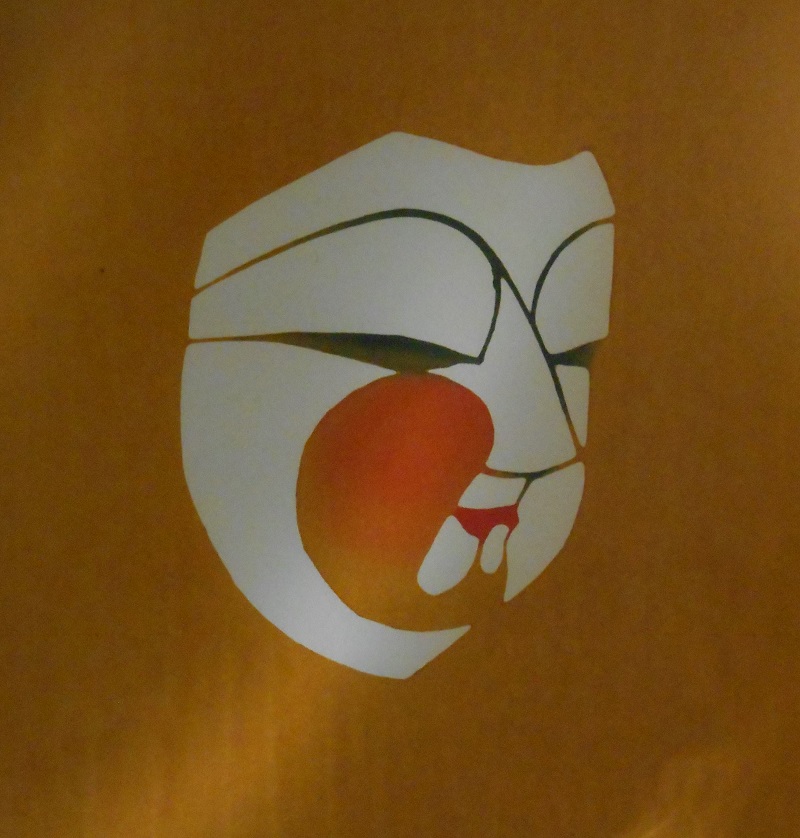
Hmmm. The face is a mask that nobody is wearing. Who could be contemplating? And yet …
There is no nothingness.
Quantum physics finds
tumult in vacuum behind
contemplative mask.
If the allusion in my haiku responding to
« Contemplation ~ Pic and a Word Challenge #103 »is too cryptic, I recommend A Universe from Nothing by L.M. Krauss.
While the form is conventional, the content of the haiku may be the farthest outside the box that I have gone. As of now, anyway. So the haiku is also a response to
« Carpe Diem Writing and Enjoying Haiku #6 new ways »
Not me. I am wistful. When color computer displays came in, I was jolted to see that a yellowish green (along with an orangish red) was now a “primary” color in RGB coordinates for colored pixels. I also had to use CMYK coordinates for colored inks and pray to the graphics gods that printing software would translate from RGB to CMYK in a way that respected how something looked. Eventually, I learned to put away childish things (like hard copy).
Before RGB
Red, yellow, and blue
were “primary” when kids
smeared paint on paper.

The ancient insight that «seemingly opposite … forces may actually be complementary … and interdependent» has modern echoes as diverse as wave/particle duality and concerns about work/life balance. The insight is profound but (like many insights) is sometimes pushed to absurd and pernicious extremes. I refuse to shrug off falsehood as the yin that complements the yang of truth. Likewise for evil and goodness.
Maybe the yin of solemn generality needs a little more of the yang of irreverent specificity.
Harmonious Completion of Necessary Cycle
|Balanced yin and yang.
|Spinning world will not wobble.
|Cosmic clothes washer.
My previous posts about waiting for autumn were not CDHK responses. My response to
Carpe Diem #1227 waiting for autumn
(Aki tikashi, Aki wo matsu)is to update and reblog them. They fit the prompt better than anything else I can offer now.
Soon after the wild daylilies have finished blooming, another flower in my yard turns to prophecy. The pale blue blossoms are long gone, but a few of the leaves on a few of the plants have another calling now. For about a day, they prophesy the next season.
Prophet for a Day
Wild geranium
(just one leaf for just one day)
turns in high summer.
As happens in many years where I live, late August of 2015 was a sneak preview of fall, the year’s best season:
Days are still too warm, but more are dry and breezy while fewer are hot and humid. A few cool nights lead to chilly mornings, and I suddenly notice that my garden flag with a picture of phlox is out-of-season. The roadsides have goldenrod and purple loosestrife now.
Virginia creeper is turning, as are some red maples in wet areas. Nearly all the healthy trees are still green, but there is a hint of yellow in many of those greens. The process will slow to a crawl in September; I will spend much of that month grumbling when the weather backslides and thinking “C’mon! C’mon!” when I look at green leaves.
October
Bright sun and cool air;
azure skies and pumpkin pies.
Leaves fall in glory.
I row against the current. My oar bends. Will it break?
« Current ~ Pic and a Word Challenge #97 »
Thru a haze of fatigue, my mind drifts to a far away place and long ago time. To Salamis. I remember the ancient Greek navy, the mostly Athenian “wooden wall” that defied long odds to save Western civilization. Salvation is not permanent.
I cannot draw to save a life, and it is hard to find a trireme to photograph on short notice. I used an image I did not create because something about triremes really matters now.
The rowers in Greek triremes were citizens rowing to defend their communities, not galley slaves rowing to avoid the lash. Tho they could not see the Persian ships they needed to ram, they could trust their leaders to see and steer. Themistocles owed nothing to Xerxes.
Here and now, rowing as a citizen is more complicated. The peril is a strong current (stealthy as metastasis) that surges around breakwaters. What is there to ram? Will the rowers be swept out to sea while squabbling over which cove to head for? Are the leaders loyal and competent? What does Trump owe to Putin?
I row against the current. I am not alone.
Here is a good example of rowing against the current that has gotten less publicity than it deserves. Senator Mazie Hirono [Dem-HI] interrupted treatment for stage 4 kidney cancer to speak eloquently and vote against the latest pseudoconservative travesty of healthcare legislation. U can read more details and hear the speech (under 5 minutes) by clicking here. U can sign a petition to thank her by clicking here.
Rules 1 and 2 of Carpe Diem’s
Writing and Enjoying Haiku #3 classical haikurequire a season-word and a cut, which is not the same as requiring exactly one of each. (Guess who has a math background.) Dunno how to write a haiku with interchangeable short lines (per Rule 6) that also flows naturally with exactly one cut, but I try to remember that there is a big difference between saying that I cannot do it now and saying that nobody can do it ever.
Hmmm. Suppose there is exactly one cut, that it is made by punctuation, and that moving the cut is allowed when interchanging the short lines. This permissive interpretation of Rule 6 did not occur to me until I saw Virginia Popescu’s beautiful haiga, where the haiku still flows naturally with exactly one cut, if we move the dash from after “stone” to after “sun” when interchanging the short lines. Her response to this episode is also a gentle reminder that my most dangerous assumptions are the ones I do not know I am making.
Maybe I can satisfy Rule 6 with a single stationary cut some time in the future. Maybe not. For now, I cut in both places where one line follows another.
This Haiku Is Kosher
No mosquitoes fly.
Basho’s frog just meditates.
The pond stays silent.

Not Quite Kosher
Zen frog bronze sculpture
(credit lost, like casting wax).
Dunno who to thank.
The images in this post are derived from
(where similar reds appear in very different places).
RevolverMaps Widget
Tiny raspberries
twinkle on revolving globe.
No seeds between teeth.
It is late afternoon, so I will get while the getting is good.
Do It Now
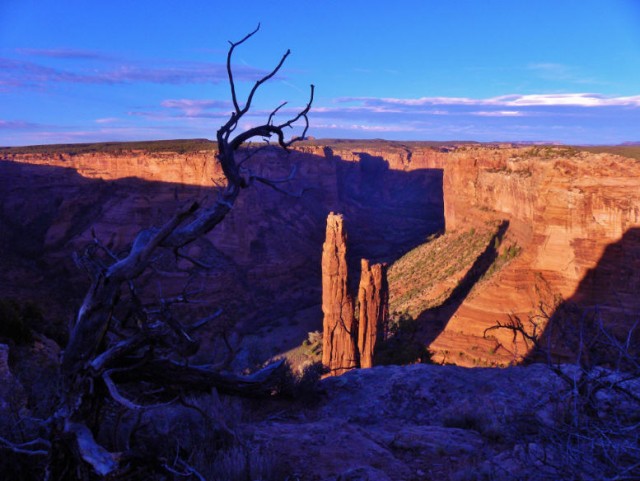
Low sun; long shadows.
Take photos before sunset:
twilight summons night.

Spider Rock — ©2012 John Wanserski for Creative Juice LLC
While there are many fine photos of Spider Rock and its shadow, this splendid one by John Wanserski has colors and composition that are distinctive and especially appropriate for my haiku. Click here to buy a print.
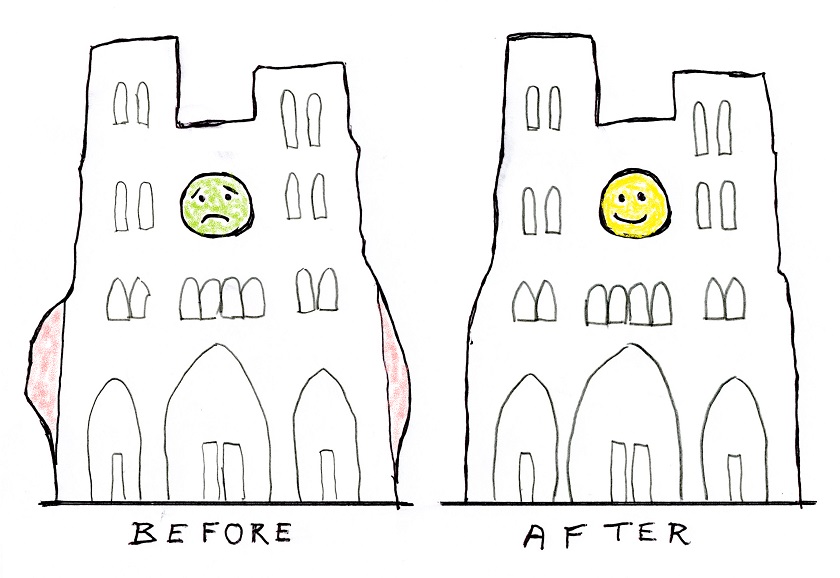
Designed and built long before there were supercomputers, the great Gothic cathedrals often developed cracks and bulges.
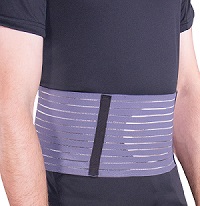
When more buttressing did not look like it would be enough to avert a catastrophic collapse at Amiens, the engineers there devised a way to get the net effect of putting a really big and really strong hernia support belt around the cathedral walls. Cathedrals don’t wear clothes; how do U hide such a belt? How do U cinch it? How do U accomplish all that with medieval technology?
The answers are sketched in the Wikipedia article on the Amiens Cathedral and visualized in a 2010 NOVA episode on PBS: Building the Great Cathedrals. (To read more detail, look for “iron” in the transcript.) U can blame me for bringing up hernias.
Dunno whether the engineers at Amiens were called ingénieurs at the time; at least one of them should have been called créatif. The cathedral is an enduring monument to the faith of many and the creativity of some, including a few engineers.
![]() |
![]() |
Rules Went Away
!Doorknob meteor shower:
!mundane miracle.
Have U read Alice in Wonderland ? Expecting me to refrain from reworking an initial idea in my wordsmith’s forge is like expecting Alice to refrain from following a white rabbit who looks at a watch and frets about being late. Ain’t. Gonna. Happen.
Rules Came Back
!Meteor shower
!seen by day in a doorknob:
!mundane miracle.
Tho originally written in response to a challenge on a blog other than CDHK, the tanka here can also respond to Carpe Diem #1214 dawn because it uses the word dawn and has fragment/phrase structure on 2 levels: between the haiku and the rest of the tanka as well as within the haiku itself.
My tanka responding to a challenge posted by Patrick Jennings is a riff on the splendid photo he provided, with hills that seem to go on forever in both time and space.
Originally posted by Patrick Jennings in
[Evanescent ~ Pic and a Word Challenge #89]:

Seize the Sunrise
Evanescent dawn.
Do hills endure forever?
No, but long enough.
~ ~ ~ ~
Art subverts time with pixels;
the moment also endures.