(reblog), humor, language, STEM

Narrative Starkness and Word of the Year

Kurt Brindley advocates “narrative starkness” that omits extraneous details about the characters in his fiction.  Apart from applauding Kurt’s starkness (and his ability to write humorous introductions for serious issues), the purpose of this post is to remark on a major difficulty with starkness and how the Word of the Year for 2015 may help.
(BTW, the [Menu] button atop the vertical black bar reveals the widgets.)

For reasons explained in the post excerpted below, Kurt Brindley advocates “narrative starkness” that omits extraneous details about the characters in his fiction.  Unless a character’s appearance (or gender or sexual orientation or …) matters to the plot, readers can imagine whatever they like.  Readers may later get a jolt if some details become relevant later and are different from their imaginings.  Maybe such a jolt will loosen the grip of a stereotype.

Apart from applauding Kurt’s starkness (and his ability to write humorous introductions for serious issues), the purpose of this post is to remark on a major difficulty with starkness and how the Word of the Year for 2015 may help.


My Uncolorful* Character(s)
Originally posted on
Kurt Brindley:

I don’t know about you, but as for me – unless it is absolutely critical to the movement of a story – I don’t need to always know every item in each room, or the style and brand of every shoe in the protagonist’s closet.

So it should come as no surprise then when I tell all you other reader dudes*** that I try to write my stories in the way that I prefer to read them: with limited and only absolutely necessary descriptive telling.

While I am very happy that DADT was finally axed and homosexuals are now allowed serve without any restrictions to their being, it was all of that nasty DADT stuff that became the impetus for me writing my novel.

And my goal in writing it was to force the reader to have to apply his or her own values, via perceptions and stereotypes, upon the characters in and events of the story.  Consequently, it was important for me as a writer to not tell the reader what I wanted them to think by way of character description, but to allow them to draw their own conclusions.

This equality stuff sure is a difficult nut to crack – witness the all-white Oscar nominees for this year’s Best and Supporting Actors/Actresses – and I’m not about to attempt to try and crack it here.

Except to say that screenwriters can certainly have a hand in keeping an open playing field for actors of all races and ethnicity by – you guessed it – laying off the descriptive details in their screenplays and leaving it up to the director to cast the best actor for the role based on the story’s content and need and not on the screenwriter’s biases.

*Yeah, I know “uncolorful” is not a real word, whatever a real word may be, but I it sounds less negative to me than “colorless” so, for what it’s worth, I’m going with it.

**gender specific

***non-gender specific

View original


Yes, “uncolorful” is awkward.  The aesthetic that urges omission of extraneous detail is well-established in STEM (as in “abstract algebra” or “Occam’s Razor”), but I cannot think of a good word or short phrase for wider advocacy of specifying only what really matters.  An “abstract” character is no more appealing than an “uncolorful” one.

It gets worse.  Writing smoothly and vividly but abstractly is tough.  George Orwell’s forever relevant 1946 essay Politics and the English Language includes a hilarious comparison between a memorable Bible passage and a translation into flabby blather that tries to make the general point w/o the concrete examples:

… the race is not to the swift, nor the battle to the strong, …; but time and chance happeneth to them all.

becomes

… success or failure in competitive activities exhibits no tendency to be commensurate with innate capacity, but … the unpredictable must invariably be taken into account.

In one way, a recent event may make narrative starkness a little easier.  The American Dialect Society’s Word of the Year award for 2015 went to “they” when used as a 3rd person singular pronoun that is gender-neutral.  I hope this usage sticks.

Suppose I want to write a story whose characters include a Navy sailor and a PhD scientist.  I could call them “Ensign Wood” and “Doctor Stone” to give them names that leave their genders unspecified.  But the old he-she-it gang gives me no appropriate pronoun to use.  Tho adequate in nonfiction writing, the clunky alternatives “he/she” or “(s)he” are hopeless in speech.  For my story, those pronouns may be making a misplaced fuss about being gender-neutral.  I can use “they” instead.  The ADS will have my back if grammar prigs attack.

It is nice to see that a humble pronoun has gotten the WOTY honor and may even help those who are fighting the good fight.  I have no appropriate haiku to end this post, but a limerick I read long ago does come to mind.

The function that’s nowhere defined
is an orange with only a rind.
But it turns up the hero
(like the null set and zero)
in many a proof you will find.

humor, photography, science, seasons, serendipity

Serendipity with Squid

Did I superimpose 2 images to create a (clumsy) visual metaphor about the interconnectedness of life?  Nope.  The story begins millions of miles away.  It ends on a window pane.
(BTW, the [Menu] button atop the vertical black bar reveals the widgets.)

HeronSquid_581x684Hmmm?  A ghostly translucent squid seems to hover in midair between the viewer and nesting herons.  No, I did not combine a heron image with a squid image in my photo editor.

The story begins millions of miles away, where the sun emits photons even more copiously than the pols emit factoids.  Minutes later, a tiny fraction of the photons bounce off a neighbor’s window, pass thru my window, and hit me in the eye.  There are many ways I would love to emulate people like Bach or Galileo; going blind is not one of them.

Yes, I could pull the drapes. But only a small portion of my window needs to be obscured.  Would rather not waste winter sunshine.  Yes, I could buy a window decal.  Most of the decals I have seen are cutesy.  The rest make a statement:

I am as ugly as a warthog with zits,
but the jerk who owns this dump
bought me as a decoration.  Ha!

Of course, I am dissing only the decals I have seen, not any other decal U may have and like.

The Dec/Jan 2016 issue of National Wildlife magazine has photos from the annual NWF photo contest, including a photo of nesting herons by Mario Labado and a photo of a squid by Jackie Reid.  I read the magazine on paper (yes, I am that old), and it so happens that the photos are on opposite sides of the same thin sheet, w/o much else to clutter what is seen when bright light passes thru.  The fraction of duplex printed sheets that look at all good when both sides are seen at once is like the fraction of photons emitted by the sun that bounce off my neighbor’s window:  tiny.

So I cut out the sheet and taped it to my window.  The image of the squid is actually on the far side; the illusion of being closer than the herons is the same in my house as in my photo.

The composite image is indeed clumsy as a visual metaphor for the interconnectedness of life, but it does tone down the excess sunlight.  It cost nothing beyond what I already spent to help support the NWF, and it looks better than a warthog with zits.

haiku, history, humor, politics

Long After the Sixties

When will things slide …

from liberty to anarchy?

from growing to shrinking?

from bravery to bravado?

from firmness to fascism?

from hope to rage?

The answer, my friend, has blown in on the wind.

The answer has blown in on the wind.

Fiscal Responsibility
|Debts rise; incomes fall.
|Hard times demand bold action:
|tax cuts for the rich!
 

baseball, flowers, haiku, humor, photography

Orange and Blue

The [Menu] button (atop the vertical black bar) reveals widgets like the Search box.  Typing just the [Enter] key into the Search box is a way to browse WordPress blogs.

orange-blue_938x337I had no interest in baseball during my misspent youth.  My late wife had some interest in it, her interest was contagious, and we had become casual fans of the NY Mets by the time they won their 2nd World Series in 1986.  With stamina unthinkable today, we saw the sights in Washington DC by day and watched much of the 1986 World Series by night, on the big TV in our motel room.  There were no games on the nights of travel days, but we managed.

While fans of the NY Yankees got to see many more wins over the years, Mets fans got to see more strategy because there is no designated hitter in the National League.  A great baseball team has an unusual combination of strategic leadership, individual initiative, and teamwork.  It is like a great army, but nobody gets killed.  Moreover, a not-great team can try again next year.

Tho definitely not a great team in most years, the Mets did and do have great colors: a strong orange and a strong blue, much like the colors in my photo.  Many fond memories of 1986 were refreshed by seeing orange and blue on a great postseason team in 2015, in addition to seeing them on foliage walks.

October is blessed with a riot of reds and yellows (and some persistent bright greens), as well as the glorious oranges of many of the sugar maples (Acer saccharum), some of the red maples (Acer rubrum), and NY Mets uniforms (but only in a few special years).  One color I seldom see in October is pink.  In 2015 I saw that also.

cactus_oak_888x504

Willful Cactus
|My “Christmas” cactus
|blooms whenever it pleases.
|Pink for Halloween!


haiku, history

Motion in Haiku: 2 Surprises

The [Menu] button (atop the vertical black bar) reveals widgets like the Search box.  Typing just the [Enter] key into the Search box is a way to browse WordPress blogs.

Some fine haiku were among the few good things to come out of World War I.  My experiment with one of them provides a response to Carpe Diem Perpetuum Mobile #2 rainbows sparkle (or movement in haiku).  While refining my nuanced stance on the 5-7-5 Rule ( Helpful guideline? Yes! Firm requirement? No! ), I tried tweaking a few classic haiku that broke the rule.  Could something that was already good be improved by revisions to comply with 5-7-5?  In particular, I considered a World War I image by Maurice Betz.  Neither the French original nor the straightforward translation on page 50 of The Haiku Handbook (2013 edition) obeys 5-7-5.  This post ends by quoting the translated Betz haiku (which is utterly static) and my [5-7-5]-compliant version (which has both fast and slow motion).  I was surprised twice.Duck-Rabbit_illusion_439x242

  1. The history of the shell hole can be narrated succinctly within the confines of 5-7-5.
  2. I do not have a stable preference for either version.  Like someone viewing the classic ambiguous image that can be seen as a duck facing one way or as a rabbit facing the other, I flip-flop between the still photo by Betz and the movie by me.

© Maurice Betz
|A shell hole
|In its water
|Held the whole sky.

Redemptive Trickle
|A shell exploded!
|Water slowly filled the hole
|and held the whole sky.

Image Source

  • Jastrow, J. (1899). The mind’s eye. Popular Science Monthly, 54, 299-312.
  • The soft copy used here has been downloaded and cropped.


haiku, photography, seasons

Chiaroscuro

Autumn is the best season of the year and also the shortest, unless we submit to calendar tyranny and say that “late fall” includes the leafless gray weeks before the winter solstice.
(BTW, the [Menu] button atop the vertical black bar reveals the widgets.)

Chiaroscuro_moon_443x449
I have a daylight photo that looks much like a shot of the full moon thru colored leaves, so I can illustrate Chèvrefeuille’s beautiful evocation of true autumn while responding to

Carpe Diem Haiku Experiment #1 an introduction

with a short haiku (in 3-5-3 form) about how short the season is.

© Chèvrefeuille
|light of the full moon
|shines through colored leaves
|at last … autumn

Ending Too Soon
|Wind speeds up!
|Leaves fall in panic!
|Clouds roll in …

haiku, history, humor, photography, science

Moving the Earth

Sometimes the Earth moves, quite apart from the constant motion in orbit around the Sun.  No, I am not using hyperbole to describe a big, screaming orgasm.  I am considering an even rarer event.
(BTW, the [Menu] button atop the vertical black bar reveals the widgets.)

Sometimes a really big idea challenges and ultimately transforms deeply held beliefs about the fundamental nature of human life.  Centuries ago, the idea that the Earth does indeed move around the Sun was such an idea.  Oh shit, we may not be at the center of the universe!  Astronomical humble pie from Copernicus has been pretty well digested; some people still cannot swallow humble pie that was pulled from the oven in 1858.

Already know what happened in 1858?  Please don’t leave.  I will keep it brief, keep it light, and put my own eccentric spin on the story.  (Honestly now, when was the last time U saw the phrase “big, screaming orgasm” in the 2nd sentence of a note on the history of science?)  Sources are thanked at the end of this post.

Back in 1858, there were no search boxes.  No Google.  No Wikipedia.  No e-mail!  Anything called a “manuscript” really was a collection of sheets of paper on which letters and symbols had been written by hand.  Want to show it to somebody U cannot visit?  Put it in the mail and hope it eventually arrives intact.  Want to have a backup copy in case it gets lost or damaged?  Write it out all over again before mailing.  No scanners.  No soft copy.  Yuck.

I am old enough to have lived and worked in a hard copy world, albeit with gadgets like electric typewriters that made it less painful than in 1858.  Collaborating with somebody several time zones away was agony in my early days and impossible in 1858.  In some important ways, doing science in my early days was more like it was in 1858 than it is now.  So I can imagine how Charles Darwin felt when he read the mail on 1858-06-18.

Correctly anticipating that his concept of evolution by natural selection would ignite a firestorm of controversy when published, Darwin had spent some of his time over the previous 20 years thinking about possible objections or misunderstandings, devising ways to answer or avoid them, and organizing a mountain of evidence.  Already an A-list biologist, Darwin was in no hurry and wanted to dot more i-s and cross more t-s before the firestorm.  Naturally, he wanted to wait a while before publishing his big idea.

The letter and manuscript that Darwin received on 1858-06-18 came from Alfred Wallace, a younger colleague then roughing it somewhere in one of the places that would now be called Indonesia or Malaysia or New Guinea.  Wallace sought advice about how to publish a new idea: evolution by natural selection.  Tho Wallace did not have a mountain of evidence, his pile was plenty high enough to justify publication.

Wallace earned his living by collecting natural history specimens for sale and was being hassled for the amount of time he devoted to nerdy “theorizing” when he should be killing things.  Naturally, he wanted to publish his big idea soon.  Naturally, he sought the opinion of a senior colleague with whom he had already exchanged a few letters on smaller matters.  He did not know (and could not know for months) that he had independently come up with the same big idea that Darwin had been quietly refining and supporting for years.

How could the differing priorities of Darwin and Wallace be reconciled?  How could Darwin respond to Wallace in a way that was fair to both of them and feasible in 1858?  No e-mail.  No conference calls.  Darwin consulted a few friends.  More than a century before the exhortation to

Let it all hang out!

enjoyed a vogue, they decided to do exactly that.  Those who attended the meeting of the Linnean Society of London on 1858-07-01 were treated to an explanation of the unusual situation, a reading of a summary of Darwin’s work, and a reading of Wallace’s paper.  Wallace was still in the boondocks and did not even know that his work (presented for him in his absence by one of Darwin’s friends) was sharing the spotlight on equal terms with Darwin’s.

Wallace did eventually return to England, make further contributions to biology, and enjoy a long friendship with Darwin.  Yes, they disagreed on some points.  Yes, creationists took such disagreements at the frontiers as an excuse to claim that the whole enterprise was “just a theory” with no greater plausibility than an extremely literal reading of Genesis as translated from a translation of the original ancient Hebrew.  But the Earth had begun to move again.  Oh shit, we may not be descendants of a pair of idle nudists who took advice from a snake!

Archimedes in 1858
|Darwin and Wallace
|found a lever long enough
|and a place to stand.

Greater Bird of Paradise

Sources

      • The brief biography of Wallace by Andrew Berry in the September 2015 issue of Natural History is very readable and provides some details I had not known.  No access to that issue of the magazine?  Pasting a few phrases into search boxes will compensate nowadays.  I have zoomed in on June/July of 1858 to elaborate on collaboration technologies (then and now), Darwin’s fairness predicament,  and why I applaud the way he resolved it.

    • Tim Laman’s many bird of paradise photos are featured in the September 2015 issue of Natural History.  The photos that appear here have been cropped to fit well on this page.  The originals (and many other splendid photos) can be seen on Tim Laman’s website.  Prints can be bought.

  • The concluding zinger about Adam and Eve is believed to be original; it is inspired by the edgy absurdist humor in Eric Wong’s blog.


haiku, humor

Pegasus

Tho childhood fantasies about flying horses are long gone, I can see the upside.  I have 2 favorites to share before my own take on Pegasus.
(BTW, the [Menu] button atop the vertical black bar reveals the widgets.)

In response to Carpe Diem #825 Pegasus:

I have 2 favorites to share before my own take on Pegasus: Chèvrefeuille’s beautiful Hippocrene-inspired image and Haiku Plate Special’s charming reminder of the way I and so many others were introduced to Pegasus.

© Chèvrefeuille
|after the rainstorm
|horses galloping through puddles
|droplets of poetry

© Haiku Plate Special
|winged horse
|flying through my childhood
|Mobil Gas

Tho childhood fantasies are long gone, I can be good-humored about practical matters.|

Pegasus
|Ever been shat on
|by a bird? Be glad there are
|no flying horses.

Pegasus_RM_450x450
Perhaps the image credit requested by the Rijksmuseum refers to a likeness of Persephone on the other side of a coin? Perhaps some copy-then-tweak editing did not go far enough? A magic spring with water that ensures complete editing would be a worthy companion to Hippocrene.
haiku, seasons

Another Maple Seed Haiku

This post responds to a CDHK challenge by sharing two haiku about seeing maples consign their seeds to the warm wind: my own and one written by Betty Hayes Albright.
– Gray button (upper left corner) reveals widgets, –
– above post (on phone) or beside it (on desktop). –

In response to CARPE DIEM HAIKU KAI: Carpe Diem Utabukuro #10 Wim Lofvers’ “a maple seed”

In late May of 2015 I happened to be out walking on a perfect day for seeing maples consign their seeds to the warm wind.  Having neither the skill nor the equipment to capture the moment on video, I kept walking and composed an appropriate haiku.

I like to use a haiku to wrap up a discussion that not even Basho could fit into 3 lines.  Having no more to say at that time, I typed the haiku into my computer and left it there.  Now I have a CDHK opportunity for my haiku.  As of this writing, there are 9 responses posted.  From a wealth of good haiku about maple seeds, I will share as a favorite the same favorite (written by Betty Hayes Albright) that is shared in the 5-th response.

Albright’s haiku stands out for me because it is vivid and reads quite naturally as English w/o any apology for squeezing into 5-7-5.  It also uses ordinary capitalization and punctuation, which I prefer over the affectations common in poetry.  At the risk of shooting myself in the foot, I will display it alongside my own haiku at the end of this post.

Seedling_911x655

© Betty Hayes Albright
|The air is spinning!
|Squadrons of maple-copters
|take the fertile earth. 
|Seize the Breeze
|Helicopter seeds
|fall from maples and travel
|far enough, this once.


(reblog), love

Holding On

Poet Rummager has written a splendid tribute to fallen soldiers, with a simplicity and directness reminiscent of Hemingway’s 6-word short story.

Am I the only one who was initially bewildered, having read “while” literally at first? The leave-taking and the funeral need not have been simultaneous. Time passed slowly while there was still hope that the soldier could return home on the scheduled date, relatively unhurt and relatively unhaunted. Then, suddenly, it felt as if he had left moments ago.

Poet Rummager's avatarPoet Rummager

OLYMPUS DIGITAL CAMERA

His wife was crying

He held her hand while his son

Saluted his tomb

(Photo from Definitivamente)

View original post

haiku, humor, photography

Various Viewpoints

To a female mosquito, I look like lunch: a big bag of nice warm blood.  From her viewpoint, my birdbath was a good place to lay eggs after lunch.  But then I rigged a hose to drip into it.  The drip also made the water better for washing down a bird’s caterpillar lunch.  I have another view of what makes a good lunch; my friend has yet another view.
(BTW, the [Menu] button atop the vertical black bar reveals the widgets.)

To a female mosquito, I look like lunch:  a big bag of nice warm blood.  The bag is annoyingly mobile, but she is also mobile and is quite good at using a mix of cues (chemical, thermal, and visual) to home in on the bag.  Then it will be time to lay eggs.  From her viewpoint, my birdbath was a good place for egg laying until I rigged a hose to drip into it.

birdbath-ripple_840x312
The dripping also keeps the birdbath full and makes it more attractive to the birds, who consider it a good place for a sip of water and sometimes a bath.  From the birds’ viewpoint, it never was a good place for egg laying.  I am glad that the mosquitoes have finally come around to the birds’ opinion.

Blood for lunch does not appeal to me.  Neither do caterpillars, so I do not compete with any past or present birdbath visitors for food.  I eat something healthy (from a human viewpoint) and finish off with something obscenely healthy: a few raw carrot sticks and then a few raw snow peas.  (That lets me get away w/o brushing my teeth after lunch.)  I also view the veggies as colorful objects to be arranged in a very temporary display on the plate before they become ugly mush that is mercifully out of sight.

A few days ago, I happened to arrange my lunch veggies so as to look a little like a dragonfly, with snow peas as wings.  Hmmm.  Maybe I could pull more veggies from the fridge and make an arrangement that looks a lot like a dragonfly to me. (No real dragonfly would be fooled.) This little project reminded me that a dragonfly is the enemy of my enemy, and thus my friend.

Dragonfly_480x481

What’s for Lunch?
|Mosquitoes in flight
|are seen as meat on the hoof
|by a dragonfly.

flowers, haiku, photography

Fall Preview

As happens in many years where I live, late August of 2015 was a sneak preview of fall, the year’s best season.  August teases; September backslides and hesitates; October triumphs in the end.

WiPachysandra_842x582

As happens in many years where I live, late August of 2015 was a sneak preview of fall, the year’s best season:

Days are still too warm, but more are dry and breezy while fewer are hot and humid.  A few cool nights lead to chilly mornings, and I suddenly notice that my garden flag with a picture of phlox is out-of-season.  The roadsides have goldenrod and purple loosestrife now.

Virginia creeper is turning, as are some red maples in wet areas.  Nearly all the healthy trees are still green, but there is a hint of yellow in many of those greens.  The process will slow to a crawl in September; I will spend much of that month grumbling when the weather backslides and thinking “C’mon! C’mon!” when I look at green leaves.

OnRock_825x619

October
|Bright sun and cool air;
|azure skies and pumpkin pies.
|Leaves fall in glory.

– Gray button (upper left corner) reveals widgets, –
– above post (on phone) or beside it (on desktop). –
(reblog), haiku, humor, photography

A Falling Sound

(BTW, the [Menu] button atop the vertical black bar reveals the widgets.)

 
The photo by Dancing Echoes reblogged below has inspired another haiku.

         A flipped coin may land
         on edge. Erect, her dropped shoe
         mimics his penis.

 
At my age, on the other hand, those high heels and narrow toes scream “Bunion City!”

Dancing Echoes's avatarDancing Echoes

image

Shoes dropping to floor
Quickened anticipation
Clothes fly in frenzy

In response to CARPE DEIM HAIKU KAI: On The Trail With Basho Encore 5 a falling sound

View original post

(reblog), language, mundane miracle, photography

The Transition to Created Light

The [Menu] button (atop the vertical black bar) reveals widgets like the Search box.  Typing just the [Enter] key into the Search box is a way to browse WordPress blogs.

A rose by any other name would smell as sweet, said the Big Bad Bard.  That is a good approximation; one striking exception is a photo by Elusive Trope that is effectively reblogged below.   (I say “effectively” because there were technical reasons to avoid the [Reblog] button in this case.)  A really good title can enhance work that is already good.  (Giving a nice name or title to junk may help sell it but will not dejunkify it.)  When Mark Twain likened the difference between “the right word” and a merely adequate word to the difference between the lightning and the lightning bug, he was stretching the point.  In the case of Elusive Trope’s photo, however, he nailed it.

Originally posted on Elusive Trope:

IMG_2459_picmonkeyed

The Transition to Created Light

View original (if link can be restored)

We look at the photo and see an austerely beautiful composition with strong colors.  One possible title (inspired by the actual title of Whistler’s famous painting of his mother) would be accurate but rather clunky and stuffy:

        Composition in Blue, Black, and Yellow: Light Fixture

Maybe we should use the time of day.  Saying just “Dusk” or “Twilight” would be accurate and mercifully brief, but those words have a sad or ominous connotation.  Our distant ancestors had good reason to fear nocturnal predators.  There is nothing sad or ominous in the light fixture’s defiance of the coming darkness.

Maybe we should be more specific about what is happening at dusk, with something close to the actual title:

        The Transition to Artificial Light

Adequate? Yes, but still not quite right.  The phrase “artificial light” has a milder version of the connotation of “artificial color” or “artificial flavor” as something to be confessed, not proclaimed.  Changing one word leads to the actual title used by Elusive Trope:

        The Transition to Created Light

Now the title reconnects us to the creativity of distant ancestors who invented campfires that discouraged their nocturnal predators.  Then there is the creativity of more recent ancestors who invented candles and lamps that let them mend their nets or write their thoughts during long dark evenings at high latitudes.  Still more recently, the creativity of people like Edison and Tesla made it so easy to light the darkness that nowadays we do it too much and appreciate it too little.  (The failing is ours, not theirs.)  Elusive Trope found the right word; we thrill to the lightning; Mark Twain’s ghost says “Told ya!” between puffs on his cigar.

haiku, humor, politics

Fridge Follies

CrowdedKitchen_464x348

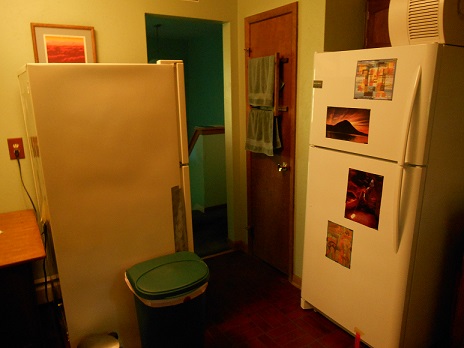
Why does the small kitchen in my very small household have 2 refrigerators?  The story begins in 2002, when the fridge now blocking the view of a framed print was delivered.  The 1985 fridge it replaced had the condenser tubing on the back, readily accessible for an annual cleaning.  I was surprised to find that the tubing was hidden on the bottom of the then-new fridge.  I was also surprised to find that the then-new user’s guide said

There is no need for routine condenser cleaning in normal home operating environments.

A few months later, I was not at all surprised to find that the guide’s assurance was bullshit.

Section 1: Noble Intentions

I have a good collection of brushes and crevice tools for my vacuum cleaner, but most of the condenser tubing was still uncleanable.  Some people dare to empty a fridge, tip it over, unscrew any bottom cover, and vacuum the hidden tubing.  I estimated the likelihood that such a saga would accomplish much for my extremely convoluted tubing to be less than the likelihood that I would crush a toe while fumbling with the heavy fridge.  So I left the fridge upright and improvised filtration of much of the air being sucked past the tubing by a fan.  I changed the filter monthly and was pleased that it intercepted much of the incoming dust.  But not all of it.

When new, the 2002 fridge was fairly efficient.  The rated energy consumption (514 kWh/yr) was decent (and much better than the 874 kWh/yr of the significantly smaller 1985 fridge it replaced).  While the gradual buildup of dust on the condenser tubing implied a gradual decrease in efficiency, the fridge was still working.  Old Yankees do not replace old stuff that does work well enough with new stuff that might (or might not!) work better.

Several things changed in 2015.  I happened to put my hand on the top of the fridge, near the freezer door.  It was uncomfortably warm, almost hot.  The heater that prevents the door from freezing shut had become overenthusiastic.  More energy wasted.  Some newer fridges have LED lights to avoid unwanted heat.  The electric company has a nice rebate offer: they will pick up a working old fridge for recycling and give me a little $ for it.  I could get an up-to-date fridge with pristine condenser tubing, verify that it works, move into it at leisure, and only then have the 2002 fridge hauled away.  I plan to stay in my house long enough that the 2002 fridge could not go the distance, but not long enough to need yet another fridge purchase after buying one in 2015.  May as well do it with dignity now, when nothing much has hit the fan recently.

So I saddled myself with 2 problems: choosing a new 2015 fridge and temporarily squeezing it into my small kitchen along with the old 2002 fridge.

Section 2: The Agony of Choice

Comparing 2015 with 2002, I found that choosing a fridge is both easier and harder.  Lots of pertinent info (and some misinfo) is online, and my current internet connection is fast enough to access it.  On the other hand, there has been a luxuriant profusion of brands, configurations, and features.  Had to wade thru all of that to find a top-freezer fridge of moderate size with half-width cantilever shelves, LED lighting, and no ice maker.  Why no ice maker?  My kitchen’s plumbing only supplies water to the sink and the dishwasher, and remodeling is not on the horizon.  I need the space an ice maker would occupy for ice trays.  That is no hardship for me, as I am old enough to remember rigid metal trays that stuck to my fingers when the water had frozen and had Rube Goldberg arrangements of louvers and levers for forming and releasing the ice cubes.  The arrangements pinched my fingers and sent much of the ice flying across the room as little shards.  So I am quite content to use modern 1-piece plastic trays that almost always release the cubes intact when gently twisted.

Yes, the big stores have websites with options for filtering searches.  The behavior of those options reminded me of the disclaimer that sometimes appears when movie credits roll:

«Any resemblance between the filtering specified by the user
and the filtering actually performed is purely coincidental.»

One day when my errands took me nearby anyway, I decided to look at fridges in an actual brick-and-mortar store.  I found a phalanx of stainless steel behemoths with bottom freezers, French doors, thru-the-door controlled substance dispensers, and so on.  What sustains the French door craze?  Yes, some people need them because they have really weird kitchens with door-swing limitations.  (Maybe there are also some people who can remember which side of the fridge has the mayonnaise jar and want to hi-5 themselves after opening only the appropriate door?)  Anyway, there were a few token fridges with my basic configuration.  They also had full-width shelves, each with too few height choices. Feh.

Back to the web.  I eventually got past the behemoths and the cheapies.  I eventually got past the ambiguities and contradictions in the specs posted on store websites.  I settled on a fridge configured much like my old one but more efficient (rated at 471 kWh/yr).  Neglecting to visit the manufacturer’s own website and confirm all the specs there (cue the horror movie music), I placed an order and scheduled delivery.

Section 3: We All Live in a Yellow Submarine

KitchenCorner_387x516

My camera’s white balance is flaky; the kitchen is not really that yellow.  Being in it, however, is much like being in a submarine.  Everything is shoved up against something, with barely enough room to move around.  This is only temporary.

Does the title of this section sound familiar?  In the 1960-s, I thought the popularity of The Beatles was only temporary.

Eager to have my own place after some dismal rental experiences, I knowingly bought a badly designed and badly built house in 1972.  It was only temporary, a way to get off the rental treadmill for a few years while looking around for something better.  I am still in that house.

My track record in predicting how long situations will last is not good, but hope springs eternal.  (I did have enough foresight to ensure that I could still cook in my submarine kitchen.)  This is only temporary.  Can repeating a dubious mantra often enough make it true?  Should we ask the pols who postulate that tax cuts stimulate enough economic growth to pay for themselves?

Delivery day!  I showed the crew the odyssey required to get from the front door to a kitchen doorway that is wide enough, in my badly designed house.  The new fridge agreed with my tape measure and settled into place w/o incident.  I tipped the crew, admired the new fridge briefly, and settled down to a snack in the adjoining room.

BANG! CLANK! CRACKLE! BANG!

The sound character was like that of ice cracking when a fridge does its defrost routine after a heavy buildup.  The sound volume implied that a hostile navy had located the yellow submarine and had good aim with depth charges.  I ran into the kitchen in time to verify that the noise was coming from the new fridge.  Then it stopped.  The fridge was running quietly.  Apart from a little muffled rattling now and then, it has been quiet ever since.

I know what happens when an appliance (or a car or a body part) misbehaves erratically and the worried owner consults a pro.  I sympathize with the reluctance of pros to diagnose an unrepeatable symptom on the basis of a layman’s verbal description.

It’s working fine now.  Call us if it acts up again.  Goodbye.

So I resolved to extend the temporary squeezing of 2 fridges into 1 kitchen for a few more days, keep using the old fridge, and listen for nasty noises from the new one.

Section 4: The Ice Maker Cometh

Reasonably confident that the new fridge was OK, I turned it off and gave it time to warm up before playing with the shelves to approximate the arrangement in the old fridge.

I opened the freezer door and found — (cue the horror movie music, louder this time) — an ice maker!  This hulking monster could supply enough ice to host a cocktail party for an army, but only if it had a water supply.  Dry as the Namib Desert on a fogless day, the monster sullenly hogged much of the precious freezer space.  The new fridge devotes a smaller fraction of its space to the freezer than the old fridge does, and I had recently bought ridiculously many pints of frozen yogurt because the market was discontinuing a flavor I liked and discounting the remaining inventory.  I had to evict the monster despite the risk of quibbles about “tampering” if I ever needed warranty service.

The screws attaching the ice maker to the freezer wall were readily accessible.  Then there was the electical connection.  Like the connections in cars, it was a plug-socket arrangement, latched shut and secured in place by springy prongs that could be released by pressing gently with a small flat-bladed screwdriver in exactly the right place.  After some looking and cautious probing that did no damage, I found the place and disconnected the monster.  That left 4 metal contacts open in the socket, hoping to get connected again but willing to accept condensation and a chance to short out in revenge for being abandoned.  So I covered the socket with duct tape and protected the tape with some bubble wrap and more duct tape.

Freezer_390x293

The freezer of the old fridge still holds a few things that I have not been able to fit into the new one’s freezer.  Otherwise, I did eventually move everything from old to new and no longer guess wrong about which fridge holds what.  I should be able to adjust my freezer usage to the current reality and am otherwise pleased with the new fridge.  Maybe the electric company’s rebate offer for the old fridge will still be in effect when I am finally ready to use it.

Section 5:  Directions for Further Research 😉

LabGadgets_688x349

During installation of improvised external air filtration for the 2015 refrigerator, examination of the hidden condenser tubing revealed a configuration differing from that of the 2002 refrigerator.   It is hypothesized that the 2015 configuration will be more amenable to cleaning than the 2002 configuration, albeit still less amenable than was the 1985 configuration.   This hypothesis will be tested when sufficient dust has accumulated.

A concluding haiku about refrigerators is not available at present.   In the interest of timely publication, this  post concludes with haiku pertinent to auxiliary considerations discussed in Sections 3 and 4, respectively.

Fiscal Responsibility

Debts rise; incomes fall.
Hard times demand bold action:
tax cuts for the rich!

Silver Savior

The crowning glory
of our civilization
is, of course, duct tape.

haiku, humor, math, philosophy, science

Could a Long Fly Ball Hit a Flying Horse?

This is one of the few times I need to put some fiction into my blog, so I will change font for a little while.

Plato

Sometimes it is hard to be fair to Plato.  He is basically a good guy, but his politics are bullshit.  That “philosopher-king” notion is so self-serving.  Then there is that cave shtick.  Most people know that philosophers can be a little klutzy in everyday life.  We give them some slack and don’t make a big deal of it.  But Plato says the wannabe king has been looking at ultimate reality and absolute truth (and maybe a pretty girl sunbathing?) in bright daylight, so he stumbles in the cave that passes for the real world among ordinary Joes.  After his eyes adapt to the dim light, he will govern just fine.  No way.

Feeling mellow enough to ignore Plato’s politics, I invited him over to watch a baseball game on TV.  He was surprised that the pitcher threw a ball rather than a discus or a javelin, and that nobody was naked.  But he is a smart guy and soon understood the duel between the pitcher and the batter.  He noticed the (4 balls or 3 strikes) rule for ending an at-bat and said something about the ratio 4:3 in music by The Pythagoreans.  Are they a band I don’t know about?  He broke into a big grin when a batter sent a long fly ball arcing high above the field.  Tho he knows zip about physics, he hangs out with Euclid and knows a parabola when he sees one.


To Plato, the path of the fly ball in the grungy everyday world is an imperfect realization of the timeless perfection of an ideal parabolic form.  To me, the description of the path as a parabola is a good approximation that ignores air resistance and wind.  Ignoring those things is OK in an introductory physics course.  It is not OK in a baseball game.

Pegasus_RM_450x450

Using the parabola to describe the fly ball oversimplifies a staggeringly complex everyday world that emerges from a staggeringly weird tarantella of elementary particles.  Our use of the parabola is fundamentally a story we tell ourselves.  Unlike the story of Pegasus the flying horse, it has been corrected, refined, and integrated with many other stories by scientific processes.  The notion of a flying horse is appealing (to people who have not been hit by a bird splat).  The parabolic story is ultimately more satisfying, as part of something gloriously predictive and useful (despite not being much help to the outfielder running to catch the fly ball).

Pegasus himself is as limited in time and space as the Pegasus story: an idea created by some people at some time and place, elaborated and spread by other people at other times and places.  The Pegasus story will vanish and its starring horse will vanish with it, if we succeed in our current efforts to make the Earth uninhabitable long before we can go elsewhere.  Would the parabolic story vanish also?  That is a question for another time.  The mathematical cast of characters in the parabolic story, on the other hand, is special.  Very special.

Plato’s Challenge
|Three plus two was five
|before any mind could know.
|Where do numbers live?

My snapshots of Plato and of Pegasus could not get thru the time warp, but I did some cropping of public domain images with good likenesses.

(BTW, the [Menu] button atop the vertical black bar reveals the widgets.)