flowers, humor, photography

3 on 1 on 3

The [Menu] button (atop the vertical black bar) reveals widgets like the Search box.  Typing just the [Enter] key into the Search box is a way to browse WordPress blogs.

I saw something on 2016-07-06 that I had never seen before, in about 40 yrs of making daylily bouquets.  I saw 3 flowers blooming on 1 stalk.  It was on day 3 for a batch of stalks I had cut.  (By cutting about as many stalks with mature buds as with open flowers, I get a batch that supports 4 or 5 days of bouquets.)  While I see 2 flowers on 1 stalk much less often than just 1, I do see 2 on 1 often enough to take it in stride.  Seeing 3 on 1 was a pleasant reminder that there may still be new wonders to be directly experienced, even in the same old yard.

3-on-1

Hope nobody misconstrued the title of this post as a reference to a bizarre kind of group sex.

haiku

Gifts from an Old Oak

I had nothing in mind for this particular CDHK episode, but then I read the fine contribution by Dancing Echoes, had a sudden inspiration, and was astonished to see that the episode was still open.  Thank U, Dancing Echoes.

In response to CARPE DIEM HAIKU KAI: Carpe Diem #989 Oak

Gifts from an Old Oak
|Acorn stew tonight?
|No, let them feed squirrels or
|grow to be old oaks.

Please read the fine contribution by Dancing Echoes to this episode.

– Gray button (upper left corner) reveals widgets, –
– above post (on phone) or beside it (on desktop). –
(reblog), enlightenment, haibun, haiku

Invictus in 5-7-5

As there is already more than enough grimness in the real world, I usually dislike grim art.  The haiku by Poet Rummager that is effectively reblogged below is one that I admire despite its grimness.

An Escape | Poet Rummager

At her throat, he pressed
The knife and told her to strip
She leaned on the blade

View original post

In response to Carpe Diem Utabukuro #12, I admire Poet Rummager’s haiku for 3 reasons.

  1.  It is so well-crafted.
  2.  It pushes the envelope of haiku subject matter.
  3.  It honors an unflinching spirit, as in William Ernest Henley’s poem Invictus.

Whether #1 also applies to my own grim haiku is for others to say; I do have #2 and #3.

Edge of Enlightenment
|Behold the abyss
|without flinching.  If you can,
|then you are at peace.

UrbanAbyss_512845-800x600

© Lucas Surtin

– Gray button (upper left corner) reveals widgets, –
– above post (on phone) or beside it (on desktop). –
(reblog), Buddhism, haiku, humor, oversimplify, photography

Wine Making, then Buddhism

Fleeting moments in nature are good haiku subjects.  But there are others.  Among them are wine making and Buddhism.  A haiku can be a zingy summary of a discussion or attitude.
(BTW, the [Menu] button atop the vertical black bar reveals the widgets.)

The haiku by Dancing Echoes that is effectively reblogged below is one that I admire because it deals so well with big concerns.  While I do appreciate haiku about particular fleeting moments in nature, I also like to try summarizing a general discussion or attitude very briefly, with a haiku.

Vintage | Dancing Echoes

Blue in Green

Both art and science
Plus a little bit of luck
Makes a good vintage

View original post

I will complete my response to Carpe Diem Utabukuro #12 with my own new haiku shortly, but first I want to admit that a zingy summary may be a serious oversimplification if taken too literally.  With an understanding about wiggle room, a forthright oversimplification is sometimes better than an attempt to dot every i and cross every t.

My haiku is not quite so extremely oversimplified as it may seem.  I am considering Buddhism only as the attitude toward life that I take to underlie the organized religion.  Peel away the legends and rituals.  Peel away the historical adaptations to local circumstances.  What do I find after much peeling?  I find green tea, the sound of one hand clapping, and a haiku.

Buddhism in 6 Words
|Shit happens.
|Keep calm;
|be compassionate.

economics, history, humor, oversimplify, politics

Twelah of Stonina

No, the title is not the name of a character in a dreary fantasy epic.  It links 2 examples of something that can happen to oversimplifications as circumstances change: what is initially harmless (and perhaps mildly beneficial) can become pernicious.
(BTW, the [Menu] button atop the vertical black bar reveals the widgets.)

As in my earlier post arguing that oversimplification is unavoidable but can be done honestly, a whimsical example that is easily understood breaks trail for a serious example that is not.

1. Puzzles

Instructions for puzzles usually explain what the solution should look like, w/o constraining how to get there.  The Jumble series of puzzles has been around for decades, originally just on printed pages but now online also.  I sometimes solve the puzzle as printed in my daily newspaper.  (Yes, I am that old.)  Taken literally, the instructions for a Jumble do constrain the how, but in a way that strikes me as a harmless oversimplification in explaining the what.  More precisely, it was harmless until the series went online.

The weird words in the title of this post are scrambled versions of the ordinary words wealth and nations.  A typical Jumble puzzle invites the reader to unscramble several such scrambled words and then use the letters at some specified positions in the ordinary words to complete the caption of a cartoon.  Printed and online versions of the puzzle for 2016-06-10 are displayed below.  Both the layout and the use of “Now” in the printed instructions indicate that unscrambling comes before completing.  Similarly for the online instructions revealed by the [HELP] button.

2016-06-10_E23_Jumble

While I sometimes proceed in the instructions’ order, I more often guess the completion before unscrambling all (or even any) of the words.  So what?  I can put my pen anywhere on the page at any time.  The sequencing in the instructions is just a convenient way to explain what would be a solution to a Jumble puzzle.  One could rewrite and reformat the instructions so as to explain that w/o extraneous sequencing (as in the instructions for Sudoku), but it is not obvious how to write sequence-free instructions for Jumble that are as clear as the oversimplified instructions with extraneous sequencing.  Why bother?

Here’s why.  Look at the online version.  That bright green square is a place for typing, if U so choose.  The interface does a good job of allowing U to drag letters rather than type.  After unscrambling all the scrambled words, U will see the available letters appear above the caption and can type or drag to complete the caption, just as U typed or dragged when unscrambling.   While the interface displays several signs of  good software engineering, it takes the informal specs too literally and mandates the heuristic of unscrambling all the words before doing anything to complete the caption.   (Being a nerd myself, I can sympathize.)   What began as a harmless oversimplification became a killjoy.

As it happens, I started by guessing the caption for the 2016-06-10 Jumble, then verified that my unscramblings of 3 words were consistent with my guess, and then used the resulting tentative knowledge about letters to be contributed by the word still scrambled as a hint about how to unscramble it.  (A tiny example of how science works.)  No can do in the online version.  There is a [HINT] button that doles out a single letter in a single word.  My preference for making my own hint is not just a consequence of my being compulsively self-reliant.  My own hint is discovered and might be misleading because I might have guessed wrong at the start.  The online hint is an infallible gift from on high.  No fun in that.

If U want to work on the online version of this particular Jumble, U can click on its image to visit a page with today’s puzzle and then use the page’s calendar widget to go back to 2016-06-10.

Now it is time for the serious example, which starts in the same century as the scene depicted in this example, but on the other side of The Pond.

2. Free Markets

The other momentous document published in 1776 was Adam Smith’s The Wealth of Nations, with a then-harmless oversimplification that has become a now-pernicious dogma.

Smith’s readers were familiar with intrusive governments and quasigovernmental organizations like craft guilds.  Mercantilist governments restricted who could sell what to whom.  Guilds set the prices of what their members made.  That was normal, as was censorship, state-sponsored religion, and commercial privileges granted by royal whim.  Smith was aware that his readers might find his free-market ideas disturbingly anarchic, and he tried to reassure them with his famous fantasy about an invisible hand.  He succeeded too well.

Smith remarked that, while he advocated much less intrusive government than his readers considered normal, there were still important government functions needed to make his free markets work.  He mentioned some explicitly.  Unsurprisingly, he did not mention those that would not be on anybody’s radar for over a century.  Markets cannot work properly w/o transparency: potential buyers need to know what they would be getting and how much they would be paying.  Apart from providing a trustworthy money supply, there was no obvious need for laws and regulations to make markets transparent.  They seemed obviously transparent; nobody wearing a 3-cornered hat noticed that transparency was being assumed and might someday need to be enforced.

With the passage of time, Smith’s ideas took hold, the economies of his nation and ours grew richer and more complex, and economists eventually realized that markets cannot be perfectly transparent.  What happens when they are seriously opaque?  When getting pertinent info is costly?  When some of the info floating around is false?  When insiders have pertinent info that they act upon but keep to themselves?  Long technical answers won Nobel Prizes for Kenneth Arrow and Joseph Stiglitz.  The financial crisis of 2008-2009 and its precursors illustrate a somewhat oversimplified short answer that suffices for present purposes:

The shit hits the fan.

By the time the importance of transparency and the need for laws and regulations that enforce it had become common knowledge among thoughtful advocates of free markets, the invisible-hand fantasy had morphed into market fundamentalism.  That dogma is a godsend for anybody who wants to act like a psychopath but suffers from the inconvenience of having a conscience.  It is OK if I scramble to enrich myself and U scramble to enrich yourself, no matter how much we harm each other or anybody else.  If the stupid gummint stays away and just lets “The Market” work its magic, everything will come out as well as possible in the real world, where resources are scarce and buying anything precludes buying something else with the same money.

Like religious fundamentalism, market fundamentalism is rigid, simplistic, and oblivious to the suffering it causes.  The real world is indeed harsh.  It is also vastly more complex than fundamentalists concede, perhaps more complex than they can imagine.  Enforcing fairness and transparency w/o stifling useful innovation is not easy.  More generally, finding a good balance between public and private economic activity is not so easy as it seems to market fundamentalists (or to socialists, at the other extreme).

Much longer (but still readable) discussions of opacity and other market failures can be found in books like The Roaring Nineties by Joseph Stiglitz.  Perverse incentives lead to perverse behavior.  Is that really surprising?

ethics, humor, oversimplify, philosophy, politics

Green Grass and Golden Rules

Like overeating, oversimplifying is something we should always try to avoid.  Oops, that’s an oversimplification.  Sometimes it is harmless (or even helpful, for certain purposes or as a temporary expedient) to oversimplify; sometimes it is hardly better than lying.

Is grass green?  Not if it’s Japanese blood grass in autumn.  Does a bear shit in the woods? Not if it’s a polar bear.  Is the sky blue?  Not at 1:00 AM.  Something important is hiding in plain sight here.  Everybody and their uncle have always known counterexamples to the claim that the sky is blue, and some of them have been celebrated with striking photos.  On the other hand, when cartoonist Garry Trudeau wanted to poke fun at reflexive Republican opposition to anything proposed by President Obama, he used this same claim in the Doonesbury strip that appeared 2015-05-24 in my local paper.  Clinging to his tattered hope for bipartisanship, Obama responds to an aide’s disillusionment by announcing something he thinks will be utterly uncontroversial: that the sky is blue.  The last panel shows a subsequent press conference held by the Senate’s Republican majority leader.

Reporter:
Leader McConnell, is the sky blue?
McConnell:
I am not a meteorologist.

Whether or not U agree with Trudeau’s take on the attitudes of those who pass for Republicans nowadays (and whether or not U found the strip funny), I trust that U did recognize the question about the sky’s color as a more polite version of the question about ursine defecation.  Even tho U know about sunsets.  Even tho U know that everybody else knows about them too. What is going on here?

1. Everything Is Oversimplified

belted-galwaybelted-galway-brown
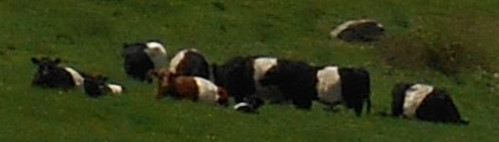
Well, not everything.  The black and white cattle living on the farm near my house are not oversimplified.  They just are what they are.  Much of what I might say about them is oversimplified.  Indeed, it is hard to find anything nontrivial to say about them that is just plain true (like 2+3 = 5), w/o any qualifications or exceptions.  From a distance, they are black and white cattle, lounging on green grass under a partly blue sky.  Look more closely, and a few of them have brown instead of black.  Does it matter? Not to me.  Maybe it would matter to somebody who breeds Belted Galloway cattle.  I just admire the bu-cow-lic scene and stay upwind.  Does a cow shit in the pasture?

Overeating is something people often do.  They should always try not to, and many of us can succeed most of the time.  Oversimplifying is more complicated.  Sometimes it is harmless (or even helpful, for certain purposes or as a temporary expedient); sometimes it is hardly better than lying.  Trying not to oversimplify is generally good, but the cure can be worse than the disease.  It may be better to oversimplify, be honest about it, and remain open to working on a more accurate formulation as the the need arises.  A more accurate formulation may well be good enough for a long time, but not forever.  Scientific theories and engineering calculations are like that.  Guess what?  So are ethical principles.

2. Why Is “Golden Rules” Plural in the Title?

What we call “the” Golden Rule has been formulated in various ways by various cultures.  A nice discussion appears on pages 83-86 in the book Plato and a Platypus Walk into a Bar by Cathcart and Klein.  (The book is a great read, even if U aced Philosophy 101 and have already heard many of the jokes.)  They use an old joke to illustrate how seriously oversimplified the rule is:

A sadist is a masochist who follows the Golden Rule.

It gets worse.  Even when how people like to be treated is pretty much the same thruout a group, the Golden Rule stumbles.  I was both amused and disturbed when cartoonist Scott Adams showed how badly it stumbles in a Dilbert strip I should have saved.  The boss proclaims that company policy will henceforth be to follow the Golden Rule.  Dilbert objects; the boss asks why.  The resulting exchange goes something like this:

Dilbert:
Would U like me to give U $100?
Boss:
Um, yes.
Dilbert:
OK, follow the Golden Rule and give me $100.

The boss is reduced to sputtering indignation.  Dilbert is clearly taking the rule too literally and ignoring an implicit consensus about exceptions.  But what are they?  I could not say where Dilbert errs.

Most of the formulations discussed by Cathcart and Klein are somewhat clunkier than our culture’s usual

Do unto others as U would have others do unto U.

They amount to saying

Do not do unto others as U would not have others do unto U.

Maybe people thought of the Dilbert objection and tried to get avoid it by prohibiting X rather than mandating Y.  This does help, but there is still a problem.

Dilbert:
Would U be disappointed if I refused your request to give U $100?
Boss:
Um, yes.
Dilbert:
Please give me $100.
Boss:
No.
Dilbert:
 I see.  U are just as hypocritical about the Confucian version of the Golden Rule as U are about our usual version.

If U fall off a boat and I hear U shout a request to be thrown a life preserver, I will try to do just that.  Just don’t walk up to me and request to be given $100.  What is the difference?  People can start with our usual formulation of the Golden Rule, admit that it is grossly oversimplified, consider what seems reasonable in thought experiments like this, try for a more explicit consensus about exceptions, and remain open to considering more adjustments as more situations arise, either in practice or in thought experiments.  Can we do better?

Immanuel Kant tried valiantly to do better with his Supreme Categorical Imperative, which is a fun read if U like reading tax laws or patents.  Cathcart and Klein have the details.

As a former wannabe mathematician, I would very much like to see a nice crisp formulation of the Golden Rule (or of any other important general principle) that just nails it, w/o exceptions or vagueness.  Nice work if U can get it.  If I ever get stuck with trying to help socialize a child, I will give the kid our usual version of the Golden Rule, say that it is a great starting point for thinking about how to behave, admit that real life is messier, and offer to talk about it more as the need arises.  I will not mention Kant.

humor, language, parody

Megawatt Smile

U can understand this post w/o actually seeing the short skit that inspired it.  After a note on the subtlety of what is or is not offensive, we end with a parody of a familiar song.
– Gray button (upper left corner) reveals widgets, –
– above post (on phone) or beside it (on desktop). –

Megawatt SmileThe image at right is a severely cropped screenshot from a video of a short skit involving thongs and silly raunchiness (or raunchy silliness).  The skit is no longer online, but U can understand this post (and maybe get a laugh at the end) w/o actually seeing the skit.

Tho not offended by the skit itself, I was briefly offended by some accompanying verbiage:

would you let your girl make money on the internet??? fellas answer now

At first, I read the word let in the sense of permit and bristled at the notion that permission is theirs to give or withhold.  Then I realized that let could have been meant in the same mild sense as

Live and let live.

and decided to give whoever wrote the verbiage the benefit of the doubt.

In addition to providing a glimpse of a megawatt smile (with longer looks at other features) and a little comic relief from the US politics train wreck, the skit inspired me to write a parody of a familiar seasonal song.  U can see the parody by scrolling down.  Fair warning: leave now if U dare not risk thinking of the sexually exuberant parody whenever U hear the song in December.

Keep scrolling …
Almost there …
Now … yes … ooooh …

Jiggle buns; jiggle buns; jiggle all the way.
Oh, what fun it is to ride on a girl who likes to lay.

Pushing thru her slit,
on a girl who likes to lay.
Pressing on her clit;
thrusting all the way.
Bed sheet getting wet
as she hugs me tight.
What fun it is to kiss and pet
and lay again tonight.

enlightenment, flowers, history, humor, language, photography

Lion’s Tooth

I like the scattered violets that appeared in my lawn some years ago.  In the spring I let the grass get high before I mow, so that the violets will have a good chance to set seed.  The delay also gives the dandelions a good chance to set seed.  Fine.

DandelionViolets

Would the dandelion have a better rep if we had translated (rather than anglicized) the Old French name?  Not likely.  Every flower is the same bright yellow, so there is no variation for plant breeders to coax toward white or red and then offer “Snow Ball Lion’s Tooth” or “Fire Ball Lion’s Tooth” in seed catalogs.  Any klutz can grow dandelions, so they give gardeners no bragging rights.

Nowadays the French have a derogatory-sounding name for dandelions.  Were the royal gardeners frustrated by the plant’s defiance of the oppressive formality of the plantings at Versailles?  The Germans have kept the good old phrase “lion’s tooth” (in their own language, of course), as have the Italians and the Spanish.  If it ain’t broke, don’t fix it.

When many people see a dandelion, they see a weed.  I don’t.  I see Löwenzahn, the Wagnerian Heldenblume that thrusts green and gold into the grayest and grimmest of our cityscapes.  I see Dent de Lion, the Enlightenment philosophe whose call for liberty and rationality rides the wind.

DandelionSeeds_few

I do pull weeds; I do not pull dandelions.

Flower of the Day – July 20, 2018 – Dandelion

– Gray button (upper left corner) reveals widgets, –
– above post (on phone) or beside it (on desktop). –
engineering, humor, philosophy

How My Blog Became Phone-Friendly

The tweetable answer is that I switched to the Satellite theme.  U can get a wry take on the sometimes quirky path of progress by reading the rest of this post.
(BTW, the [Menu] button atop the vertical black bar reveals the widgets.)

The tweetable answer is that I switched to the Satellite theme.  There are more things in heaven and earth than are dreamt of in Twitter’s philosophy (and I don’t tweet anyway), so U can get a wry take on the sometimes quirky path of progress by reading the rest of this post.

When I started blogging, I wanted a genuinely uncluttered theme that would leave me free to concentrate on content and decide whether I wanted to continue, w/o paying upfront with $ (for a premium membership) and with time (spent customizing).  I wanted black text in a sans serif font on a white background, with lines long enough and vertically separated enough for a readable brief essay w/o too much scrolling.  I also wanted something that was (and still is?) rare among uncustomized themes: I can print out a preview of a draft, get hard copy that looks very much like what the browser displays, and scribble notes about revisions.  Yes, I am that old.

Browsing the theme catalog was a dreary experience, and I found that the only good way to see what my own stuff would really look like was to adopt a theme temporarily and hope nobody was turned off by how ugly my blog was before I found and switched to something better.  After several false starts, I settled on Academica.

A post on Horizon Feedback on 2015-09-14 asked users to beta test changes to “the” WordPress.com editor (the “Beep-beep-boop” editor reached from the WordPress interface with a blue top bar).  Tho I usually used the other editor (the “Classic” editor reached from the WordPress interface with a black top bar), I decided to help out a little.  Improvements in “the” editor might lead me to use it more and enjoy the nice colors.

I started drafting a post, observed the result of clicking the [Preview] button, and submitted a comment including the complaint that

What comes up … is horizontally truncated, with the 1st letter of each line flush against a sky blue border on the left and the last few letters of each line hidden under a vertical scroll bar for the frame containing the draft purportedly being previewed.

Sheri at WordPress looked into the problem promptly and found that it was 2-fold.

  1. The preview was coming up in tablet mode, with no provision for changing the mode to either desktop/laptop or phone.
  2. My theme was not responsive to the kind of device (desktop/laptop, tablet, or phone?) in use.

Sheri and friends fixed #1 soon after, adding buttons that would let a blogger working at (say) a desktop/laptop see how the previewed post would look on (say) a phone:

PreviewButtons

Fixing #2 by switching to a responsive theme would of course be my responsibility, and now I could see how utterly unreadable my posts were to anybody browsing on a phone rather than a real computer.  Remembering how dreary theme shopping was, my initial reaction was curmudgeonly.  I was writing for people who use real computers, not people who surf while standing in line at Starbucks, so I would stay with Academica.

On the other hand, I can remember when the only real computers filled rooms with refrigerator-sized boxes and ran up huge electric bills for power and cooling.  I have also been a frequent visitor to a nursing home and noticed that the aides could sometimes get a brief respite from their jobs by enjoying things like cat videos on their phones.  However unlikely it was that an aide might want to read my blog on a quick break, they should not be forced to look elsewhere just because I am an old fart with an unresponsive theme.  So I resolved to fix #2.  Someday.

When someday finally came in 2016-04, I found that theme shopping is easier now, with a preview capability that lets me see how one of my own posts would look on a phone rather than just how a demo would look on a computer.  I also had plenty of my own posts to play with.  With some experience in blogging, I was willing to forego printed previews.  I could tolerate crappy printing and be content with a theme whose perversities in displayed pages either were minor enough to ignore or could be worked around by adding attributes to a few HTML tags.  (As a frugal Yankee, I still wanted to avoid paying for extensive customization unless I actually needed it.)  Several themes looked OK until I saw what they did to block quotes: they maimed them with an ugly distracting decoration.  I was a big user of block quotes and did not know how to work around this sin.  I did know how to work around Satellite’s sin of using an absurdly light font color for block quotes, and I can bypass the use of a similar font color for my tag line by not having a tag line.

So I switched to Satellite and went over all my posts, retrofitting them with a few workarounds, a few small unrelated updates I had been intending to do someday, and a few small wording changes to make the flow of text around narrow images look good on all devices.  Only 1 post required nontrivial rearranging to look good on a phone.  The whole process took roughly 4 times longer than I had expected, as is common in software engineering.

MenuButton

There is a great virtue of Satellite that should be mentioned: the retractable sidebar.  Apart from the click-me-for-a-menu button at the top, the retracted sidebar is an unobtrusive black band along the left side of the post.  Clicking that button reveals widgets like the [Follow] button and the Search box.

SearchGreenFuzz

Press the [Enter] key after entering a few words, and U will get a display of that search’s hits.  There is just 1 hit for the specific words illustrated here:

TrojanHorse

Clicking on the title of that search’s single hit will visit a whimsical introduction to one of the 20-th century’s epistemological earthquakes.  It’s OK if U don’t give a rat’s ass for epistemology; the secret revealed at the end is useful in daily life and does not depend on anything else in the post.  Even if U skip the post’s mental exercise, please do consider why I displayed a screen shot with the search words instead of putting them in the text of this post.  Extra credit for all who can explain how the answer to that question relates to the earthquake.

flowers, haiku, love, photography

Confluence

I took my favorite photo of my late wife Edith in 1981, long before she showed symptoms of Alzheimer’s disease.  This post is about one aspect of the endgame that may be helpful to others in a similar situation.
– Gray button (upper left corner) reveals widgets, –
– above post (on phone) or beside it (on desktop). –

daffodils-closeEdith-1981I took my favorite photo of my late wife Edith in 1981, long before she showed symptoms of the disease that would dominate our lives in the current century.  Alzheimer’s.  I cared for her in our own home as long as possible; I visited often during her final years in a nursing home.  This post is about one aspect of the endgame that may be helpful to others in a similar situation.

In Edith’s childhood home city, the Ohio River emerges from the confluence of smaller rivers.  Three streams flow together at the end of this post.  Please bear with me.

  1. The plantings around our house were few and scraggly when we moved in.  Over the years, I planted trees and shrubs while Edith planted bulbs.  Lots of bulbs.  She was especially proud of the many kinds of daffodil, blooming at various times thruout the season.  Long after she stopped gardening, she enjoyed the flowers every year.
  2. When Edith was in custodial care but still aware of who and where she was, the saddest moments came when she said she wanted to go home.  I distracted her as best I could, never said anything to indicate that her condition precluded that, and never said that I would “go home” when it was time to end a visit.
  3. Many years ago, we had seen ads for cemetary plots, discussed what was and was not a good way to use land, and decided that we preferred cremation.  When I began considering specific arrangements for Edith in 2014, I found that there are astonishingly many styles of urn available online.  Stardust Memorials had one that would have pleased Edith as a vase for a bouquet of her daffodils.  Packed carefully and shipped promptly, the urn was ready when the dreaded phone call came.

“Are you ready to bring Edith home now?”  The funeral director’s question at the end of the calling hours brought me a sense of relief.  She could come home at last, in our own car.  While she waited for reunion with her favorite flowers in the spring of 2015, I began what eventually became a trilogy of haiku.

daffodils-medium

Widower’s Song #1
|No haiku can say
|how strange this is: her journey …
|ended before mine.

Widower’s Song #2
|Warm earth welcomed her,
|ashes among daffodils
|she planted and loved.

Widower’s Song #3
|Ghosts do not haunt me.
|Remembered joys can often
|overcome regrets.

Update [2017-01-15]

In response to Sometimes Stellar Storyteller Six Word Story Challenge:

I scattered
her ashes
among daffodils.

growing old, haiku, humor, mundane miracle, photography

Mundane Miracle – Pond

A consolation for the decreased mobility that comes with age is an increased appreciation of mundane miracles close to home. One example is considered here; I hope to post a few more in coming months.
(BTW, the [Menu] button atop the vertical black bar reveals the widgets.)

Long ago, I drove/flew/drove to a motel in the town on the western edge of Rocky Mountain National Park in Colorado.  Soon afterwards, I hiked into the park, admired an alpine lake, ate a trail lunch, and hiked out in a thunderstorm that mocked my “waterproof” boots.  Nothing epic, but well beyond me now.  That’s OK.  I did it once (which was more than enough for the thunderstorm part).

Some people consider it a miracle when the government does something right.  Over the years since that trip to Colorado, the EPA adopted (and enforced!) vehicle emissions standards.  I can walk the roads near my house w/o being assaulted by trucks and school buses belching black diesel crud.  Their exhaust is still smelly and unhealthy, but not bad enough to ruin a walk on a breezy day.  So I can often walk about 1.5 miles to the far end of an artificial pond beside the road.  An artificial pond ringed by hilly pasture land is not the same as a natural lake ringed by mountains, but water is water and blue sky is blue sky.

sparkle-geese

kiyawana-sky

After a few rainy days, excess water in the pond rushes thru a culvert under the road and into the little brook that was dammed to create the pond.  I can admire the exuberant splashing on the rocks in the brook w/o dwelling on the artificiality of the scene.

outflow
outflow-closeup_ObjRem


Sound of Sunlight
|Rushing waters bring
|joy to those who hear them sing
|and see them sparkle.

Happy Heraclitus
|(added 2018-06-07)
|Life flows and splashes.
|No things are permanent and
|all things are precious.

Buddhism, flowers, haiga, haiku, photography, quote, riff

Riff on a Quote

We expand one of the Dalai Lama’s remarks about being happy (as quoted in a CDHK challenge) with a haiku touching on other things to be also.  Can we illustrate the haiku with a photo?

“The purpose of our lives is to be happy.”

Being calm and compassionate is also important in Buddhism, so I have responded to

Carpe Diem Tokubetsudesu #72 Use that quote

by expanding the Dalai Lama’s quote about being happy into a haiku about being all 3.  Rhododendrons originated in Asian mountains, so a photo with 3 clusters of their blossoms seems appropriate for illustrating the rather abstract haiku to follow.

Rhodo_928x599

Riff on a Quote from
|Tenzin Gyatso (14th Dalai Lama)

|Be calm and happy.
|Give loving help to those
|who are frantic or sad.

– Gray button (upper left corner) reveals widgets, –
– above post (on phone) or beside it (on desktop). –
haiku, history, humor, politics

Rhyming Haiku: Couplet and Triplet

I enjoy smuggling rhymes into blank verse but have not yet gotten all 3 lines of a haiku I really like to rhyme.  My response to Carpe Diem #932 silk tree is a pair of all-new haiku.  I do like the one with a couplet.  The one with a triplet (plus an internal rhyme in the title at no extra charge) is submitted in the spirit of Abraham Lincoln’s corny jokes during the American Civil War: I laugh so that I will not cry.

Sound of Sunlight
|Rushing waters bring
|joy to those who hear them sing
|and see them sparkle.

Silly Rhymes for Scary Times
|A rhyme in blank verse?
|President Trump would be worse.
|Vote Dem or you’ll curse.

US_flag_inverted

Image Source

A public domain image of the American flag has been turned upside down to reflect the current state of US politics.

(BTW, the [Menu] button atop the vertical black bar reveals the widgets.)
haiku, humor

Indigo

Some of my own humorous haiku are blue and/or dark; some are just silly.  Here are a few responses to


Mission Accomplished?

Ant with wings staggers,
then dies. Did I see him smirk?
Had he banged a queen?

Vampire Bunny

With coprophagy
as the alternative,
you might suck blood too.

Why Tall Men Walk Slowly in Gardens

A short-handled rake
waits (teeth up) to deliver
a clunk in the junk.

Silver Savior

The crowning glory
of our civilization
is, of course, duct tape.


(reblog)

The Present

This splendid short film has a surprise ending.

jusd's avatarJusd

After a very successful festival circuit, running on over 180 film festivals and winning more than 50 awards, we’ve decided that it’s finally time to share “The Present” with the rest of the world.

“The Present” is based on a great little comic strip by the very talented Fabio Coala.
Make sure to check out his page: mentirinhas.com.br

“The Present” is a graduation short from the Institute of Animation, Visual Effects and Digital Postproduction at the Filmakademie Baden-Wuerttemberg in Ludwigsburg, Germany.
We really hope you enjoy the result of our hard work. Thanks to everyone who help creating this film and everyone who supported us during the festivals. Thanks a lot for making this such an incredible journey.

View original post