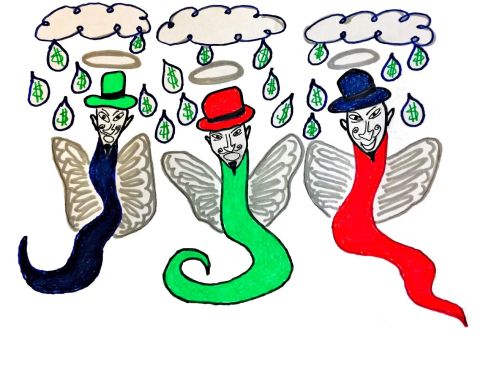
U will suck up to Putin and tweet vicious lies.
For some years of Hell they are all stuck with U.


In Yogi Berra’s Washington Post obituary, the subtitle “American philosopher” is well-chosen. While some of the quotes attributed (or misattributed) to Yogi Berra may just be funny malapropisms, some strike me as quirky ways to say something important, akin to Zen koans. One of his gems is widely applicable and especially relevant to a world on the brink of ecological and/or political collapse. It deserves a special name. It is also so widely quoted that 2 versions are common, as indicated below:
Yogi Berra’s Law
The game ain’t over til it’s over.
It ain’t over til it’s over.
Yes, the original context was baseball. With 2 outs in the bottom of the 9-th inning, the home team may be trailing. Yogi rightly admonishes both the home team (to resist despair) and the visitors (to resist complacency). A lot can still happen with 2 outs in the bottom of the 9-th inning. I prefer the shorter version of the law because it is more explicit about the law’s generality. “It” could be almost anyhthing.
My current context for heeding Yogi Berra’s Law is the imminent inauguration of Donald Trump as POTUS. At best, this event marks the start of 4 long and nasty years in the US. At worst, this event might combine with trends elsewhere (in China, Europe, and Russia) to start a new Dark Age. To consider the worst case is prudent, not alarmist.
Mindless repetition of platitudes like
is no substitute for the eternal vigilance that Jefferson said is the price of liberty. (There are other prices.) I resist the complacency of those platitudes; I also resist despair and continue (in my own small way) to be a citizen rather than just a complainer.
In a late inning in the biggest game of my lifetime, the Enlightenment is trailing. That sucks. But 2+3 is still 5 and Yogi Berra’s Law is still true.
I cannot draw my way out of a paper bag, but Poet Rummager can draw. She is also a fine creative writer (with an impish and sometimes dark sense of humor) and a fun collaborator.
Originally posted on Slasher Monster:


the British Royal Navy bombards the fort guarding Baltimore’s harbor with state-of-the-art artillery. The attack inspires a mediocre poem that is just barely singable (if U pretend that “yeh-et” is a word) to the tune of a British drinking song. The Brits eventually get a consolation prize for the failure of the seige of Baltimore, when their song becomes our national anthem (but with lyrics from the poem, not the pubs).

I find that the Pink Rebel (a Xmas cactus that blooms when it damn well pleases, and never at Xmas) has a nice blossom. I take that to be a good omen. Good omens have been in short supply recently, as the pseudoconservative coalition of bigots and plutocrats bombards a wobbly electoral process with state-of-the-art ratcrap, propelled by dark money and deep resentments. The pseudoconservatives hope for veto-proof majorities in Congress as a consolation prize, if they cannot install a protofascist buffoon as President.
My local polling place is crowded. The people who run it have finally found an efficient way to arrange all the stuff that must be crammed into a tiny room in the firehouse: a sign-in table, little booths for marking the ballots, and a machine to scan the ballots and keep them secure in case a recount is needed. I have finally remembered to remove my ballot from the privacy sleeve before feeding it to the scanner. (It is only in theory that the scanner can grab the ballot by an edge protruding from the sleeve.) The scanner accepts the naked ballot w/o fuss. Walking back to my car after an unexpectedly smooth and quick process, I tear up a little.
I have just now experienced an America that is calm and polite and competent. For how long?

I rise with the dawn’s early light and go online to see the results for races that were not foregone conclusions. Mostly vomit-worthy, with a few consolations in the Senate. The Dems will keep the NV seat that Reid is leaving. The new Dem for IL is a combat veteran who knows the difference between patriotism and posturing; a seat for NH also flipped. Maybe filibusters can keep the pseudoconservatives from passing the very worst things on their wishlist.
For at least the next 4 years, I expect that American politics will not be calm and polite and competent. I hope I am wrong in this prediction, and not wrong merely because of surrender by those who oppose the pseudoconservative agenda.
Remember Mitch McConnell’s declaration (soon after the 2008 election) that preventing a 2nd term for Obama would have his top priority? I was angered by that commitment to reflexive opposition (regardless of the cost to the nation) to whatever Obama might propose. So I will try to keep an open mind. It is conceivable that Trump will surprise everybody (even himself) by growing quickly and well into his awesome new responsibilities. But not at all likely.
What is likely? Zombie economics and accelerating climate change will lead to global suffering comparable to the Great Depression of the 1930-s. Less likely (but still far from being alarmist hype) is the possibility of descent into thinly veiled fascism.
Yes, our traditions of liberal democracy are stronger than those of the Weimar Republic in 1932 and 1933. The question is not whether our traditions are stronger than Weimar’s but whether they are still strong enough to withstand escalating bombardment from pseudoconservatives who have honed expertise at selective vote suppression. The land of the free has its share of people with authoritarian personalities and deep resentments, often legitimate but exaggerated or misdirected. As did Germany in the 1930-s.
The Royal Navy bombardment in 1814 was 202 years ago. After the imminent 4 years of intensified pseudoconservative bombardment, will our flag be still there?


Rightly disgusted with the choices offered by the major parties in the 2016 POTUS election, many voters abstained or voted third party. Being sympathetic to both Green and Libertarian concerns (and angry that those concerns got so little attention in the inane debates), I agree that there is something to be said for voting third party in the uncontested states that are safely blue or red. A minor party that crosses the 5% threshold in the popular vote will get ballot access and more attention in the next election.
What about the contested states?
Like it or not, Hillary Clinton and Donald Trump were the only candidates who could have become the next President. Like it or not, abstentions and 3rd party votes in contested states could have tipped them from Clinton to Trump. Like it or not, tipping contested states could have tipped the Electoral College from Clinton to Trump (or even thrown the decision into the House of Representatives, which would have chosen Trump).
So what? Should I not vote my conscience, regardless of where I live? No!
The point of voting is not self expression. The point is to participate in choosing the driver of a bus we all must ride in. The 2016 POTUS election was a choice between 2 bad drivers. One of them had a record that includes moving violations and at-fault collisions, but not DWI or total losses. The other was (and still is) an intoxicated newbie seething with road rage.
Image cropped from the Seattle Times
Among the many posts on many blogs that deal with this election, U can read more with independent and unusual angles in Keith’s blog as well as here.
If lumping fairness with (liberty; rationality; tolerance) sounds odd, please note that fairness to me is subtler than crude egalitarianism. Credit where credit is due. Ability rather than ancestry as qualification for high office. Opportunity for upward mobility. Respect for differing priorities. Willingness to forego getting all I want so that everybody has a shot at getting all they need, w/o trying to impose the same wants/needs categories on everybody.
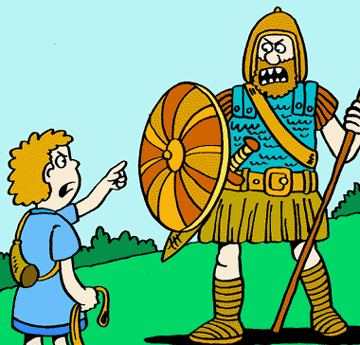
Downloaded from Clipart Kid, the image of David and Goliath trash talking illustrates a subtlety of fairness. It may look unfair that Goliath is the only one with armor and heavy weapons. Should David have them too? No, he would still be a scrawny youth, just encumbered by all that stuff. Let David have what suits David’s (not Goliath’s) skills and will not interfere with Plan B:
If my shots miss, run like Hell!
Deciding what is fair and then doing it can be a lot of work, as the endless stream of affirmative action lawsuits illustrates. Dunno how that story will end. I do know a true story about the difficulties of being fair in the real world that has a happy ending. I blogged about it in 2015, before I had a responsive theme. My post would have been unintelligible to anybody surfing on a phone or tablet (Harrumph!) rather than a real computer. Now that I have a responsive theme and a renewed urge to defend Enlightenment values (thanks to the current dismal state of US politics), I have revised that post in many small ways, partly to make it more explicit about fairness. The WordPress previewer assures me that it is indeed intelligible on all 3 platforms. Here is the link:
Typing just [Enter] key into the Search box makes it easy to browse WordPress blogs like this one. Here, the [Menu] button (atop the vertical black bar) reveals widgets like the Search box.The post reblogged here is a welcome reminder that there are still some thoughtful and pragmatic people in the US. Tho seriously flawed in many ways, the ACA is an improvement over what came before. The flaws can be fixed if the pols will stop posturing for a while.
Dear Mark T. Bertolini, Chairman and CEO, Aetna,
As a former actuary, benefits consultant, benefits manager, and a business and personal client of Aetna, I recognize fully the complexity of healthcare delivery and insurance in the US. I understand the meaning of claims loss ratios and the need for Aetna to earn a profit for its shareholders.
With this context, I ask that you please reconsider pulling Aetna out of the Healthcare exchanges in North Carolina and other states. I became an Aetna customer again when Aetna purchased the business of Coventry and integrated the two companies into the Aetna network. On the whole, our service has been good and we appreciate your negotiated discounts with Carolinas Medical Center and its doctor network. Many insureds do not realize the value of these discounts that must be paid by uninsureds.
The Affordable Care Act is still in its early childhood, but…
View original post 271 more words
As John Adams noted long ago, facts are stubborn things. So are misconceptions. Tossing dull little facts against a seductively simple misconception is like tossing pebbles against a window. To break the window, U must organize the pebbles into something like a chunk of concrete.
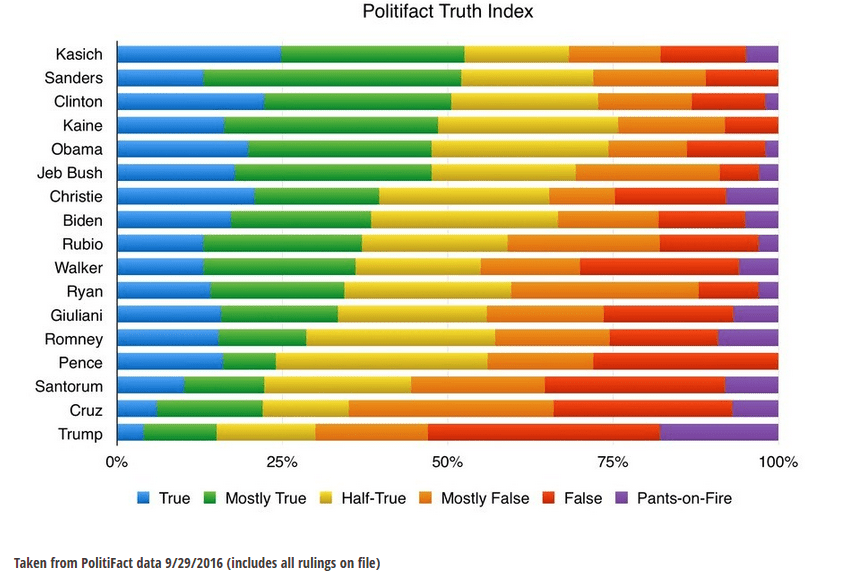
One way to organize facts is to create a clear and colorful visualization that sums up the take-away. One kind of visualization is a bar chart where all the big bars have the same length but are divided into little bars of various lengths. Perhaps a green little bar shows the percentage of my daily protein that comes from breakfast, while yellow and red little bars show the percentages that come from lunch and dinner. Another big bar shows those 3 percentages for somebody else. This kind of bar chart can be very helpful when there are more kinds of little bar than just breakfast/lunch/dinner, if the chart marker chooses colors well.
An excellent example of this kind of bar chart is in a Daily Kos post by Auriandra dated 2016-10-05. The whole post is a good read; the chart is shown below, in a cropped screenshot.

Contrary to what many cartoonists and progressive purists (not to mention right-wingers) proclaim, Hillary Clinton is relatively truthful, among the pols considered. (None of them deserve high marks by the standards of scientific research or testimony under oath.) By far the least truthful is Donald Trump.
If voters eventually notice and heed the veracity difference between Clinton/Kaine and Trump/Pence, the loss will leave Trump angry at the fact checkers. How can someone with his skillset (blustering; lying; swindling) get back at them? He could try for yet another Pants-on-Fire rating, with a lie about the fermentation capabilities of his microbiome.
Revenge for Fact Checking
Donald Trump could say
his farts and his shit smell like
warm cinnamon rolls.
Learning from history is tough, even for those who remember it. Parallels are never exact. The importance of each difference between then and now is a judgement call. Consider a darkly hilarious cartoon by Jen Sorensen:

Yes, the resemblance of the armed guard to a Nazi storm trooper is as subtle as a sledge hammer. Fine by me. Maybe it will overcome the American propensity for historical amnesia and wishful thinking.
Much to my dismay, Hillary Clinton is the only Trump opponent who might conceivably be elected. The progressive purists who disdain supporting Clinton are confident that something like what happened in Germany in 1932 and 1933 could not happen here and now, with a Trump victory. Yes, our traditions of liberal democracy are stronger than those of the Weimar Republic. The pertinent question is not whether our traditions are stronger but whether they are still strong enough, after years of relentless assault from the pseudoconservative coalition of bigots and plutocrats that controls staggering amounts of dark money and has already taken over the GOP. Dammit, the answer is not obvious.
This is not about whether the war in Afghanistan (or any war) was justified. This is about doing right by good people who put their lives on the line but are being abandoned by lazy pols.
As a thoughtful video (under 3 minutes) produced by No One Left Behind points out, this is one of those extremely rare situations where it would be fairly easy to act both honorably and in our own self-interest, if only Congress would listen to a few combat veterans in its own ranks.
The rest of this post is excerpted from e-mail about the visa crisis that I received 2016-09-19 from No One Left Behind. There are plenty of links to details in the excerpt.
Congress left Washington, DC at the end of last week having failed to hold a vote on the Afghan Special Immigrant Visa program. As a result of their unconscionable inaction, the State Department will run out of visas on 1 October 2016 (the start of the new fiscal year). The current backlog of visas is roughly 10,000 applicants (when one includes family, we estimate the true number of applicants is 35,000+). Thanks to Congress, our country will now break its promise to our Afghan translators and other wartime allies – who will continue to wait in limbo, in hiding, afraid that any moment might be the one where the Taliban or ISIS’s death squads finally find them. How many will die before Congress does their job (votes to renew the program and authorize and issue more visas to the State Department) and honors our nation’s promise?
To help highlight the national security implications of this issue and the importance of protecting the honor of the American military, veterans, and credibility, we organized a Letter to Congress, which we delivered on 6 September 2016. Hundreds of thousands of veterans, representing every branch of service in every American conflict dating back to World War II joined Medal of Honor recipients from Vietnam to the wars in Afghanistan and Iraq, former Chairmen and members of the Joint Chiefs, numerous wartime commanders, and other general and flag officers in adding their signatures to the letter.
˙ ˙ ˙ This past weekend, the [Wall Street] Journal joined the New York Times and the Washington Post in urging the Congress to renew and properly fund the program – the nation’s three leading newspapers are rarely this unified on matters of policy.
This is the 11th hour. The State Department will run out of visas in 11 days. Unless we build a movement and demand Congress renew the program immediately, it will likely die an unceremonious death, lost as an obscure program that got drowned out by the intense rhetoric of the 2016 election.
Help us prevent this tragedy by doing two things:
|
If U have not already done so, please contact your Senators and Representatives.
I dislike phones and try to be much less scathing when communicating to pols rather than about them, so I used the e-mail links on my legislators’ web pages to send the following message.
General topic: Immigration | National Security
Specific topic: Afghan Special Immigrant Visas
Message text:
The failure of Congress to renew the Afghan Special Immigrant Visa program endangers people who served as translators for US troops in Afghanistan. Enduring the same dangers and hardships as the troops, the translators sometimes fought alongside them. This is one of those extremely rare situations where it would be fairly easy to act both honorably and in our own self-interest, if only Congress would listen to a few combat veterans in its own ranks and do right by good people who put their lives on the line but are being abandoned.
Who’s Bhaskara? We will get to that question shortly. First, consider whatever gadget U are using to read this post. It depends on many things, discovered over many years by many people who (unlike many pols) preferred building up to tearing down. With many steps omitted (and “depends on” abbreviated to ←), a few of those dependencies go like this:
Your Gadget ← quantum physics ← coordinate systems ← Pythagoras’ Theorem
Back in high school, Pythagoras’ Theorem may have seemed like a little fact about right triangles that may have been mildly interesting but did not deserve the effort of slogging thru the book’s tedious proof. I could read the proof line by line, observe that it was valid, and be glad that I never needed to retrieve it for a test. Hardly anybody could remember it for more than a few minutes.
Pythagoras’ Theorem turned out to be essential to blogging (and much else), so it would be nice to have a proof that mere mortals could remember, appreciate, and be inspired by. Enter Bhaskara, 1114-1185.
Bhaskara replaced the usual picture (of 3 squares glued to the sides of 1 triangle) with a picture of 4 copies of the same triangle, arranged to form a big square with a little square inside it:
The proof is sometimes displayed more tersely, with just the figure. I prefer to write out a little algebra (while not belaboring why the angles do add up the way the figure suggests). Tho he did not have modern notation, Bhaskara did have an elegant way to provide more detail for the mathematically fastidious. He displayed another figure that also puts the 4 copies of the triangle inside a big square with sides a+b. In the other figure, the area not covered by copies of the triangle amounts to a²+ b² because it consists of 2 small squares. But the not-covered area amounts to c² in the figure displayed above, so we can conclude that
a²+ b² = c²
w/o bothering with algebra and how to compute areas of right triangles. We just need to bother with drawing both figures. Wanna try your hand at drawing the other figure? U can find the answer by following the link provided by Sieglinglungenlied in the comment section.
OK, I admit that having written a proof of mind-blowing elegance does not really qualify Bhaskara to be POTUS. Too bad that many people think mind-blowing arrogance can hack it.
Clicking on the “politics” category or tag in this post will display all my uses of acidic humor to cope with the current state of US politics. But acids are corrosive. Sometimes, I forgo acid and contemplate some of the enduring (so far) glories of modern Western civilization, one of which is that it is not exclusively Western. In particular, we got some elegant math from India and some elegant poetry forms from Japan.
One Way to Stay Sane in the Age of Trumpery
Cherish all that is
true and good and beautiful
(like Bhaskara’s proof).

© Wisconsinart | Dreamstime.com
As American politics in 2016 illustrates, Calliope’s portfolio is not as weird as I would wish. Neither is my title.
Stale Bread Can Wait
My muse is stingy (when implored)
or really bitchy (when ignored).
If I want to sing of croutons
(but her fancy turns to plutons),
I have just one way to go:
with the mighty magma flow.
As I discovered long ago when I tried to read an English translation of Goethe’s Faust, poetry in couplets tends to sound silly even when it is dead serious. Now that I have had my little respite from blank verse in haiku form, maybe I should go back to solemn austerity. Maybe.
What the World Needs
More silliness from
those who know they are silly;
less from the others.
While I did not take the photos shown here, I did write the haiku.

Many amazing photos have been submitted to the Weather Channel’s It’s Amazing Out There / 2016 Photo Contest. The contest has both expert judging and voting for the “fan favorite” by anybody with a Facebook account. U can vote daily until 2016-08-26 and distribute those votes however U like. Having viewed only a few of the submissions, am I competent to recommend votes to other people? Not really, but Donald Trump has set the competence bar low enough to be cleared by a garden slug. Being a little more competent (and a lot more honest) than Trump, I will share my enthusiasms anyway, with cropped/resized versions of 2 submissions.
While I have been voting enthusiastically for Coming Storm by CJDraper (aka Dancing Echoes on WordPress), I also want to salute the fan favorite as of the last time I looked: Ozzie (a bald eagle) by Davedc. The latter already has plenty of well-deserved votes, so I wrote a haiku inspired by it.
Mythornithology
When we saw himself,
Narcissus forgot to drink.
Eagle had more sense.
The choices listed in the following poll have varying plausibility; they do include the actual author. Please have a go before scrolling down to see the answer and why it matters.
Scroll down for the answer …
↓
↓
↓
↓
↓

↓
↓
The image of the US Constitution’s famous oversimplification “We the People” was downloaded and resized from http://mtviewmirror.com/wp-content/uploads/we-the-people-9.jpg.
↓
↓
↓
↓
↓
All of the quotes are from a speech on The New Nationalism delivered 1910-08-31 by Theodore Roosevelt. More than a century later, the work has still not been done. More than a century later, pseudoconservatives still dump truckloads of ratcrap on anybody who opposes running the USA for the benefit of the biggest corporations and richest billionaires.
What to do in 2016? Yes, I feel the pull toward a protest vote like writing in Bernie Sanders (or Theodore Roosevelt). In what is not so obviously a mere gesture of protest, I could vote Green or Libertarian. But I will not. Unless U live in a cobalt blue or screaming red state, voting Green or Libertarian in 2016 is voting for Trump. In the real world, all options suck. Some suck worse than others. Much worse.
Yes, one can hope that the combination of Trump in the White House with McConnell and Ryan dominating Congress will be so blatantly toxic that “the people” finally wake up, rise up, and wrest control from the plutocrats. Alas, the 99% of us who are getting shafted includes bigots and nitwits. It includes those who bought the Fox News claim to be fair and balanced. It includes heavily armed crazies like Omar Mateen and Dylan Roof.
Popular uprisings do succeed now and then, as when the government of East Germany collapsed in 1989. Hey, the good people on the wrong side of the Berlin Wall suffered only 44 years (*) of communist oppression before that. More often, uprisings are either crushed (as in Hungary 1956) or seem successful for a while but descend into chaotic violence that spawns yet another tyranny (French Revolution; Russian Revolution; Arab Spring; …).
So I will trudge to the polls, hold my nose, and vote for Hillary. I will also remember a more familiar quotation from TR, excerpted below with a few letters added in italics:
While Hillary is deeply flawed, she is not one of those “timid souls who know neither victory nor defeat” detested by TR. For that matter, neither is Trump. He has other issues. While TR was far from being a pacifist, he could see the downside of putting an impulsive jerk in a position to start a war. That jerk also thinks appeasing the NRA is more important than making it harder for crazies like Adam Lanza to murder school children and their teachers.
As in my earlier post arguing that oversimplification is unavoidable but can be done honestly, a whimsical example that is easily understood breaks trail for a serious example that is not.
Instructions for puzzles usually explain what the solution should look like, w/o constraining how to get there. The Jumble series of puzzles has been around for decades, originally just on printed pages but now online also. I sometimes solve the puzzle as printed in my daily newspaper. (Yes, I am that old.) Taken literally, the instructions for a Jumble do constrain the how, but in a way that strikes me as a harmless oversimplification in explaining the what. More precisely, it was harmless until the series went online.
The weird words in the title of this post are scrambled versions of the ordinary words wealth and nations. A typical Jumble puzzle invites the reader to unscramble several such scrambled words and then use the letters at some specified positions in the ordinary words to complete the caption of a cartoon. Printed and online versions of the puzzle for 2016-06-10 are displayed below. Both the layout and the use of “Now” in the printed instructions indicate that unscrambling comes before completing. Similarly for the online instructions revealed by the [HELP] button.
While I sometimes proceed in the instructions’ order, I more often guess the completion before unscrambling all (or even any) of the words. So what? I can put my pen anywhere on the page at any time. The sequencing in the instructions is just a convenient way to explain what would be a solution to a Jumble puzzle. One could rewrite and reformat the instructions so as to explain that w/o extraneous sequencing (as in the instructions for Sudoku), but it is not obvious how to write sequence-free instructions for Jumble that are as clear as the oversimplified instructions with extraneous sequencing. Why bother?
Here’s why. Look at the online version. That bright green square is a place for typing, if U so choose. The interface does a good job of allowing U to drag letters rather than type. After unscrambling all the scrambled words, U will see the available letters appear above the caption and can type or drag to complete the caption, just as U typed or dragged when unscrambling. While the interface displays several signs of good software engineering, it takes the informal specs too literally and mandates the heuristic of unscrambling all the words before doing anything to complete the caption. (Being a nerd myself, I can sympathize.) What began as a harmless oversimplification became a killjoy.
As it happens, I started by guessing the caption for the 2016-06-10 Jumble, then verified that my unscramblings of 3 words were consistent with my guess, and then used the resulting tentative knowledge about letters to be contributed by the word still scrambled as a hint about how to unscramble it. (A tiny example of how science works.) No can do in the online version. There is a [HINT] button that doles out a single letter in a single word. My preference for making my own hint is not just a consequence of my being compulsively self-reliant. My own hint is discovered and might be misleading because I might have guessed wrong at the start. The online hint is an infallible gift from on high. No fun in that.
If U want to work on the online version of this particular Jumble, U can click on its image to visit a page with today’s puzzle and then use the page’s calendar widget to go back to 2016-06-10.
Now it is time for the serious example, which starts in the same century as the scene depicted in this example, but on the other side of The Pond.
The other momentous document published in 1776 was Adam Smith’s The Wealth of Nations, with a then-harmless oversimplification that has become a now-pernicious dogma.
Smith’s readers were familiar with intrusive governments and quasigovernmental organizations like craft guilds. Mercantilist governments restricted who could sell what to whom. Guilds set the prices of what their members made. That was normal, as was censorship, state-sponsored religion, and commercial privileges granted by royal whim. Smith was aware that his readers might find his free-market ideas disturbingly anarchic, and he tried to reassure them with his famous fantasy about an invisible hand. He succeeded too well.
Smith remarked that, while he advocated much less intrusive government than his readers considered normal, there were still important government functions needed to make his free markets work. He mentioned some explicitly. Unsurprisingly, he did not mention those that would not be on anybody’s radar for over a century. Markets cannot work properly w/o transparency: potential buyers need to know what they would be getting and how much they would be paying. Apart from providing a trustworthy money supply, there was no obvious need for laws and regulations to make markets transparent. They seemed obviously transparent; nobody wearing a 3-cornered hat noticed that transparency was being assumed and might someday need to be enforced.
With the passage of time, Smith’s ideas took hold, the economies of his nation and ours grew richer and more complex, and economists eventually realized that markets cannot be perfectly transparent. What happens when they are seriously opaque? When getting pertinent info is costly? When some of the info floating around is false? When insiders have pertinent info that they act upon but keep to themselves? Long technical answers won Nobel Prizes for Kenneth Arrow and Joseph Stiglitz. The financial crisis of 2008-2009 and its precursors illustrate a somewhat oversimplified short answer that suffices for present purposes:
The shit hits the fan.
By the time the importance of transparency and the need for laws and regulations that enforce it had become common knowledge among thoughtful advocates of free markets, the invisible-hand fantasy had morphed into market fundamentalism. That dogma is a godsend for anybody who wants to act like a psychopath but suffers from the inconvenience of having a conscience. It is OK if I scramble to enrich myself and U scramble to enrich yourself, no matter how much we harm each other or anybody else. If the stupid gummint stays away and just lets “The Market” work its magic, everything will come out as well as possible in the real world, where resources are scarce and buying anything precludes buying something else with the same money.
Like religious fundamentalism, market fundamentalism is rigid, simplistic, and oblivious to the suffering it causes. The real world is indeed harsh. It is also vastly more complex than fundamentalists concede, perhaps more complex than they can imagine. Enforcing fairness and transparency w/o stifling useful innovation is not easy. More generally, finding a good balance between public and private economic activity is not so easy as it seems to market fundamentalists (or to socialists, at the other extreme).
Much longer (but still readable) discussions of opacity and other market failures can be found in books like The Roaring Nineties by Joseph Stiglitz. Perverse incentives lead to perverse behavior. Is that really surprising?
Is grass green? Not if it’s Japanese blood grass in autumn. Does a bear shit in the woods? Not if it’s a polar bear. Is the sky blue? Not at 1:00 AM. Something important is hiding in plain sight here. Everybody and their uncle have always known counterexamples to the claim that the sky is blue, and some of them have been celebrated with striking photos. On the other hand, when cartoonist Garry Trudeau wanted to poke fun at reflexive Republican opposition to anything proposed by President Obama, he used this same claim in the Doonesbury strip that appeared 2015-05-24 in my local paper. Clinging to his tattered hope for bipartisanship, Obama responds to an aide’s disillusionment by announcing something he thinks will be utterly uncontroversial: that the sky is blue. The last panel shows a subsequent press conference held by the Senate’s Republican majority leader.
Reporter:
Leader McConnell, is the sky blue?
McConnell:
I am not a meteorologist.
Whether or not U agree with Trudeau’s take on the attitudes of those who pass for Republicans nowadays (and whether or not U found the strip funny), I trust that U did recognize the question about the sky’s color as a more polite version of the question about ursine defecation. Even tho U know about sunsets. Even tho U know that everybody else knows about them too. What is going on here?


Well, not everything. The black and white cattle living on the farm near my house are not oversimplified. They just are what they are. Much of what I might say about them is oversimplified. Indeed, it is hard to find anything nontrivial to say about them that is just plain true (like 2+3 = 5), w/o any qualifications or exceptions. From a distance, they are black and white cattle, lounging on green grass under a partly blue sky. Look more closely, and a few of them have brown instead of black. Does it matter? Not to me. Maybe it would matter to somebody who breeds Belted Galloway cattle. I just admire the bu-cow-lic scene and stay upwind. Does a cow shit in the pasture?
Overeating is something people often do. They should always try not to, and many of us can succeed most of the time. Oversimplifying is more complicated. Sometimes it is harmless (or even helpful, for certain purposes or as a temporary expedient); sometimes it is hardly better than lying. Trying not to oversimplify is generally good, but the cure can be worse than the disease. It may be better to oversimplify, be honest about it, and remain open to working on a more accurate formulation as the the need arises. A more accurate formulation may well be good enough for a long time, but not forever. Scientific theories and engineering calculations are like that. Guess what? So are ethical principles.
What we call “the” Golden Rule has been formulated in various ways by various cultures. A nice discussion appears on pages 83-86 in the book Plato and a Platypus Walk into a Bar by Cathcart and Klein. (The book is a great read, even if U aced Philosophy 101 and have already heard many of the jokes.) They use an old joke to illustrate how seriously oversimplified the rule is:
A sadist is a masochist who follows the Golden Rule.
It gets worse. Even when how people like to be treated is pretty much the same thruout a group, the Golden Rule stumbles. I was both amused and disturbed when cartoonist Scott Adams showed how badly it stumbles in a Dilbert strip I should have saved. The boss proclaims that company policy will henceforth be to follow the Golden Rule. Dilbert objects; the boss asks why. The resulting exchange goes something like this:
Dilbert:
Would U like me to give U $100?
Boss:
Um, yes.
Dilbert:
OK, follow the Golden Rule and give me $100.
The boss is reduced to sputtering indignation. Dilbert is clearly taking the rule too literally and ignoring an implicit consensus about exceptions. But what are they? I could not say where Dilbert errs.
Most of the formulations discussed by Cathcart and Klein are somewhat clunkier than our culture’s usual
Do unto others as U would have others do unto U.
They amount to saying
Do not do unto others as U would not have others do unto U.
Maybe people thought of the Dilbert objection and tried to get avoid it by prohibiting X rather than mandating Y. This does help, but there is still a problem.
Dilbert:
Would U be disappointed if I refused your request to give U $100?
Boss:
Um, yes.
Dilbert:
Please give me $100.
Boss:
No.
Dilbert:
I see. U are just as hypocritical about the Confucian version of the Golden Rule as U are about our usual version.
If U fall off a boat and I hear U shout a request to be thrown a life preserver, I will try to do just that. Just don’t walk up to me and request to be given $100. What is the difference? People can start with our usual formulation of the Golden Rule, admit that it is grossly oversimplified, consider what seems reasonable in thought experiments like this, try for a more explicit consensus about exceptions, and remain open to considering more adjustments as more situations arise, either in practice or in thought experiments. Can we do better?
Immanuel Kant tried valiantly to do better with his Supreme Categorical Imperative, which is a fun read if U like reading tax laws or patents. Cathcart and Klein have the details.
As a former wannabe mathematician, I would very much like to see a nice crisp formulation of the Golden Rule (or of any other important general principle) that just nails it, w/o exceptions or vagueness. Nice work if U can get it. If I ever get stuck with trying to help socialize a child, I will give the kid our usual version of the Golden Rule, say that it is a great starting point for thinking about how to behave, admit that real life is messier, and offer to talk about it more as the need arises. I will not mention Kant.