ethics, humor, oversimplify, philosophy, politics

Green Grass and Golden Rules

Like overeating, oversimplifying is something we should always try to avoid.  Oops, that’s an oversimplification.  Sometimes it is harmless (or even helpful, for certain purposes or as a temporary expedient) to oversimplify; sometimes it is hardly better than lying.

Is grass green?  Not if it’s Japanese blood grass in autumn.  Does a bear shit in the woods? Not if it’s a polar bear.  Is the sky blue?  Not at 1:00 AM.  Something important is hiding in plain sight here.  Everybody and their uncle have always known counterexamples to the claim that the sky is blue, and some of them have been celebrated with striking photos.  On the other hand, when cartoonist Garry Trudeau wanted to poke fun at reflexive Republican opposition to anything proposed by President Obama, he used this same claim in the Doonesbury strip that appeared 2015-05-24 in my local paper.  Clinging to his tattered hope for bipartisanship, Obama responds to an aide’s disillusionment by announcing something he thinks will be utterly uncontroversial: that the sky is blue.  The last panel shows a subsequent press conference held by the Senate’s Republican majority leader.

Reporter:
Leader McConnell, is the sky blue?
McConnell:
I am not a meteorologist.

Whether or not U agree with Trudeau’s take on the attitudes of those who pass for Republicans nowadays (and whether or not U found the strip funny), I trust that U did recognize the question about the sky’s color as a more polite version of the question about ursine defecation.  Even tho U know about sunsets.  Even tho U know that everybody else knows about them too. What is going on here?

1. Everything Is Oversimplified

belted-galwaybelted-galway-brown
Well, not everything.  The black and white cattle living on the farm near my house are not oversimplified.  They just are what they are.  Much of what I might say about them is oversimplified.  Indeed, it is hard to find anything nontrivial to say about them that is just plain true (like 2+3 = 5), w/o any qualifications or exceptions.  From a distance, they are black and white cattle, lounging on green grass under a partly blue sky.  Look more closely, and a few of them have brown instead of black.  Does it matter? Not to me.  Maybe it would matter to somebody who breeds Belted Galloway cattle.  I just admire the bu-cow-lic scene and stay upwind.  Does a cow shit in the pasture?

Overeating is something people often do.  They should always try not to, and many of us can succeed most of the time.  Oversimplifying is more complicated.  Sometimes it is harmless (or even helpful, for certain purposes or as a temporary expedient); sometimes it is hardly better than lying.  Trying not to oversimplify is generally good, but the cure can be worse than the disease.  It may be better to oversimplify, be honest about it, and remain open to working on a more accurate formulation as the the need arises.  A more accurate formulation may well be good enough for a long time, but not forever.  Scientific theories and engineering calculations are like that.  Guess what?  So are ethical principles.

2. Why Is “Golden Rules” Plural in the Title?

What we call “the” Golden Rule has been formulated in various ways by various cultures.  A nice discussion appears on pages 83-86 in the book Plato and a Platypus Walk into a Bar by Cathcart and Klein.  (The book is a great read, even if U aced Philosophy 101 and have already heard many of the jokes.)  They use an old joke to illustrate how seriously oversimplified the rule is:

A sadist is a masochist who follows the Golden Rule.

It gets worse.  Even when how people like to be treated is pretty much the same thruout a group, the Golden Rule stumbles.  I was both amused and disturbed when cartoonist Scott Adams showed how badly it stumbles in a Dilbert strip I should have saved.  The boss proclaims that company policy will henceforth be to follow the Golden Rule.  Dilbert objects; the boss asks why.  The resulting exchange goes something like this:

Dilbert:
Would U like me to give U $100?
Boss:
Um, yes.
Dilbert:
OK, follow the Golden Rule and give me $100.

The boss is reduced to sputtering indignation.  Dilbert is clearly taking the rule too literally and ignoring an implicit consensus about exceptions.  But what are they?  I could not say where Dilbert errs.

Most of the formulations discussed by Cathcart and Klein are somewhat clunkier than our culture’s usual

Do unto others as U would have others do unto U.

They amount to saying

Do not do unto others as U would not have others do unto U.

Maybe people thought of the Dilbert objection and tried to get avoid it by prohibiting X rather than mandating Y.  This does help, but there is still a problem.

Dilbert:
Would U be disappointed if I refused your request to give U $100?
Boss:
Um, yes.
Dilbert:
Please give me $100.
Boss:
No.
Dilbert:
 I see.  U are just as hypocritical about the Confucian version of the Golden Rule as U are about our usual version.

If U fall off a boat and I hear U shout a request to be thrown a life preserver, I will try to do just that.  Just don’t walk up to me and request to be given $100.  What is the difference?  People can start with our usual formulation of the Golden Rule, admit that it is grossly oversimplified, consider what seems reasonable in thought experiments like this, try for a more explicit consensus about exceptions, and remain open to considering more adjustments as more situations arise, either in practice or in thought experiments.  Can we do better?

Immanuel Kant tried valiantly to do better with his Supreme Categorical Imperative, which is a fun read if U like reading tax laws or patents.  Cathcart and Klein have the details.

As a former wannabe mathematician, I would very much like to see a nice crisp formulation of the Golden Rule (or of any other important general principle) that just nails it, w/o exceptions or vagueness.  Nice work if U can get it.  If I ever get stuck with trying to help socialize a child, I will give the kid our usual version of the Golden Rule, say that it is a great starting point for thinking about how to behave, admit that real life is messier, and offer to talk about it more as the need arises.  I will not mention Kant.

haiku, history, humor, politics

Rhyming Haiku: Couplet and Triplet

I enjoy smuggling rhymes into blank verse but have not yet gotten all 3 lines of a haiku I really like to rhyme.  My response to Carpe Diem #932 silk tree is a pair of all-new haiku.  I do like the one with a couplet.  The one with a triplet (plus an internal rhyme in the title at no extra charge) is submitted in the spirit of Abraham Lincoln’s corny jokes during the American Civil War: I laugh so that I will not cry.

Sound of Sunlight
|Rushing waters bring
|joy to those who hear them sing
|and see them sparkle.

Silly Rhymes for Scary Times
|A rhyme in blank verse?
|President Trump would be worse.
|Vote Dem or you’ll curse.

US_flag_inverted

Image Source

A public domain image of the American flag has been turned upside down to reflect the current state of US politics.

(BTW, the [Menu] button atop the vertical black bar reveals the widgets.)
haiku, history, humor, politics

Long After the Sixties

When will things slide …

from liberty to anarchy?

from growing to shrinking?

from bravery to bravado?

from firmness to fascism?

from hope to rage?

The answer, my friend, has blown in on the wind.

The answer has blown in on the wind.

Fiscal Responsibility
|Debts rise; incomes fall.
|Hard times demand bold action:
|tax cuts for the rich!
 

haiku, humor, politics

Fridge Follies

CrowdedKitchen_464x348

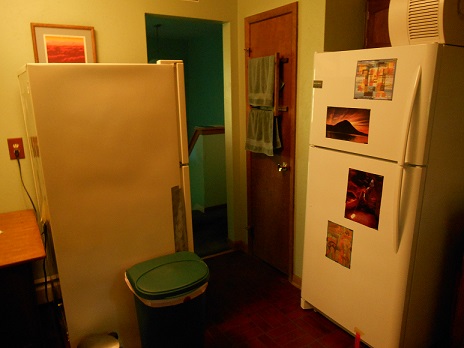
Why does the small kitchen in my very small household have 2 refrigerators?  The story begins in 2002, when the fridge now blocking the view of a framed print was delivered.  The 1985 fridge it replaced had the condenser tubing on the back, readily accessible for an annual cleaning.  I was surprised to find that the tubing was hidden on the bottom of the then-new fridge.  I was also surprised to find that the then-new user’s guide said

There is no need for routine condenser cleaning in normal home operating environments.

A few months later, I was not at all surprised to find that the guide’s assurance was bullshit.

Section 1: Noble Intentions

I have a good collection of brushes and crevice tools for my vacuum cleaner, but most of the condenser tubing was still uncleanable.  Some people dare to empty a fridge, tip it over, unscrew any bottom cover, and vacuum the hidden tubing.  I estimated the likelihood that such a saga would accomplish much for my extremely convoluted tubing to be less than the likelihood that I would crush a toe while fumbling with the heavy fridge.  So I left the fridge upright and improvised filtration of much of the air being sucked past the tubing by a fan.  I changed the filter monthly and was pleased that it intercepted much of the incoming dust.  But not all of it.

When new, the 2002 fridge was fairly efficient.  The rated energy consumption (514 kWh/yr) was decent (and much better than the 874 kWh/yr of the significantly smaller 1985 fridge it replaced).  While the gradual buildup of dust on the condenser tubing implied a gradual decrease in efficiency, the fridge was still working.  Old Yankees do not replace old stuff that does work well enough with new stuff that might (or might not!) work better.

Several things changed in 2015.  I happened to put my hand on the top of the fridge, near the freezer door.  It was uncomfortably warm, almost hot.  The heater that prevents the door from freezing shut had become overenthusiastic.  More energy wasted.  Some newer fridges have LED lights to avoid unwanted heat.  The electric company has a nice rebate offer: they will pick up a working old fridge for recycling and give me a little $ for it.  I could get an up-to-date fridge with pristine condenser tubing, verify that it works, move into it at leisure, and only then have the 2002 fridge hauled away.  I plan to stay in my house long enough that the 2002 fridge could not go the distance, but not long enough to need yet another fridge purchase after buying one in 2015.  May as well do it with dignity now, when nothing much has hit the fan recently.

So I saddled myself with 2 problems: choosing a new 2015 fridge and temporarily squeezing it into my small kitchen along with the old 2002 fridge.

Section 2: The Agony of Choice

Comparing 2015 with 2002, I found that choosing a fridge is both easier and harder.  Lots of pertinent info (and some misinfo) is online, and my current internet connection is fast enough to access it.  On the other hand, there has been a luxuriant profusion of brands, configurations, and features.  Had to wade thru all of that to find a top-freezer fridge of moderate size with half-width cantilever shelves, LED lighting, and no ice maker.  Why no ice maker?  My kitchen’s plumbing only supplies water to the sink and the dishwasher, and remodeling is not on the horizon.  I need the space an ice maker would occupy for ice trays.  That is no hardship for me, as I am old enough to remember rigid metal trays that stuck to my fingers when the water had frozen and had Rube Goldberg arrangements of louvers and levers for forming and releasing the ice cubes.  The arrangements pinched my fingers and sent much of the ice flying across the room as little shards.  So I am quite content to use modern 1-piece plastic trays that almost always release the cubes intact when gently twisted.

Yes, the big stores have websites with options for filtering searches.  The behavior of those options reminded me of the disclaimer that sometimes appears when movie credits roll:

«Any resemblance between the filtering specified by the user
and the filtering actually performed is purely coincidental.»

One day when my errands took me nearby anyway, I decided to look at fridges in an actual brick-and-mortar store.  I found a phalanx of stainless steel behemoths with bottom freezers, French doors, thru-the-door controlled substance dispensers, and so on.  What sustains the French door craze?  Yes, some people need them because they have really weird kitchens with door-swing limitations.  (Maybe there are also some people who can remember which side of the fridge has the mayonnaise jar and want to hi-5 themselves after opening only the appropriate door?)  Anyway, there were a few token fridges with my basic configuration.  They also had full-width shelves, each with too few height choices. Feh.

Back to the web.  I eventually got past the behemoths and the cheapies.  I eventually got past the ambiguities and contradictions in the specs posted on store websites.  I settled on a fridge configured much like my old one but more efficient (rated at 471 kWh/yr).  Neglecting to visit the manufacturer’s own website and confirm all the specs there (cue the horror movie music), I placed an order and scheduled delivery.

Section 3: We All Live in a Yellow Submarine

KitchenCorner_387x516

My camera’s white balance is flaky; the kitchen is not really that yellow.  Being in it, however, is much like being in a submarine.  Everything is shoved up against something, with barely enough room to move around.  This is only temporary.

Does the title of this section sound familiar?  In the 1960-s, I thought the popularity of The Beatles was only temporary.

Eager to have my own place after some dismal rental experiences, I knowingly bought a badly designed and badly built house in 1972.  It was only temporary, a way to get off the rental treadmill for a few years while looking around for something better.  I am still in that house.

My track record in predicting how long situations will last is not good, but hope springs eternal.  (I did have enough foresight to ensure that I could still cook in my submarine kitchen.)  This is only temporary.  Can repeating a dubious mantra often enough make it true?  Should we ask the pols who postulate that tax cuts stimulate enough economic growth to pay for themselves?

Delivery day!  I showed the crew the odyssey required to get from the front door to a kitchen doorway that is wide enough, in my badly designed house.  The new fridge agreed with my tape measure and settled into place w/o incident.  I tipped the crew, admired the new fridge briefly, and settled down to a snack in the adjoining room.

BANG! CLANK! CRACKLE! BANG!

The sound character was like that of ice cracking when a fridge does its defrost routine after a heavy buildup.  The sound volume implied that a hostile navy had located the yellow submarine and had good aim with depth charges.  I ran into the kitchen in time to verify that the noise was coming from the new fridge.  Then it stopped.  The fridge was running quietly.  Apart from a little muffled rattling now and then, it has been quiet ever since.

I know what happens when an appliance (or a car or a body part) misbehaves erratically and the worried owner consults a pro.  I sympathize with the reluctance of pros to diagnose an unrepeatable symptom on the basis of a layman’s verbal description.

It’s working fine now.  Call us if it acts up again.  Goodbye.

So I resolved to extend the temporary squeezing of 2 fridges into 1 kitchen for a few more days, keep using the old fridge, and listen for nasty noises from the new one.

Section 4: The Ice Maker Cometh

Reasonably confident that the new fridge was OK, I turned it off and gave it time to warm up before playing with the shelves to approximate the arrangement in the old fridge.

I opened the freezer door and found — (cue the horror movie music, louder this time) — an ice maker!  This hulking monster could supply enough ice to host a cocktail party for an army, but only if it had a water supply.  Dry as the Namib Desert on a fogless day, the monster sullenly hogged much of the precious freezer space.  The new fridge devotes a smaller fraction of its space to the freezer than the old fridge does, and I had recently bought ridiculously many pints of frozen yogurt because the market was discontinuing a flavor I liked and discounting the remaining inventory.  I had to evict the monster despite the risk of quibbles about “tampering” if I ever needed warranty service.

The screws attaching the ice maker to the freezer wall were readily accessible.  Then there was the electical connection.  Like the connections in cars, it was a plug-socket arrangement, latched shut and secured in place by springy prongs that could be released by pressing gently with a small flat-bladed screwdriver in exactly the right place.  After some looking and cautious probing that did no damage, I found the place and disconnected the monster.  That left 4 metal contacts open in the socket, hoping to get connected again but willing to accept condensation and a chance to short out in revenge for being abandoned.  So I covered the socket with duct tape and protected the tape with some bubble wrap and more duct tape.

Freezer_390x293

The freezer of the old fridge still holds a few things that I have not been able to fit into the new one’s freezer.  Otherwise, I did eventually move everything from old to new and no longer guess wrong about which fridge holds what.  I should be able to adjust my freezer usage to the current reality and am otherwise pleased with the new fridge.  Maybe the electric company’s rebate offer for the old fridge will still be in effect when I am finally ready to use it.

Section 5:  Directions for Further Research 😉

LabGadgets_688x349

During installation of improvised external air filtration for the 2015 refrigerator, examination of the hidden condenser tubing revealed a configuration differing from that of the 2002 refrigerator.   It is hypothesized that the 2015 configuration will be more amenable to cleaning than the 2002 configuration, albeit still less amenable than was the 1985 configuration.   This hypothesis will be tested when sufficient dust has accumulated.

A concluding haiku about refrigerators is not available at present.   In the interest of timely publication, this  post concludes with haiku pertinent to auxiliary considerations discussed in Sections 3 and 4, respectively.

Fiscal Responsibility

Debts rise; incomes fall.
Hard times demand bold action:
tax cuts for the rich!

Silver Savior

The crowning glory
of our civilization
is, of course, duct tape.

haiku, humor, politics

Oxymoronic Selfie

The [Menu] button (atop the vertical black bar) reveals widgets like the Search box.  Typing just the [Enter] key into the Search box is a way to browse WordPress blogs.

Yes, the title of this blog is an oxymoron.  (More on oxymorons shortly.)  This blog will touch on many things in life and language, but only when I think I have something to add to whatever has already been said.  I will try to be humorous w/o being too flippant and serious w/o being too solemn.  Some posts will end with haiku poems, as this one does.

Oxymorons can be a quick and colorful way to designate something with an unusual (but not really contradictory) mix of characteristics.  In American politics in the 1850-s, Stephen A Douglas was called the “Little Giant” because he was both short and influential.  Some other examples:  equal and opposite; fried ice cream; libertarian paternalism; love-hate relationship; passive-aggressive; tough love; virtual reality.

Tho I cannot be mellow and curmudgeonly simultaneously, I can shift quickly from one to the other when considering different aspects of something.  Before giving an example, let me issue two disclaimers:  I am not in the shall/will crowd and do not fit neatly into any common political category.  I do not hassle people who violate silly rules invented long ago by prigs with too much free time.  When I gripe about a misuse of language, it is because I see a substantial hindrance to communication.  When I take an example from politics, it is not part of a rant that has already been repeated thousands of times.

Living languages do change, often getting better and sometimes getting worse.  One change for the worse that may be happening now is the use of “legitimate” as a synonym for “genuine” or “actual” (in addition to its legitimate uses).  This usage is not in my printed dictionary from 2005 or in the online Wictionary entry last updated in 2014, but I have heard it ominously often.  In 2012, Senate candidate Todd Akin was vilified as a cruel misogynist for using the oxymoronic phrase “legitimate rape” (which illustrates why misusing “legitimate” is such a bad idea).  My initial reaction to the oxymoron by itself was mellow:  Akin is just a linguistic slob who said “legitimate” when he meant “genuine” during his pseudoscientific riff on whether a rape that causes a pregnancy could really be a rape.

On the other hand, I am old enough to remember when willful ignorance or distortion of relevant facts was frowned upon.  It did happen (perhaps more often than a curmudgeon’s memory of the good old days will admit).  Among legislators, it tended to come only from certain people on certain subjects.  Akin’s reliance on a physiological fantasy to avoid dealing with the implications of a policy position struck me as emblematic of a serious general decline in intellectual honesty.  Nowadays, pols and pundits launch outrageous factoids faster than fact checkers can sink them.  Harrumph!  So I contributed what little I could to the campaign of Akin’s opponent.  Tho I still do not believe Akin really meant what his oxymoron said, I am glad he is not in the US Senate.  Truth matters.

Still Standing
|Mellow curmudgeon
|shrugs off fate and stands proudly
|paradoxical.