haiku, math, photography, tanka

Willing to Muddle Thru

This post muddles thru the abstract/concrete conflict with a mostly abstract tanka inspired by the mostly concrete poetry in 2 posts by others.  At least in visual art, the distinction between abstract and concrete is somewhat muddled anyway (and not just because of photography).
(BTW, the [Menu] button atop the vertical black bar reveals the widgets.)

curtain-complex

Like the conflict between living in the moment and planning for the future, abstract/concrete (or general/specific) is a conflict that can only be managed, not avoided or resolved.  Trying to be 100% one or the other does not work.  We must muddle thru, preferably with awareness that what works for one person at one time will not work for all people at all times.  This post muddles thru the abstract/concrete conflict with a mostly abstract tanka inspired by excerpts from the mostly concrete poetry in 2 posts by others.

Consider the first of 4 stanzas posted in {underground (20170523)}:

© Crow
i have learned the hard way
that just because something
has been buried does not mean
it’s dead

It could stand alone as a fine short poem.  It also inspired the fourth of 7 short stanzas posted (along with an interesting biographical sketch of the 17-th century painter Caravaggio) in {Caravaggio Dreams}:

© Poet Rummager
Do you not see what I’ve buried deep,
has dug itself out to find me?

Maybe it’s because of my math background that I felt these excerpts were more powerful standing alone than in their original contexts, with concrete details about zombie cannibals and Norse gods (Crow) and a dream encounter with Caravaggio (Poet Rummager).  While I do prefer cremation to internment and do appreciate Caravaggio’s pioneering of expressive chiaroscuro, I found all those details distracting.  I was moved by the quoted stanzas despite what went with them.

One of the virtues of haiku poetry is that there is scant room for anything irrelevant, so I tried putting my takeaway into a haiku.  But I found that format a little too restrictive.  What happened after whatever was buried deep had dug itself out?  My haiku left open the possibility that it might have just toddled happily away, w/o the ominous implications of the first line from Crow’s stanza and the last 3 words from Poet Rummager’s stanza.  Wanting my poetry to be forthrightly ominous rather than ambiguous, I extended the abstract haiku to a tanka with (as it happens) concrete imagery in the 2 added lines.

Empty Grave
I buried something
that was not already dead.
It dug itself out.
~ ~ ~ ~
It shook like a wet dog and
followed my scent to find me.

it-dug-itself-out

© Doddis | Dreamstime.com

Tho a uniform level of abstraction might be nice, I can live with the muddle.  At least in visual art, the distinction between abstract and concrete is somewhat muddled anyway (and not just because of photography).

curtain-simple

flowers, humor, photography

Nonconformist

The [Menu] button (atop the vertical black bar) reveals widgets like the Search box.  Typing just the [Enter] key into the Search box is a way to browse WordPress blogs.

nonconformist-sun_820x663

Update [2018-11-06]

My photo is 100% serendipitous.  Click here to see Cee Neuner’s beautifully colored and composed photo of (assisted?) nonconformity among mums.

(reblog), haiku, photography, tanka

Seize the Sunrise

My tanka responding to a challenge posted by Patrick Jennings is a riff on the splendid photo he provided, with hills that seem to go on forever in both time and space.

Originally posted by Patrick Jennings in
[Evanescent ~ Pic and a Word Challenge #89]:

himalayan-foothills-sunrise-kunjapuri-devi-temple-rishikesh-uttarakhand-india-copy

View original

Seize the Sunrise
Evanescent dawn.
Do hills endure forever?
No, but long enough.
~ ~ ~ ~
Art subverts time with pixels;
the moment also endures.

haiku, photography, tanka

Forward, toward Light

Should we honor ancient masters by following in their footsteps?  No.   We should honor them by pressing forward and building on their work.
(BTW, the [Menu] button atop the vertical black bar reveals the widgets.)

© Adjei Agyei-Baah

ancient road…

the trails of the masters

absorbed in fallen leaves

© Mellow Curmudgeon

Footprints fade but insights shine,

lighting the path forward now.

sunlit-path

In some ways, a century ago is already ancient.  Photography’s pioneers worked with nasty chemicals in darkened rooms to produce grayscale prints.  Modern photographers can (and should!) honor them by pressing forward and building on their work in our digital world of colored pixels, using grayscale (or partial desaturation) only as appropriate for specific images.

haiku, photography, tanka

Spunky Flowers

In response to a CDHK challenge, this post completes a tan renga in praise of dandelions.  Yes, dandelions.  They are spunky flowers, not weeds.
(BTW, the [Menu] button atop the vertical black bar reveals the widgets.)

As my earlier post in praise of dandelions noted, the same spunk that frustrates prissy gardeners also thrusts green and gold into the grayest and grimmest of our cityscapes.  I like that tradeoff, so I am glad I can respond to

© Ogiwara Seisensui
dandelion dandelion
on the sandy beach
spring opens its eyes
© Mellow Curmudgeon
Glowing suns rise golden from
sand and lawns and sidewalk cracks.

DandelionViolets

education, humor, language, photography

Writing Well – Part 8

Typing just [Enter] key into the Search box makes it easy to browse WordPress blogs like this one.  Here, the [Menu] button (atop the vertical black bar) reveals widgets like the Search box.

Blood & Gold End This Series

Here are links to all posts in this project of reviewing and supplementing the splendid book

The Lexicographer’s Dilemma by Jack Lynch.

  1. Introduction
    What does the rise of “proper” English have in common with a physics conundrum about gravity?
  2. Babies, Names, and Snobs
    We name words by wrapping them in square brackets to avoid overloading more common conventions.
  3. Descriptivism, Prescriptivism, and ????
    We add a new ISM to the familiar duo of attitudes toward English language usage: readabilism.
  4. Why is English Spelling Such a Mess?
    An insight into the difficulty of spelling reform has wide-ranging significance, far beyond spelling.
  5. Ambiguity Sucks!
    Ambiguity is almost always at least a little harmful to clear communication. It can be disastrous.
  6. What is the Point of Punctuation?
    Careful punctuation helps avoid unwanted ambiguity.
  7. Yogi Berra’s Paradox
    Sometimes bad English is good English that’s good because it’s bad.
  8. Blood & Gold End This Series
    Apart from a concern about the examples on 2 late pages in the book, I could applaud those pages until my hands bleed.

There are 8 lines that start with “A time to” in the famous Bible passage Ecclesiastes 3:1-8.  I want to add another such line, anywhere in the series.

To every thing there is a season, and a time to every purpose under the heaven:

A time to comply and a time to resist; a time to obey rules, and a time to defy rules;

One of the strengths of Lynch’s book is the way page 274 (hardcover) notes that

even the schoolmarmish rules can be valuable in the right context

and later that the point of studying English in school is not

correct English but appropriate English—English suited to the occasion

(where I have replaced italics by boldface, which is better for emphasis in sans-serif fonts).

One of the book’s few weaknesses is in the examples of being suited to the occasion that Lynch uses.  While they are appropriate, the lack of any other examples may be misleading.

I believe there are some occasions where some of the rules are genuinely helpful for clear communication with a sincere and attentive audience.  I use [sincere] to describe people who want to know what somebody has to say.  (They are not just looking for excuses to pounce.)  I use [attentive] to indicate that they are not so hung up on assorted inane rules that violations are ipso facto distracting.  (If U know any better words, please suggest them.)  After reading the entire book, I am confident that Lynch and I are in general agreement, with some wiggle room for agreeing to disagree about which rules suit which occasions with sincere and attentive audiences.  The examples of suitability that Lynch uses could give a different impression.

The example of a job interview (between the passages quoted above) and a hasty reading of pages 274 and 275 (hardcover) could mislead students.  Young people tend to be rebellious and skeptical of authority.  Rightly so.  They also tend to be utopian and simplistic about what rebellion might accomplish and whether other people are good guys or bad guys.  Students do “need to become proficient in the standard form of the language” for grubby reasons like job interviews and access to “the corridors of power” and the sad fact that being sincere does not imply being attentive.  (Sometimes men need to wear neckties and women need to wear high heels, tho both would rather not.)  Apart from wishing that Lynch had been more explicit about not-so-grubby reasons for proficiency with some of the rules, I could applaud pages 274 and 275 until my hands bleed.

With curly braces around a place where I paraphrase a longer stretch of text, this section ends with more excerpts from those eloquent pages.

Clarity has to remain paramount; anything that interferes with clarity or precision of expression is a genuine obstacle to communication …

{What Samuel Johnson said about a wise Tory and a wise Whig} can be said of the two camps of language commentators—a wise prescriptivist and a wise descriptivist will agree, despite all the differences in their modes of thinking.  The problem is that the people shouting loudest about language are rarely wise.  The more extreme prescriptivists routinely make the mistake of assuming that standard English, which usually means the language of a certain class from the previous generation, is the only acceptable English.  The more extreme descriptivists make the mistake of assuming there’s nothing special about standard English, that it’s merely one variety among many.  A balanced approach would acknowledge that change happens … and that we should all learn to stop worrying and love language change.

But that approach would also recognize that … readers come with various hang-ups, preconceptions, and biases … A good writer, therefore, won’t wantonly split infinitives—not because infinitives can’t be split, not because it’s some moral outrage, and certainly not because the English language needs to be protected, but simply because split infinitives might distract readers who’ve been taught that they’re wrong.  At the same time, a good writer won’t let these rules get in the way of real communication.  Grace and clarity should always trump pedantry.

Amen to that.  I will bandage my hands and be right back.

Example 8.1: Safety First

Consider the convention of putting the full name and address of the recipient at the start of a professional or business letter, which was a big nuisance in the hard-copy world of my youth.  That standard convention struck me as a silly rule because the recipient would know their own name and address.  I got into the habit of avoiding the nuisance.

One day I sent a professional letter to a colleague (call him Joe Jones), with a CC to another colleague (call him Joe Smith) who might be interested.  My letter had just “Dear Joe:” after my letterhead and the date.  The line saying “CC: Joe Smith” was at the end of the longish letter, so Smith was confused for a while by text that seemed to be putting what Jones had said in Smith’s mouth.  Glad my tone was friendly and polite!

In today’s world (with Ctrl-C and Ctrl-V and printing from soft copy), the rule that letters “should” start with the recipient’s full name and address is no longer such a nuisance.  Apart from contexts where starting that way would be pompous, I would rather make obeying the rule habitual than try to obey it only when needed and then accidentally miss a needed case.

In the same spirit, I tend to write rather formally, as with [is not] rather than [isn’t] (let alone [ain’t]).  But not always.  Sometimes [is not] would be stilted.  Sometimes the zing of a rarely used [ain’t] is wanted.  So be it.

Example 8.2: Going for Gold

gold-1-round
As Part 3 and Part 5 and Part 6 have noted, standard English (plus a few rules against things that are “correct” but confusing) can help in communicating with people who are not native speakers (or who are native speakers from a different subculture).  Standard English is not just for grubby things.  It’s also for communicating ideas that are new and unexpected, ideas that are counterintuitive but perhaps also true and good and beautiful.


grammar, humor, language, photography, politics

Writing Well – Part 3

Typing just [Enter] key into the Search box makes it easy to browse WordPress blogs like this one.  Here, the [Menu] button (atop the vertical black bar) reveals widgets like the Search box.

Descriptivism, Prescriptivism, and ????

Here are links to all posts in this project of reviewing and supplementing the splendid book

The Lexicographer’s Dilemma by Jack Lynch.

  1. Introduction
    What does the rise of “proper” English have in common with a physics conundrum about gravity?
  2. Babies, Names, and Snobs
    We name words by wrapping them in square brackets to avoid overloading more common conventions.
  3. Descriptivism, Prescriptivism, and ????
    We add a new ISM to the familiar duo of attitudes toward English language usage: readabilism.
  4. Why is English Spelling Such a Mess?
    An insight into the difficulty of spelling reform has wide-ranging significance, far beyond spelling.
  5. Ambiguity Sucks!
    Ambiguity is almost always at least a little harmful to clear communication. It can be disastrous.
  6. What is the Point of Punctuation?
    Careful punctuation helps avoid unwanted ambiguity.
  7. Yogi Berra’s Paradox
    Sometimes bad English is good English that’s good because it’s bad.
  8. Blood & Gold End This Series
    Apart from a concern about the examples on 2 late pages in the book, I could applaud those pages until my hands bleed.

One trouble with categories is that so many of the interesting and important people and things in the real world do not fit neatly into them.  Tho wary of categories, I feel a need to introduce another one, alongside the descriptivism and prescriptivism (reviewed below) that are commonly used to categorize writings/writers that deal with the English language.

To oversimplify somewhat:

  • A descriptivist says how people actually use the language.
  • A prescriptivist says how people should use the language, according to various rules.

The captions under the following images for these attitudes link to notes and credits at the end of this post.

One of the strengths of Lynch’s book is that most of the time it is so fair to both.  Lynch is mostly in the descriptivist camp, but he sees merit in some prescriptivist ideas and explores the absurdities of trying to be 100% one or the other.  Perhaps some of the more thoughtful people on both sides are implicitly in another category, which I will call [readabilism] until somebody suggests a name I like better that is not already in use.  Still being simplistic to get started, here is what I mean by [readabilism].

  • A readabilist says how people should use the language, so as to communicate clearly.  (The caption under the following image links to a note on its relevance.)

Communicating clearly is not the same as abiding by rules.  Do U want to be clear?  Some of the prescriptivists’ rules are helpful, as is attention to the descriptivists’ findings.  Some of the prescriptivists’ rules are harmful, as is being lazy in ways that descriptivists find to be common.  As with geometry, there is no royal road to clarity.  Various examples will be in later posts.  A quick preliminary example appears later in this post.

I am a proud readabilist.  I try to write clearly.  I fail and try again.  Sometimes I succeed.  I try to recommend ways to write clearly.  I fail and try again.  I will recommend a prescriptivist’s rule that seems helpful and disrecommend one that seems harmful.  If something seems helpful in one context and harmful in another, I will try to sort things out rather than claim that one size fits all.

Any suggestions of alternative names for readabilism?  I was disappointed when Google told me that [lucidism] is already in use as the name of a religion, as is [claritism].  [Communicationism] is a pejorative term for the kind of reductionism that attributes conflicts to failures of communication.  I had better grab [readabilism] while I can.

Example 3.1: Split Infinitives


On page 19, Lynch scorches the extreme prescriptivists who make sweeping bogus claims about enhancing clarity for long lists of rules, including inanities like the rule against splitting an infinitive.  This rule was made up by prigs with too much free time who were enamored of Latin, a language with no blank space inside an infinitive where anything might be inserted.

Prescriptivists who claim devotion to clarity while peddling such drivel remind me of pseudoconservatives in US politics, who claim devotion to fiscal responsibility while peddling tax cuts for the same tiny fraction of the population that has been siphoning away wealth from everybody else for decades (while the national debt increases).

Tho the rhetoric of extreme prescriptivists may sound readabilist, the conduct is definitely not readabilist.  Fretting about where else to put an adverb that wants to follow [to] may not be directly harmful, but it siphons away time and energy from serious work on clarity.

Image Notes and Credits

An antenna from the array in a radio telescope is emblematic of the spirit of descriptivism.  Let’s see what is out there (and maybe try to explain it).

The clothes and facial expression of the man making the thumb-down gesture suggest that he is an arrogant jerk. This caricature of prescriptivism is appropriate at this admittedly simplistic stage in the discussion (and at any stage for some extreme prescriptivists).  Nuance will come later.

Back in 2013, I photographed a daylily flower in my yard because I wanted to show it to a flower lover in a nursing home.  I did not want to be at all arty.  I just wanted her to see the flower clearly and completely, w/o puzzling about what I had photographed or about the technologies that let me show her a long-gone flower on my laptop computer.  I wanted the wizardry to be transparent and therefore invisible to the casual eye.

The clear view (thru the photo to see the daylily) is emblematic of the spirit of readabilism.  While it is OK if the reader pauses briefly a few times to admire how well an idea has been conveyed, the reader should never need a shovel to unearth ideas buried by obscure writing.


birds, haiku, humor, photography, politics

Amazing Photos Out There

The [Menu] button (atop the vertical black bar) reveals widgets like the Search box.  Typing just the [Enter] key into the Search box is a way to browse WordPress blogs.

While I did not take the photos shown here, I did write the haiku.
coming-storm_350x466

Many amazing photos have been submitted to the Weather Channel’s It’s Amazing Out There / 2016 Photo Contest.  The contest has both expert judging and voting for the “fan favorite” by anybody with a Facebook account.  U can vote daily until 2016-08-26 and distribute those votes however U like.  Having viewed only a few of the submissions, am I competent to recommend votes to other people?  Not really, but Donald Trump has set the competence bar low enough to be cleared by a garden slug.  Being a little more competent (and a lot more honest) than Trump, I will share my enthusiasms anyway, with cropped/resized versions of 2 submissions.

While I have been voting enthusiastically for Coming Storm by CJDraper (aka Dancing Echoes on WordPress), I also want to salute the fan favorite as of the last time I looked:  Ozzie (a bald eagle) by Davedc.  The latter already has plenty of well-deserved votes, so I wrote a haiku inspired by it.

Mythornithology
|When we saw himself,
|Narcissus forgot to drink.
|Eagle had more sense.

eagle-drinking_350x266

haibun, haiku, humor, photography

Australian Rainbow

Randy Olson’s superb photo of a rainbow is both a visual complement to the yearning expressed in the famous Judy Garland song and a great illustration for one of my haiku.  A rainbow is forever out of reach.  And yet …
(BTW, the [Menu] button atop the vertical black bar reveals the widgets.)

To illustrate my response to Carpe Diem # 1020 rainbow, I did a quick search that found more fine images of rainbows than I could view in a lifetime.  The image used here jumped out because it has a vertical format, does not need the rainbow to grab me, and hints at a futile yearning.  The termite mound in the foreground looks like a hand trying to grasp the rainbow.

Termites are much too busy building mounds and digesting cellulose to indulge in such yearnings.  Humans are busy too, and many of us have some awareness of the geometric reasons that a rainbow is forever out of reach.  We sometimes yearn anyway.

australian-rainbow_350x466

No Pots of Gold
|Seek ends of rainbows.
|You will not find them? Okay.
|The quest is enough.

The image used here is a photo by Randy Olson that was available at the time of posting as computer desktop wallpaper from National Geographic.

Prints can still be bought.

flowers, haiku, photography

Prophet for a Day

The [Menu] button (atop the vertical black bar) reveals widgets like the Search box.  Typing just the [Enter] key into the Search box is a way to browse WordPress blogs.

Soon after the wild daylilies have finished blooming, another flower in my yard turns to prophecy.  The pale blue blossoms are long gone, but a few of the leaves on a few of the plants have another calling now.  For about a day, they prophesy the next season.

prophet

Prophet for a Day
|Wild geranium
|(just one leaf for just one day)
|turns in high summer.

haiga, haiku, love, photography, serendipity

Lovers Watching a Sunset

A haiku that began as part of a comment on a post by Sieglinglungenlied gets a title and a life of its own.  An outstanding sunset photo by Dan Hahn complements the haiku to form a haiga.
(BTW, the [Menu] button atop the vertical black bar reveals the widgets.)

This post’s haiku began as part of my comment on Sieglinglungenlied’s beautiful and creative post Partners, Flying through Clouds.  I realized later that the haiku could live outside the comment with an appropriate title.  (I like titles for haiku anyway.)  Thank U, Sieglinglungenlied.  Thanks are also owed to photographer Dan Hahn, with details at the end of this post.

lovers+at+sunset

Lovers Watching a Sunset
 The clouds burn yellow,
 smolder red, and fade to gray.
 The love keeps burning.

Image Source

It would have been nice to illustrate the poetry with a series of 3 images that show the same clouds at successive stages of a sunset: yellow; red; gray.  Even if I shoot such a series in the future, I would never be able to get a series that includes the lovers.  So I did an image search, found many fine images of sunsets being watched by lovers, and found an outstanding one by Dan Hahn that showed all 3 color stages, in different clouds at the same moment.  Bingo.

The image as used in this post has been cropped to emphasize the clouds; U can see the original in full glory by clicking on the link in item #1 below.  Haiku lovers will also enjoy item #2, and there are other treasures on Dan Hahn’s website.  Prints can be bought.

  1. Lovers at Sunset in the Cape Cod gallery
  2. Dawn Zen in the Seasons gallery
flowers, humor, photography

3 on 1 on 3

The [Menu] button (atop the vertical black bar) reveals widgets like the Search box.  Typing just the [Enter] key into the Search box is a way to browse WordPress blogs.

I saw something on 2016-07-06 that I had never seen before, in about 40 yrs of making daylily bouquets.  I saw 3 flowers blooming on 1 stalk.  It was on day 3 for a batch of stalks I had cut.  (By cutting about as many stalks with mature buds as with open flowers, I get a batch that supports 4 or 5 days of bouquets.)  While I see 2 flowers on 1 stalk much less often than just 1, I do see 2 on 1 often enough to take it in stride.  Seeing 3 on 1 was a pleasant reminder that there may still be new wonders to be directly experienced, even in the same old yard.

3-on-1

Hope nobody misconstrued the title of this post as a reference to a bizarre kind of group sex.

(reblog), Buddhism, haiku, humor, oversimplify, photography

Wine Making, then Buddhism

Fleeting moments in nature are good haiku subjects.  But there are others.  Among them are wine making and Buddhism.  A haiku can be a zingy summary of a discussion or attitude.
(BTW, the [Menu] button atop the vertical black bar reveals the widgets.)

The haiku by Dancing Echoes that is effectively reblogged below is one that I admire because it deals so well with big concerns.  While I do appreciate haiku about particular fleeting moments in nature, I also like to try summarizing a general discussion or attitude very briefly, with a haiku.

Vintage | Dancing Echoes

Blue in Green

Both art and science
Plus a little bit of luck
Makes a good vintage

View original post

I will complete my response to Carpe Diem Utabukuro #12 with my own new haiku shortly, but first I want to admit that a zingy summary may be a serious oversimplification if taken too literally.  With an understanding about wiggle room, a forthright oversimplification is sometimes better than an attempt to dot every i and cross every t.

My haiku is not quite so extremely oversimplified as it may seem.  I am considering Buddhism only as the attitude toward life that I take to underlie the organized religion.  Peel away the legends and rituals.  Peel away the historical adaptations to local circumstances.  What do I find after much peeling?  I find green tea, the sound of one hand clapping, and a haiku.

Buddhism in 6 Words
|Shit happens.
|Keep calm;
|be compassionate.

enlightenment, flowers, history, humor, language, photography

Lion’s Tooth

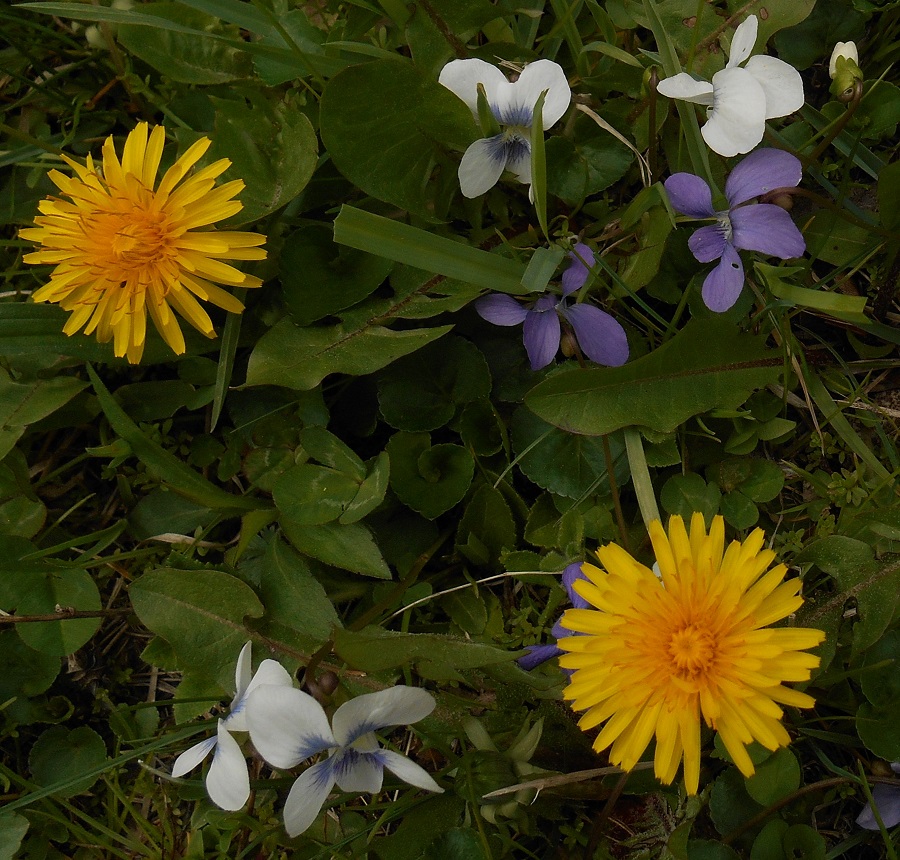
I like the scattered violets that appeared in my lawn some years ago.  In the spring I let the grass get high before I mow, so that the violets will have a good chance to set seed.  The delay also gives the dandelions a good chance to set seed.  Fine.

DandelionViolets

Would the dandelion have a better rep if we had translated (rather than anglicized) the Old French name?  Not likely.  Every flower is the same bright yellow, so there is no variation for plant breeders to coax toward white or red and then offer “Snow Ball Lion’s Tooth” or “Fire Ball Lion’s Tooth” in seed catalogs.  Any klutz can grow dandelions, so they give gardeners no bragging rights.

Nowadays the French have a derogatory-sounding name for dandelions.  Were the royal gardeners frustrated by the plant’s defiance of the oppressive formality of the plantings at Versailles?  The Germans have kept the good old phrase “lion’s tooth” (in their own language, of course), as have the Italians and the Spanish.  If it ain’t broke, don’t fix it.

When many people see a dandelion, they see a weed.  I don’t.  I see Löwenzahn, the Wagnerian Heldenblume that thrusts green and gold into the grayest and grimmest of our cityscapes.  I see Dent de Lion, the Enlightenment philosophe whose call for liberty and rationality rides the wind.

DandelionSeeds_few

I do pull weeds; I do not pull dandelions.

Flower of the Day – July 20, 2018 – Dandelion

– Gray button (upper left corner) reveals widgets, –
– above post (on phone) or beside it (on desktop). –