growing old, haiku, humor, mundane miracle, photography

Mundane Miracle – Pond

A consolation for the decreased mobility that comes with age is an increased appreciation of mundane miracles close to home. One example is considered here; I hope to post a few more in coming months.
(BTW, the [Menu] button atop the vertical black bar reveals the widgets.)

Long ago, I drove/flew/drove to a motel in the town on the western edge of Rocky Mountain National Park in Colorado.  Soon afterwards, I hiked into the park, admired an alpine lake, ate a trail lunch, and hiked out in a thunderstorm that mocked my “waterproof” boots.  Nothing epic, but well beyond me now.  That’s OK.  I did it once (which was more than enough for the thunderstorm part).

Some people consider it a miracle when the government does something right.  Over the years since that trip to Colorado, the EPA adopted (and enforced!) vehicle emissions standards.  I can walk the roads near my house w/o being assaulted by trucks and school buses belching black diesel crud.  Their exhaust is still smelly and unhealthy, but not bad enough to ruin a walk on a breezy day.  So I can often walk about 1.5 miles to the far end of an artificial pond beside the road.  An artificial pond ringed by hilly pasture land is not the same as a natural lake ringed by mountains, but water is water and blue sky is blue sky.

sparkle-geese

kiyawana-sky

After a few rainy days, excess water in the pond rushes thru a culvert under the road and into the little brook that was dammed to create the pond.  I can admire the exuberant splashing on the rocks in the brook w/o dwelling on the artificiality of the scene.

outflow
outflow-closeup_ObjRem


Sound of Sunlight
|Rushing waters bring
|joy to those who hear them sing
|and see them sparkle.

Happy Heraclitus
|(added 2018-06-07)
|Life flows and splashes.
|No things are permanent and
|all things are precious.

Buddhism, flowers, haiga, haiku, photography, quote, riff

Riff on a Quote

We expand one of the Dalai Lama’s remarks about being happy (as quoted in a CDHK challenge) with a haiku touching on other things to be also.  Can we illustrate the haiku with a photo?

“The purpose of our lives is to be happy.”

Being calm and compassionate is also important in Buddhism, so I have responded to

Carpe Diem Tokubetsudesu #72 Use that quote

by expanding the Dalai Lama’s quote about being happy into a haiku about being all 3.  Rhododendrons originated in Asian mountains, so a photo with 3 clusters of their blossoms seems appropriate for illustrating the rather abstract haiku to follow.

Rhodo_928x599

Riff on a Quote from
|Tenzin Gyatso (14th Dalai Lama)

|Be calm and happy.
|Give loving help to those
|who are frantic or sad.

– Gray button (upper left corner) reveals widgets, –
– above post (on phone) or beside it (on desktop). –
haiku, history, humor, politics

Rhyming Haiku: Couplet and Triplet

I enjoy smuggling rhymes into blank verse but have not yet gotten all 3 lines of a haiku I really like to rhyme.  My response to Carpe Diem #932 silk tree is a pair of all-new haiku.  I do like the one with a couplet.  The one with a triplet (plus an internal rhyme in the title at no extra charge) is submitted in the spirit of Abraham Lincoln’s corny jokes during the American Civil War: I laugh so that I will not cry.

Sound of Sunlight
|Rushing waters bring
|joy to those who hear them sing
|and see them sparkle.

Silly Rhymes for Scary Times
|A rhyme in blank verse?
|President Trump would be worse.
|Vote Dem or you’ll curse.

US_flag_inverted

Image Source

A public domain image of the American flag has been turned upside down to reflect the current state of US politics.

(BTW, the [Menu] button atop the vertical black bar reveals the widgets.)
haiku, humor

Indigo

Some of my own humorous haiku are blue and/or dark; some are just silly.  Here are a few responses to


Mission Accomplished?

Ant with wings staggers,
then dies. Did I see him smirk?
Had he banged a queen?

Vampire Bunny

With coprophagy
as the alternative,
you might suck blood too.

Why Tall Men Walk Slowly in Gardens

A short-handled rake
waits (teeth up) to deliver
a clunk in the junk.

Silver Savior

The crowning glory
of our civilization
is, of course, duct tape.


haiku, history, humor

Time for a Haiku about Time

Historians give us the next best thing to traveling backward in time, so as to look over the shoulders of our predecessors and see how they coped with their predicaments while planting seeds of ours.  Of course, we cannot really do that.
(BTW, the [Menu] button atop the vertical black bar reveals the widgets.)

The protagonist in H.G. Wells’ novel The Time Machine travels fast forward in time, temporarily (!?) separating the passage of time in his own life from the passage of time in the world at large.  Of course, we cannot really do that either.

rod-taylor-time-machine_940x424

On the other hand …

Is Time Travel a Fantasy?
|No.  It just happens
|(whether we like it or not)
|on a fixed schedule.


The still from the 1960 film version of The Time Machine that appears here has been cropped to fit well on this page; it appears in an interesting post on TimidMonster.com.

birds, food, haiku, humor, seasons

Spring from Another Viewpoint

A few seconds near the end of the delightful music video from a CDHK episode have inspired a haiku that looks at a familiar subject from an unfamiliar viewpoint.
(BTW, the [Menu] button atop the vertical black bar reveals the widgets.)

I consulted the plants in my yard for my first response to

Carpe Diem Special #194
A Trip Along Memory Lane — with a twist
,

but I did not consult my plants this time.  They might be shocked.

Spring from Another Viewpoint
|One fat little bird
|welcomes spring in its own way.
|Cherry buds are food.

haiku, photography, seasons

Spring

The plants in my yard have a response to the cherry blossom video shown in CDHK #194.  After the winter, green plants spring back to savor warmth and longer days.  Hmmm.  That’s a haiku.
(BTW, the [Menu] button atop the vertical black bar reveals the widgets.)

Carpe Diem Special #194
A Trip Along Memory Lane — with a twist
.

green-peek_934x657

daffodil-leaves_934x900

Spring
|After the winter,
|green plants spring back to savor
|warmth and longer days.

haiku, history, humor, politics

Long After the Sixties

When will things slide …

from liberty to anarchy?

from growing to shrinking?

from bravery to bravado?

from firmness to fascism?

from hope to rage?

The answer, my friend, has blown in on the wind.

The answer has blown in on the wind.

Fiscal Responsibility
|Debts rise; incomes fall.
|Hard times demand bold action:
|tax cuts for the rich!
 

baseball, flowers, haiku, humor, photography

Orange and Blue

The [Menu] button (atop the vertical black bar) reveals widgets like the Search box.  Typing just the [Enter] key into the Search box is a way to browse WordPress blogs.

orange-blue_938x337I had no interest in baseball during my misspent youth.  My late wife had some interest in it, her interest was contagious, and we had become casual fans of the NY Mets by the time they won their 2nd World Series in 1986.  With stamina unthinkable today, we saw the sights in Washington DC by day and watched much of the 1986 World Series by night, on the big TV in our motel room.  There were no games on the nights of travel days, but we managed.

While fans of the NY Yankees got to see many more wins over the years, Mets fans got to see more strategy because there is no designated hitter in the National League.  A great baseball team has an unusual combination of strategic leadership, individual initiative, and teamwork.  It is like a great army, but nobody gets killed.  Moreover, a not-great team can try again next year.

Tho definitely not a great team in most years, the Mets did and do have great colors: a strong orange and a strong blue, much like the colors in my photo.  Many fond memories of 1986 were refreshed by seeing orange and blue on a great postseason team in 2015, in addition to seeing them on foliage walks.

October is blessed with a riot of reds and yellows (and some persistent bright greens), as well as the glorious oranges of many of the sugar maples (Acer saccharum), some of the red maples (Acer rubrum), and NY Mets uniforms (but only in a few special years).  One color I seldom see in October is pink.  In 2015 I saw that also.

cactus_oak_888x504

Willful Cactus
|My “Christmas” cactus
|blooms whenever it pleases.
|Pink for Halloween!


haiku, history

Motion in Haiku: 2 Surprises

The [Menu] button (atop the vertical black bar) reveals widgets like the Search box.  Typing just the [Enter] key into the Search box is a way to browse WordPress blogs.

Some fine haiku were among the few good things to come out of World War I.  My experiment with one of them provides a response to Carpe Diem Perpetuum Mobile #2 rainbows sparkle (or movement in haiku).  While refining my nuanced stance on the 5-7-5 Rule ( Helpful guideline? Yes! Firm requirement? No! ), I tried tweaking a few classic haiku that broke the rule.  Could something that was already good be improved by revisions to comply with 5-7-5?  In particular, I considered a World War I image by Maurice Betz.  Neither the French original nor the straightforward translation on page 50 of The Haiku Handbook (2013 edition) obeys 5-7-5.  This post ends by quoting the translated Betz haiku (which is utterly static) and my [5-7-5]-compliant version (which has both fast and slow motion).  I was surprised twice.Duck-Rabbit_illusion_439x242

  1. The history of the shell hole can be narrated succinctly within the confines of 5-7-5.
  2. I do not have a stable preference for either version.  Like someone viewing the classic ambiguous image that can be seen as a duck facing one way or as a rabbit facing the other, I flip-flop between the still photo by Betz and the movie by me.

© Maurice Betz
|A shell hole
|In its water
|Held the whole sky.

Redemptive Trickle
|A shell exploded!
|Water slowly filled the hole
|and held the whole sky.

Image Source

  • Jastrow, J. (1899). The mind’s eye. Popular Science Monthly, 54, 299-312.
  • The soft copy used here has been downloaded and cropped.


haiku, photography, seasons

Chiaroscuro

Autumn is the best season of the year and also the shortest, unless we submit to calendar tyranny and say that “late fall” includes the leafless gray weeks before the winter solstice.
(BTW, the [Menu] button atop the vertical black bar reveals the widgets.)

Chiaroscuro_moon_443x449
I have a daylight photo that looks much like a shot of the full moon thru colored leaves, so I can illustrate Chèvrefeuille’s beautiful evocation of true autumn while responding to

Carpe Diem Haiku Experiment #1 an introduction

with a short haiku (in 3-5-3 form) about how short the season is.

© Chèvrefeuille
|light of the full moon
|shines through colored leaves
|at last … autumn

Ending Too Soon
|Wind speeds up!
|Leaves fall in panic!
|Clouds roll in …

haiku, history, humor, photography, science

Moving the Earth

Sometimes the Earth moves, quite apart from the constant motion in orbit around the Sun.  No, I am not using hyperbole to describe a big, screaming orgasm.  I am considering an even rarer event.
(BTW, the [Menu] button atop the vertical black bar reveals the widgets.)

Sometimes a really big idea challenges and ultimately transforms deeply held beliefs about the fundamental nature of human life.  Centuries ago, the idea that the Earth does indeed move around the Sun was such an idea.  Oh shit, we may not be at the center of the universe!  Astronomical humble pie from Copernicus has been pretty well digested; some people still cannot swallow humble pie that was pulled from the oven in 1858.

Already know what happened in 1858?  Please don’t leave.  I will keep it brief, keep it light, and put my own eccentric spin on the story.  (Honestly now, when was the last time U saw the phrase “big, screaming orgasm” in the 2nd sentence of a note on the history of science?)  Sources are thanked at the end of this post.

Back in 1858, there were no search boxes.  No Google.  No Wikipedia.  No e-mail!  Anything called a “manuscript” really was a collection of sheets of paper on which letters and symbols had been written by hand.  Want to show it to somebody U cannot visit?  Put it in the mail and hope it eventually arrives intact.  Want to have a backup copy in case it gets lost or damaged?  Write it out all over again before mailing.  No scanners.  No soft copy.  Yuck.

I am old enough to have lived and worked in a hard copy world, albeit with gadgets like electric typewriters that made it less painful than in 1858.  Collaborating with somebody several time zones away was agony in my early days and impossible in 1858.  In some important ways, doing science in my early days was more like it was in 1858 than it is now.  So I can imagine how Charles Darwin felt when he read the mail on 1858-06-18.

Correctly anticipating that his concept of evolution by natural selection would ignite a firestorm of controversy when published, Darwin had spent some of his time over the previous 20 years thinking about possible objections or misunderstandings, devising ways to answer or avoid them, and organizing a mountain of evidence.  Already an A-list biologist, Darwin was in no hurry and wanted to dot more i-s and cross more t-s before the firestorm.  Naturally, he wanted to wait a while before publishing his big idea.

The letter and manuscript that Darwin received on 1858-06-18 came from Alfred Wallace, a younger colleague then roughing it somewhere in one of the places that would now be called Indonesia or Malaysia or New Guinea.  Wallace sought advice about how to publish a new idea: evolution by natural selection.  Tho Wallace did not have a mountain of evidence, his pile was plenty high enough to justify publication.

Wallace earned his living by collecting natural history specimens for sale and was being hassled for the amount of time he devoted to nerdy “theorizing” when he should be killing things.  Naturally, he wanted to publish his big idea soon.  Naturally, he sought the opinion of a senior colleague with whom he had already exchanged a few letters on smaller matters.  He did not know (and could not know for months) that he had independently come up with the same big idea that Darwin had been quietly refining and supporting for years.

How could the differing priorities of Darwin and Wallace be reconciled?  How could Darwin respond to Wallace in a way that was fair to both of them and feasible in 1858?  No e-mail.  No conference calls.  Darwin consulted a few friends.  More than a century before the exhortation to

Let it all hang out!

enjoyed a vogue, they decided to do exactly that.  Those who attended the meeting of the Linnean Society of London on 1858-07-01 were treated to an explanation of the unusual situation, a reading of a summary of Darwin’s work, and a reading of Wallace’s paper.  Wallace was still in the boondocks and did not even know that his work (presented for him in his absence by one of Darwin’s friends) was sharing the spotlight on equal terms with Darwin’s.

Wallace did eventually return to England, make further contributions to biology, and enjoy a long friendship with Darwin.  Yes, they disagreed on some points.  Yes, creationists took such disagreements at the frontiers as an excuse to claim that the whole enterprise was “just a theory” with no greater plausibility than an extremely literal reading of Genesis as translated from a translation of the original ancient Hebrew.  But the Earth had begun to move again.  Oh shit, we may not be descendants of a pair of idle nudists who took advice from a snake!

Archimedes in 1858
|Darwin and Wallace
|found a lever long enough
|and a place to stand.

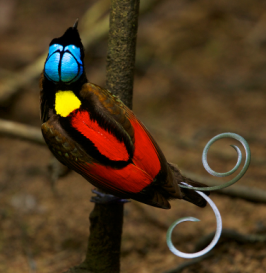
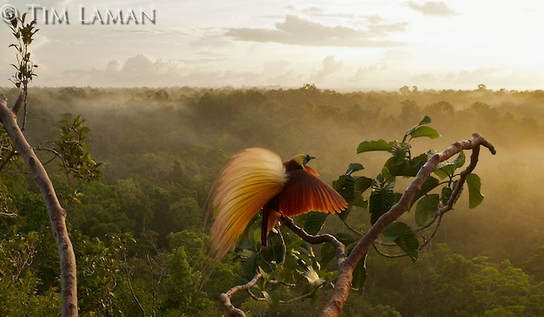
Greater Bird of Paradise

Sources

      • The brief biography of Wallace by Andrew Berry in the September 2015 issue of Natural History is very readable and provides some details I had not known.  No access to that issue of the magazine?  Pasting a few phrases into search boxes will compensate nowadays.  I have zoomed in on June/July of 1858 to elaborate on collaboration technologies (then and now), Darwin’s fairness predicament,  and why I applaud the way he resolved it.

    • Tim Laman’s many bird of paradise photos are featured in the September 2015 issue of Natural History.  The photos that appear here have been cropped to fit well on this page.  The originals (and many other splendid photos) can be seen on Tim Laman’s website.  Prints can be bought.

  • The concluding zinger about Adam and Eve is believed to be original; it is inspired by the edgy absurdist humor in Eric Wong’s blog.


haiku, humor

Pegasus

Tho childhood fantasies about flying horses are long gone, I can see the upside.  I have 2 favorites to share before my own take on Pegasus.
(BTW, the [Menu] button atop the vertical black bar reveals the widgets.)

In response to Carpe Diem #825 Pegasus:

I have 2 favorites to share before my own take on Pegasus: Chèvrefeuille’s beautiful Hippocrene-inspired image and Haiku Plate Special’s charming reminder of the way I and so many others were introduced to Pegasus.

© Chèvrefeuille
|after the rainstorm
|horses galloping through puddles
|droplets of poetry

© Haiku Plate Special
|winged horse
|flying through my childhood
|Mobil Gas

Tho childhood fantasies are long gone, I can be good-humored about practical matters.|

Pegasus
|Ever been shat on
|by a bird? Be glad there are
|no flying horses.

Pegasus_RM_450x450
Perhaps the image credit requested by the Rijksmuseum refers to a likeness of Persephone on the other side of a coin? Perhaps some copy-then-tweak editing did not go far enough? A magic spring with water that ensures complete editing would be a worthy companion to Hippocrene.
haiku, seasons

Another Maple Seed Haiku

This post responds to a CDHK challenge by sharing two haiku about seeing maples consign their seeds to the warm wind: my own and one written by Betty Hayes Albright.
– Gray button (upper left corner) reveals widgets, –
– above post (on phone) or beside it (on desktop). –

In response to CARPE DIEM HAIKU KAI: Carpe Diem Utabukuro #10 Wim Lofvers’ “a maple seed”

In late May of 2015 I happened to be out walking on a perfect day for seeing maples consign their seeds to the warm wind.  Having neither the skill nor the equipment to capture the moment on video, I kept walking and composed an appropriate haiku.

I like to use a haiku to wrap up a discussion that not even Basho could fit into 3 lines.  Having no more to say at that time, I typed the haiku into my computer and left it there.  Now I have a CDHK opportunity for my haiku.  As of this writing, there are 9 responses posted.  From a wealth of good haiku about maple seeds, I will share as a favorite the same favorite (written by Betty Hayes Albright) that is shared in the 5-th response.

Albright’s haiku stands out for me because it is vivid and reads quite naturally as English w/o any apology for squeezing into 5-7-5.  It also uses ordinary capitalization and punctuation, which I prefer over the affectations common in poetry.  At the risk of shooting myself in the foot, I will display it alongside my own haiku at the end of this post.

Seedling_911x655

© Betty Hayes Albright
|The air is spinning!
|Squadrons of maple-copters
|take the fertile earth. 
|Seize the Breeze
|Helicopter seeds
|fall from maples and travel
|far enough, this once.


haiku, humor, photography

Various Viewpoints

To a female mosquito, I look like lunch: a big bag of nice warm blood.  From her viewpoint, my birdbath was a good place to lay eggs after lunch.  But then I rigged a hose to drip into it.  The drip also made the water better for washing down a bird’s caterpillar lunch.  I have another view of what makes a good lunch; my friend has yet another view.
(BTW, the [Menu] button atop the vertical black bar reveals the widgets.)

To a female mosquito, I look like lunch:  a big bag of nice warm blood.  The bag is annoyingly mobile, but she is also mobile and is quite good at using a mix of cues (chemical, thermal, and visual) to home in on the bag.  Then it will be time to lay eggs.  From her viewpoint, my birdbath was a good place for egg laying until I rigged a hose to drip into it.

birdbath-ripple_840x312
The dripping also keeps the birdbath full and makes it more attractive to the birds, who consider it a good place for a sip of water and sometimes a bath.  From the birds’ viewpoint, it never was a good place for egg laying.  I am glad that the mosquitoes have finally come around to the birds’ opinion.

Blood for lunch does not appeal to me.  Neither do caterpillars, so I do not compete with any past or present birdbath visitors for food.  I eat something healthy (from a human viewpoint) and finish off with something obscenely healthy: a few raw carrot sticks and then a few raw snow peas.  (That lets me get away w/o brushing my teeth after lunch.)  I also view the veggies as colorful objects to be arranged in a very temporary display on the plate before they become ugly mush that is mercifully out of sight.

A few days ago, I happened to arrange my lunch veggies so as to look a little like a dragonfly, with snow peas as wings.  Hmmm.  Maybe I could pull more veggies from the fridge and make an arrangement that looks a lot like a dragonfly to me. (No real dragonfly would be fooled.) This little project reminded me that a dragonfly is the enemy of my enemy, and thus my friend.

Dragonfly_480x481

What’s for Lunch?
|Mosquitoes in flight
|are seen as meat on the hoof
|by a dragonfly.