ethics, haiku, humor, language, music, oversimplify

Be Precise, But Keep It Real

I am big on precise language.  Why am I so damn mellow about whether a poem is a haiku?  The answer hints at bigger things (like reconciling polished theory with rough-hewn reality), but there will also be a few jokes.
(BTW, the [Menu] button atop the vertical black bar reveals the widgets.)

Yes, there are short poems that are not haiku.  Limericks are not haiku.  Googling «one word poem» yielded more hits than I expected (and infinitely more than I would like).  U can read about one that made national news here.  One word poems are not haiku.  (As candidates for a one word poem about one word poetry, words like [prank] and [scam] come to mind.)  On the other hand, trying to say exactly what is a haiku is a lot harder than it seems to many people.  It is also a lot less important, and we should be thankful for small blessings.

A list of several common characteristics of haiku is a good starting point as a tentative definition.  Such a list can be good for introducing people to haiku.  Whether it should be carved in stone is another question.

Here is a plausible list of things one might say about a short poem in English, such that the poem “should” only be called a haiku if they are all true.

  1. It does not rhyme.
  2. It has 3 lines, with a total of 17 syllables distributed 5-7-5.
  3. It includes some seasonal reference.
  4. It includes a poignant relationship between nature and humanity.

I got this particular list from a thoughtful comment by Sue Ranscht on a post with a 3-5-3 haiku.  Amicably and implicitly, the comment posed the question that starts this post.  It deserves an amicable (but explicit) reply.

§1: How Do I List Thee?

Let me count the ways.  Hmmm.  Do I have enough fingers?

There is a downside to defining the word [haiku] in a way that excludes much of what the best haiku poets actually write and much of what the Haiku Society of America considers to be a haiku.  What are we to call that stuff?

Jane Reichhold (1937-2016) was among the many eminent haiku poets who do not adhere to our 4-item list.  She was also an advocate (so am I) of haiku with a characteristic that is not in that list: juxtaposing 2 contrasting images (rensô in Japanese).  Rather than import yet another Japanese word into English, she wrote about “fragment and phrase” as parts of a haiku, in an insightful essay that was nicely formatted in a CDHK episode.  The juxtaposition may seem incongruous at first, and much of the fun comes from realizing how it does make sense.  Sometimes one part clarifies the other.  Sometimes the fragment (the shorter part) is the punch line of a joke set up by the phrase, as in the essay’s clever classic

roasting_veg_chkn_800x575

Haiku © Jane Reichold superimposed on
Photo © Vladlena Azima | ShutterStock

Another criterion not in our 4-item list is interchangeability of lines 1 and 3.  While Jane did not advocate interchangeability (neither do I), it matters to some people.  Should we have a 6-item list?  There is no need to consider here the whole multitude of criteria that are sometimes important to some people.  There is no need to try wriggling out of the contradictions between some of these criteria.  This section’s takeaway is simply that there is no single authoritative list.  Do U find that conclusion stressful?  Maybe a musical interlude will help.

§2: Musical Interlude

Back in 1800, Viennese concert-goers knew what a symphony was, with or w/o knowing much music theory.  A symphony was an orchestral composition with 4 movements.  Movement #1 might have a short slow introduction; otherwise, movements #1 and #4 were both at a brisk pace.  Movement #2 was slower; movement #3 was a minuet at an intermediate pace.  Performing the whole thing took a while, but well under an hour.  And so on.  That was before Beethoven began shredding the dictionary.

Did anybody abuse the new freedom by writing schlock that was long and loud?  Of course.  But some composers crafted some beautiful and enduring symphonies with great care and skill.  Works like Dvořák’s From the New World are classics, tho in various ways they are not classical.

Saying that something is “a symphony” no longer says much about its length or layout.  With no claim that they are all great symphonies, here are a few examples of the diversity.

  • We have symphonies with less than 4 movements (Hovhaness; Schubert).  More movements were apparently intended for Schubert’s “unfinished” symphony, but it is deservedly popular as is.
  • We have a short strings-only symphony that does have 4 movements, but the 2 (not 1!) based on dance forms are not minuets (Britten).
  • We have humongous symphonies with vocal parts (Beethoven; Mahler).

And so on.

Maybe it would be nice if the word [symphony] had a more specific meaning, but we get by.  When Prokofiev revisited the old layout from before 1800, he did not claim to be writing the first “real” symphony in decades.  He just wrote his Classical Symphony. The title’s meaning is clear enough.

§3: Back to Haiku

I wish those who advocate one of the narrower concepts of haiku would imitate Prokofiev.  Speak of “classical” haiku or (better still) “traditional” haiku.  Say which of the various traditions U have in mind.  Want to make a discussion of a single tradition flow more smoothly by temporarily restricting the word [haiku] to that tradition?  That might work, but it is hard to avoid any hint of permanently excluding other traditions in other discussions.  Want to claim that working within your favored tradition tends to help people write good haiku?  OK.  I may well agree, unless U go on to claim that all haiku (or all good ones) are necessarily in that one tradition.  Ain’t so.

Most of my own haiku (and many that I admire by others) do comply with at least 2 items in our 4-item list.  Full compliance is common but far from universal.  Want to be careful and focused when writing haiku?  Pay serious attention to a list like this.  But don’t let the tail wag the dog.

§4: Leery of Labels

The 6-item list briefly contemplated at the end of §1 is much like the 7-item list of rules that was actually used in a challenging CDHK episode.  The main difference between the lists is in whether rhymes or words referencing the poet (like [I] or [dunno]) are forbidden.  Neither is common in haiku; both do occur.

I responded to the challenge with a cheekily titled but fully compliant haiku (This Haiku Is Kosher), followed by one that breaks a few of the rules (Not Quite Kosher).  Which rules?  In the unlikely event that anybody cared, I could say.  As it happens, my Not Quite Kosher is a wry lament (about crediting an image illustrating This Haiku Is Kosher).  The title’s double meaning would be lost if it somehow specified which rules in the 7-item list were being broken.

zen-frog

Not Quite Kosher
|Zen frog bronze sculpture
|(credit lost, like casting wax).
|Dunno who to thank.

Suppose we want to discuss partial compliance with a list of rules in some detail.  Would it be helpful to have a noun as a 1-word label to pin on my partially compliant haiku, so as to indicate exactly which rules it obeys?  Not really.  With 4 rules we would need 16 nouns.  That would be burdensome.  With 6 (or more) rules, we would need an absurd 64 (or more) nouns.  Better to just say what happens with each rule, if there is any need to say it.

Maybe a single noun for obeying all the rules would still be helpful?  No, it is better to just plop a convenient adjective (like [classical] or [compliant] or [kosher] or [traditional]) in front of good old [haiku].  Remembering which rules are relevant at the moment is enough of a cognitive load.

A cluttered vocabulary is not the only downside of a profusion of special nouns, one for full compliance with each of several lists of rules.  People tend to confuse pinning a fancy label on something with understanding it.  They also tend to assume that labels are mutually exclusive.  When the recipients of labels are other people, the results can be nasty.

§5: Takeaway

Tho willing to break the 5-7-5 rule, I obey it more than might be expected of somebody who knows about its origin in a translation error.  I am especially respectful of 5-7-5 when I write an aphoristic haiku (as a zingy summary of some nerdy philosophizing) rather than a moment-in-nature haiku.  With a linebreak after the comma, this post’s title could be a 2-line aphoristic haiku.  (Yes, there are 2-line haiku.)  Maybe a 5-7-5 aphoristic haiku will reinforce the point.

Precision < Accuracy
|Speaking precisely
|is great, if we speak about
|what is really there.

growing old, haiku, philosophy, photography

Wisdom in Wood

The haiku titles in my response to

Wisdom ~ Pic and a Word Challenge #124

stretch the word.  Another response stretches it similarly.

maple-far_800x1240

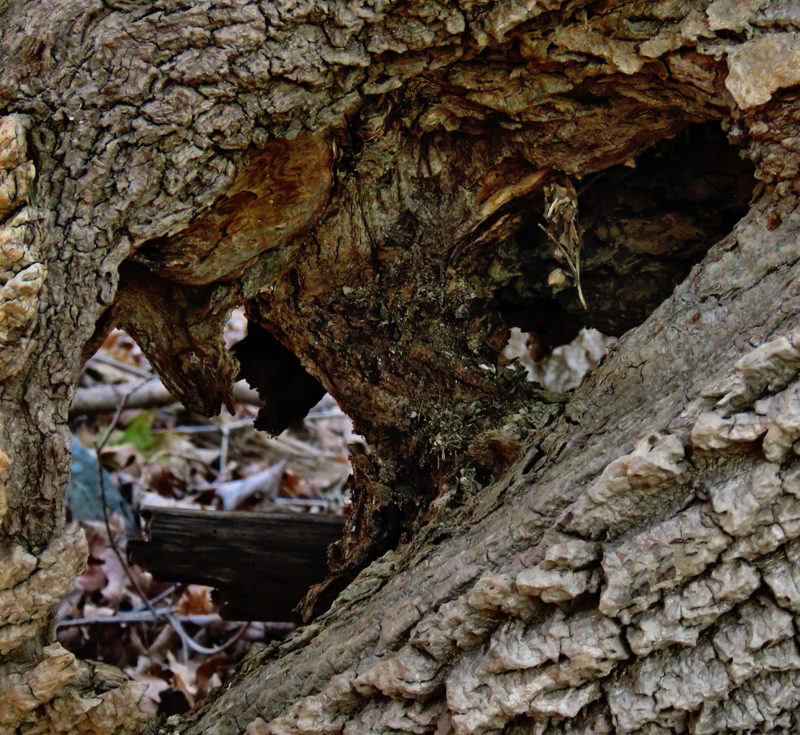
After the leaves have fallen in a wooded area, the good news is that we get a relatively unobstructed view of the tree trunks and branches.  The bad news is that it is not clear which of the trees are alive.

With one exception, all the trees and branches shown in this post are alive.

maple-hole-crop_800x595

Wisdom in Wood #1
|Singing silent songs
|of injury and healing,
|trees refuse to quit.

Wisdom in Wood #2
|Never die?
|No, the choice is to
|never quit.

ash-trunk_800x453

(BTW, the [Menu] button atop the vertical black bar reveals the widgets.)
flowers, haiku, photography

Elegy in 3-5-3

Basho (1644-1694) mourned the death of his friend and teacher Tando with a beautiful sad haiku.  A CDHK episode calls for variations on this theme.  Mine is an elegy for Tando.
(BTW, the [Menu] button atop the vertical black bar reveals the widgets.)

Basho (1644-1694) mourned the death of his friend and teacher Tando with a beautiful sad haiku:

© Matsuo Basho (Tr. Jane Reichhold)
|falling to the ground
|a flower closer to the root
|bidding farewell

Chèvrefeuille presents his own beautiful variation on this sad theme in the CDHK episode

Carpe Diem Weekend-meditation #14 Revise That Haiku

and challenges readers to “revise” Basho’s haiku in the same spirit:

© Chèvrefeuille
|tears flow
|falling to the ground
|autumn leaves

My response honors Tando’s influence on Basho (and hence on countless haiku poets) with imagery like Basho’s but a change in the metaphorical correspondence between the 2 people and some parts of flowering plants.  As he weeps, Basho also resolves to carry on.

Elegy for Tando
|Flowers fall,
|but seeds will ripen.
|Some will sprout.

Seedling_321x231_Basho_320x231_opq-62_321x215

birds, humor

Dirty Look Thru Dirty Window

My seed feeder is hung just outside my living room window.  Please pretend that the white specks in my hasty snapshot are snowflakes, not crud on plexiglass that refuses to stay clean (but is springy enough to prevent serious injury when a bird tries to fly thru it).

hungry-chickadee_A-ME-De0_800x498

Hey, stupid! The feeder’s empty!

When I am slow to refill the feeder, birds rummage in the tray and sometimes find a seed among the debris that has accumulated.  Then they usually go elsewhere for a while.

Sometimes a chickadee (but never a bird of another species) has a different response.  The chickadee sits on the edge of the tray (looking into my house) and glares at me.  Corvids and parrots are not the only brainy birds.

(BTW, the [Menu] button atop the vertical black bar reveals the widgets.)
history, language, photography, seasons

Solstice Salutation

Whether a person lives fully and righteously is vastly more important than which religion (if any) helps them do so.  But I still wish people “Merry Xmas” in late December.  Can anybody suggest something with more pizzazz than the generic salutations but w/o religious implications?

When I say Merry Xmas (pronounced like “MEH-ree KRIS-muhs”), it might be heard as an unwelcome hint that the hearer is (or should be) a Christian.  I suppose I should say something like Happy Holidays or Season’s Greetings instead, but the generic salutations for this time of year sound bland and vague to ears as old as mine.  Can anybody suggest something with more pizzazz but w/o religious implications?

I decorate for the winter solstice (with multicultural Xmas lights and wreaths) and hope it is OK to wish U a

chickadee-wreath_el-greco

Merry Xmas!

– Gray button (upper left corner) reveals widgets, –
– above post (on phone) or beside it (on desktop). –
(reblog), grammar, humor, photography

5 Days, 5 Abstract Photos – Day #5

The [Menu] button (atop the vertical black bar) reveals widgets like the Search box.  Typing just the [Enter] key into the Search box is good for browsing WordPress blogs.

Day #5 of Olga’s challenge is effectively reblogged at the end of this post, after my own abstract photo.  (I tweaked this post’s title to avoid ambiguity.)  The challenge has been fun but intense.  Now I can turn to whatever has been piling up.  Hmm… Yikes!

penis-gourd_800x1067

Originally posted as
5 Days, 5 Photos Challenge: Abstract (Day 5) | Stuff and what if…:

icicles3

Rules:  No people.  No explanations.  Open invitation to anyone else who would like to participate.

flake2

Since this is the finale, an extra photo to say Merry Christmas and Peace to all.

View original

(reblog), grammar, photography

5 Days, 5 Abstract Photos – Day #4

The [Menu] button (atop the vertical black bar) reveals widgets like the Search box.  Typing just the [Enter] key into the Search box is good for browsing WordPress blogs.

Day #4 of Olga’s challenge is effectively reblogged at the end of this post, after my own abstract photo.  (I tweaked this post’s title to avoid ambiguity.)  Am working on a jollier possibility for day #5.

ash-hole_800x735


Originally posted as
5 Days, 5 Photos Challenge: Abstract (Day 4) | Stuff and what if…:

lake6

Rules:  No people.  No explanations.  Open invitation to anyone else who would like to participate.

View original

(reblog), grammar, photography

5 Days, 5 Abstract Photos – Day #3

The [Menu] button (atop the vertical black bar) reveals widgets like the Search box.  Typing just the [Enter] key into the Search box is good for browsing WordPress blogs.

Day #3 of Olga’s challenge is effectively reblogged at the end of this post, after my own abstract photo.  (I tweaked this post’s title to avoid ambiguity.)  Maybe I can do all 5 days.

corner-grn-pink-align_800x564

Originally posted as
5 Days, 5 Photos Challenge: Abstract (Day 3) | Stuff and what if…:

abstractxxx

Rules:  No people.  No explanations.  Open invitation to anyone else who would like to participate.

View original

(reblog), grammar, photography

5 Days, 5 Abstract Photos – Day #2

The [Menu] button (atop the vertical black bar) reveals widgets like the Search box.  Typing just the [Enter] key into the Search box is good for browsing WordPress blogs.

Day #2 of the challenge is effectively reblogged at the end of this post, after my own abstract photo.  (I tweaked this post’s title to avoid ambiguity.)  I might bail out before 5 days are complete.

Coleus closer 1.4 800x491

Originally posted as
5 Days, 5 Photos Challenge: Abstract (Day Two) | Stuff and what if…:

warm9

Rules:  No people.  No explanations.  Open invitation to anyone else who would like to participate.

View original


(reblog), grammar, photography

5 Days, 5 Photos Challenge: Abstract (Day One)

The [Menu] button (atop the vertical black bar) reveals widgets like the Search box.  Typing just the [Enter] key into the Search box is good for browsing WordPress blogs.

The title of the post effectively reblogged below could be parsed as saying that it announces either day #1 of a challenge to post 5 abstract photos on 5 days or a challenge to post 5 photos on 5 days, with an abstract photo wanted for day #1 (and what is wanted later left open).  I will guess the former, post an abstract photo today, and see if I can post 4 more.  I might bail out before 5 days are complete.

Originally posted as
5 Days, 5 Photos Challenge: Abstract (Day One) | Stuff and what if…:

Rules:  No people.  No explanations.  Open invitation to anyone else who would like to participate.

Abstract photography is sometimes called non-objective, experimental, conceptual or concrete photography.

Abstract photography is based on the photographer’s eye who’s looking to capture something in a way that it would not usually be seen.  Looking for the details, the patterns, the lines, the form, shape and colors that complete a subject and utilizing those key features to make an engaging image.

View original

Here is my abstract photo for day #1:

multi-horiz_800x328_Adj_B-25_C+70_S+50

enlightenment, haibun, haiku, history, photography, seasons

Oh Come, All Fibo-ku

An old Xmas lighting tradition defies a darkness worse than long nights.  I honor it with my lights and with a fibo-ku (a haiku using the Fibonacci series rather than 5-7-5 for syllable counts).

My response to

Carpe Diem Weekend-Meditation #10
Fibo-ku winter time

could be called a “fibo-bun” because it is like a haibun but has syllable counts from the Fibonacci sequence in the haiku part.

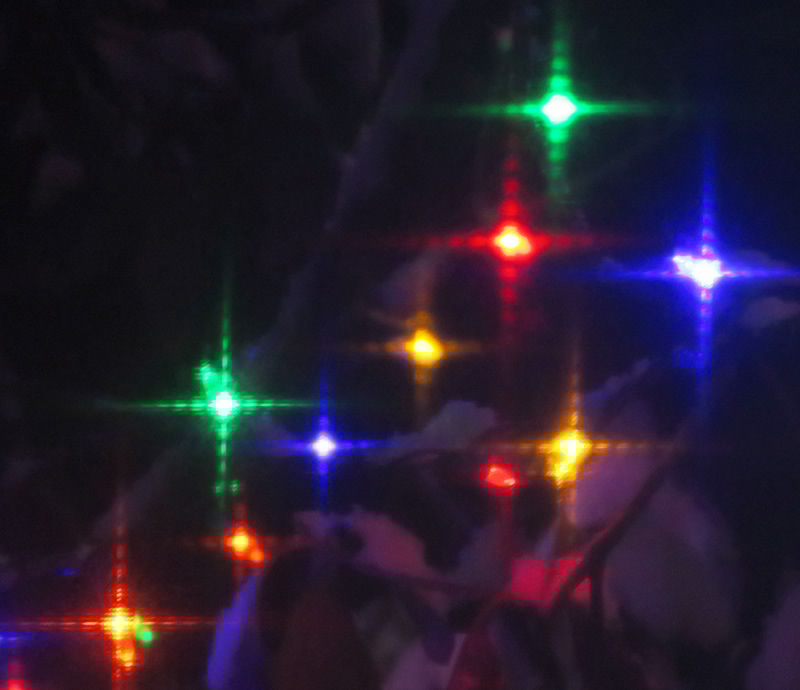
Several cultures have responded to the long nights of winter with festivals or structures celebrating light at roughly the time of the solstice.  While not quite old enough to have personal memories of Stone Age passage tombs aligned with the sunrise (on a few of the several days that amounted to the solstice with Stone Age time-keeping), I do remember multicolored Hanukkah candles and the cheerful chiaroscuro of multicolored Xmas lights draped over trees and large shrubs.

multi-vert_800x1116
Nowadays I see mostly different kinds of Xmas lights.  Some people set out ugly jumbles of inflated Santas and other symbols of the gifting frenzy; others outline their houses with harshly uniform white lights.  But some still carry forward the old Xmas lighting tradition (with LED-s now).  And the glorious vocal music of Hanukkah and Xmas still transcends the literal meanings of the verses (2 of which inspired my titles here).

Darkness worse than long nights and garish decorations hangs heavy in today’s air.  Maybe this darkness will also recede.  My lights are up.

Yet in the Darkness Shineth
|Red,
|green,
|blue, and
|yellow lights:
|multicultural
|winter solstice celebration
|defies dark tribal hatred to sing of love and light.

multi-square_800x669

– Gray button (upper left corner) reveals widgets, –
– above post (on phone) or beside it (on desktop). –
photography, seasons

Thirty-six Hudson Valley Pix in 2017

These photos illustrate why fall is the best season of the year in the Hudson Valley.  U can vote for your favorite(s) in Central Hudson’s annual Fall Foliage Photo Contest.
(BTW, the [Menu] button atop the vertical black bar reveals the widgets.)

I have gotten my electricity from Central Hudson for many years.  This year, I also got some deeply discounted LED bulbs and a tiny chance to win a contest.

There are 36 finalists in Central Hudson’s Fall Foliage Photo Contest for 2017 (out of 180 entries).  My entry is among the finalists, but winning is unlikely.  That’s OK.  A flyer for the contest was enclosed with my electric bill; it was a good day for a short local walk; I wanted to learn by doing with a new camera; I got lucky.

To see some good illustrations of why fall is the best season of the year in the Hudson Valley, U can visit the album page on Facebook with cropped thumbnails of the finalists.  Click on a thumbnail to see the full image.

The contest is judged by counting Facebook [Like]-s.  U can [Like] as many photos as U wish.  Voting ends at noon on Tuesday, 2017-11-21.  To have your vote(s) count, U must also visit Central Hudson’s main page on Facebook and click [Like] there.  Central Hudson is indeed likable as an enterprise.  They deliver the juice well, encourage conservation, and facilitate buying juice generated from renewable sources if the customer is willing and able to pay accordingly.

My own photo got some postprocessing on the computer to make the image more like the experience, but I refrained from goosing the image beyond the experience (and from [Like]-ing my own photo):

JM_2017-10-27_BKR_800x442

I liked many of the photos and decided to [Like] 2 photos that had unusual compositions and bright (but believable!) colors:

humor, philosophy, photography, seasons

Old Gold

Ultimate reality is elusive (or maybe illusory).  All photos in this post were taken by daylight on sunny late winter mornings in 2017, using the same dried silver dollar plant in the same corner of the same room.  But they don’t look it.
(BTW, the [Menu] button atop the vertical black bar reveals the widgets.)

Tattered old gold still glows.

gold-point_800x600

But is it really silver?

silver_800x600

Or some nameless pearlish color?

Shifting light; flaky white balance; …

Ultimate reality is elusive (or maybe illusory).

Rashomon

All photos in my response to

Gold ~ Pic and a Word Challenge #111

were taken by daylight on sunny late winter mornings in 2017, using the same dried silver dollar plant in the same corner of the same room.  The old camera’s unpredictable white balance sometimes lucked into interesting images.  It also inspired a riff connecting an old Beatles song to a recycling incentive, but the old camera was replaced after showing more signs of senility.

Another response to the same challenge shows that silver dollar plants sometimes do look golden in natural light!

history, music, politics

Battle Hymn of the Re…

At best, those who fight to save the Republic from the Age of Trumpery will get tired and sweaty.  My update of Julia Ward Howe’s lyrics is something they can sing in the shower.  I tried that.  It helps.
(BTW, the [Menu] button atop the vertical black bar reveals the widgets.)

The song commonly known as Greensleaves has been given several other titles and sets of lyrics.  The melody is too good to be bound by any one version of the song’s words.  Likewise for the song commonly known as the Battle Hymn of the Republic, which got the familiar title and lyrics from the five stanzas published by Julia Ward Howe in 1862.  Details and diction bind her words to the Civil War era, but the melody and rhythm break free.

As a performance by the Mormon Tabernacle Choir and another by the US Army Field Band illustrate, there is considerable variety in musical phrasing and how the singers are accompanied (as well as which 2 or 3 stanzas are sung).  I tried to write 3 stanzas appropriate for 2017 that really could be sung well by people who know how to sing.  The choir or the field band could give a rousing performance of my updated battle hymn.

A few of Howe’s phrases still resonate; I have used them (and a few other fragments of American societal hymnody) in my updated title and lyrics.  Will the future find my details from 2017 as dated as Howe’s details from 1862?  I hope so.

Battle Hymn of the Resistance

Our eyes have seen the glory
|of a land where freedom rings;
where fear and hate are cast aside;
|where no one bows to kings;
where clean air fills the spacious skies;
|where hope can spread its wings.
We fight to make it real.

|Glory, glory hallelujah!
|Glory, glory hallelujah!
|Glory, glory hallelujah!
|We fight to make it real.

When shills disguised as pundits
|stole the spotlights on the stage,
the centrists lost their bearings
|and misread the workers’ rage.
Dark money seized a chance to buy
|a second Gilded Age.
We fight the lies with truth.

|Glory, glory hallelujah!
|Glory, glory hallelujah!
|Glory, glory hallelujah!
|We fight the lies with truth.

We still can hear the trumpet
|that will never call retreat.
A white-haired warrior still steps forth
|to drum a steady beat.
Our voices shout rebuttal
|to each cryptofascist tweet,
and we will win this fight.

|Glory, glory hallelujah!
|Glory, glory hallelujah!
|Glory, glory hallelujah!
|Yes, we will win this fight.

Sprit_of_'76

Spirit of ’76

Writing cogent modern English in triplets is not easy.  Neither is saving the Republic from the Age of Trumpery.  At best, those who fight this fight will get tired and sweaty.  My update of Howe’s lyrics is something they can sing in the shower.  I tried that.  It helps.