A-B1-A-C-A-D-A-E-A-B2-A.
Cee’s Fun Foto Challenge: Close Up or Macro


– above post (on phone) or beside it (on desktop). –
A-B1-A-C-A-D-A-E-A-B2-A.
Cee’s Fun Foto Challenge: Close Up or Macro


The subtitle’s question is rhetorical, not an ancient conundrum. Nearly all of the prose I read or write is nonfiction. Why am I posting (for the third and final time) about a book of weird stories rather than about something in the endlessly fascinating Real World?
The tweetable answer begs the question. Sure, I wrote one of the 35 stories. (Click here to see blurbs for some of them.) But why did I get involved in a substantial fiction project? The answer is some nonfiction weirdness.
The call for submissions grabbed me in 2 ways:
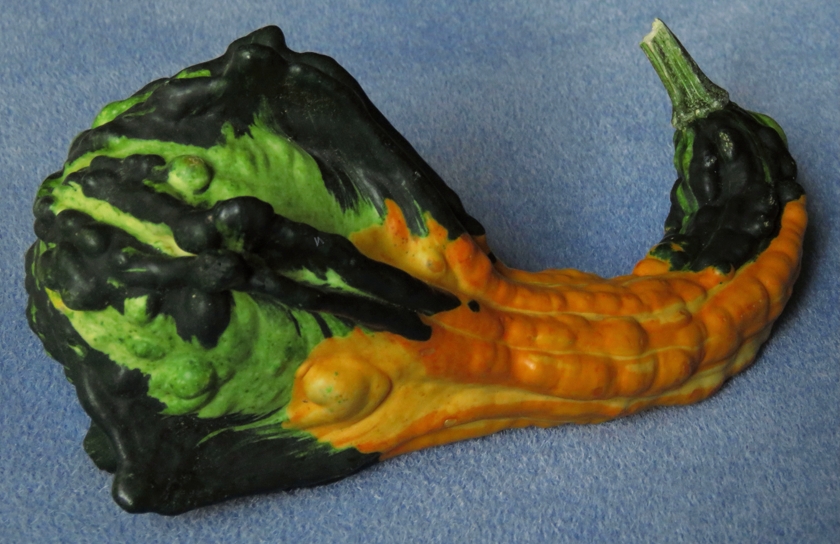
Hmmm. Could some of the stories in this anthology be simultaneously weird and funny and thought-provoking? Could they be a little like some of the best surrealist paintings? The following photo doubles down on the idea behind a great painting by René Magritte:

Seduced by the call for submissions, I took up the challenge of revising a fragment of weird fiction from a discussion of several poems (and comments) that involved various people, so as make a standalone short story that would be broader and even weirder. After another revision in light of helpful comments from one of the editors (Atthys Gage), I believe that my story is good as well as weird. It is also just 2 pages long, so even those who dislike it may still be glad they bought The Rabbit Hole for $2.99 as an e-book or $12.50 as an ink-on-paper book.
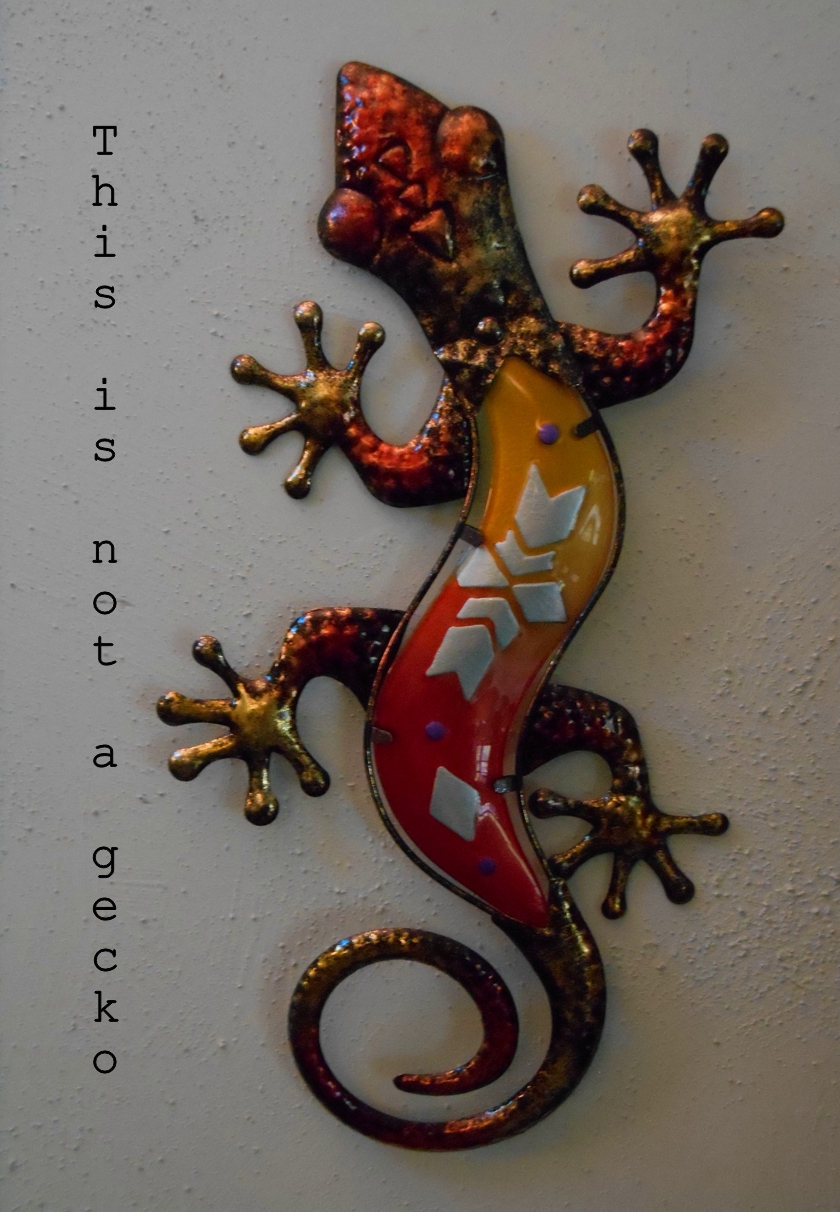
BTW, gecko lizards really can climb straight up hard, smooth walls. Weird. But they don’t speak with an Australian accent or tout insurance. Not in this universe, anyway.
Providing a brief writer’s bio for the anthology prompted me to revise this blog’s grossly outdated About page. The revised page has a new joke, a few links, and a nice photo. A nice photo of me would be really weird, so the photo is of something else appropriate.
My other short forays into fiction are also weird. Both are about an ancient Greek (but written in modern English): Plato watches baseball and copes with a hangover.
… Why are we here? …
‘Cuz wer nawt theyah.
… What is the meaning of life? …
Wehrds need meanings; life don’t.
What happens when an irrestible force meets an immovable object?
We lehrn who was lyin’: the fellah sellin’ a fawhrs or the fellah sellin’ an awbject.
Hmmm. Coulda been both.
Certainty is not exclusive to math and logic.
For example, no squirrel can get past the baffle on my bird feeder.
Ehyah??

This post ends with 2 haiku, each inspired by a photo of clouds imitating clams. I took the calm photo; Sue Ranscht took the dramatic one.
Cee’s Fun Foto Challenge: Pastel Colors
Tho I usually prefer deeply saturated colors, I love the pastel pink and green sometimes seen in a cloud, when the angles are just right in the triangle formed by the cloud and the sun and the viewer. At my latitude, it is a rare sight. I have had just one chance to photograph the elusive synergy of pastel pink and green:

Dramatic photos of pink and green in clouds can be seen by searching online for
[mother-of-pearl clouds] or [nacreous clouds].
There is also the marvel by Sue Ranscht that appears below. Fair warning: the image credit links to a post in a series, with a striking image for each episode in a fantasy epic. The series is so addictive that it hooked me despite my aversion to fantasies and impatience with epics.

© Sue Ranscht | Space, Time, and Raspberries
Cee’s Fun Foto Challenge: Vibrant Colors
I like the synergy when a few good things up their game by working together, as with peanuts and chocolate. When they do not clash, bright colors can work together in vibrant synergy.
Pink and Green:

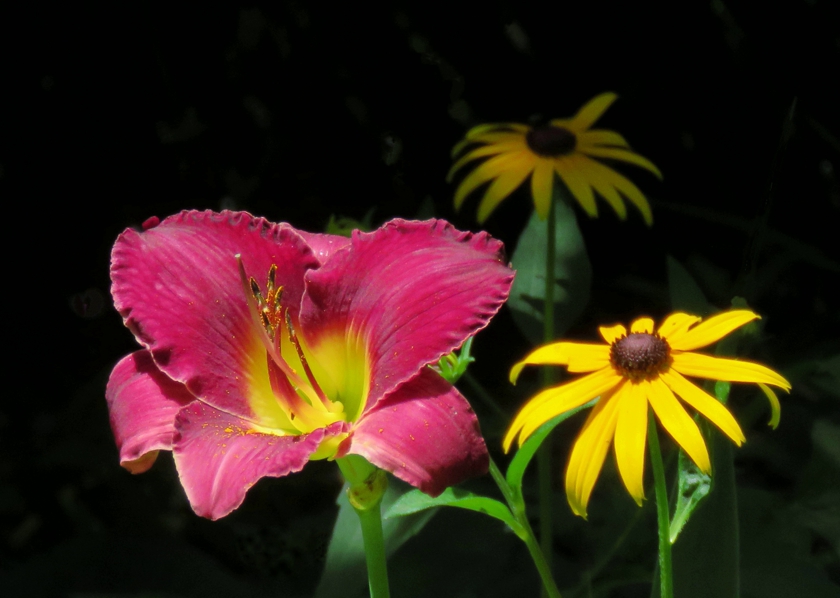
Magenta and Yellow (with a bee):

With help from blue and green, the pink and yellow flowers in the following photo team up to illustrate a deep truth about statistics. Really.
Outside of CFFC, I posted the photo along with a beautiful image found on the web that espresses the same deep truth in another way. Both ways have no equations, no jargon, and no saturated fat. Click on the photo to see the details.
Emptiness ~ Pic and a Word Challenge #153

Carpe Diem’s Quest For A (New) Masterpiece
#3 the quest continues
My latest haiku came quickly when I saw a superb photo by Cee Neuner. While I gave the haiku a title to make it intelligible w/o the photo, I also requested and received permission to share the photo in a post.

I often look at things from an odd angle. Red trillium plants like shade, grow low, and have flowers that face downward. Now is your chance to get a from-below view of a red trillium flower, in a mix of reflected and transmitted sunlight:

Figuratively, I sometimes “look” at a neat little thing from an odd angle to shine some light on a messy big thing with a subtle similarity to the little thing. For example, there is a parallel between the history of a little word puzzle’s instructions and the history of a big idea in economics.
Some of my photos with prominent reds were used outside of CFFC. The following images link to posts that use them in ways that may be surprizing. Can U guess what ideas they illustrate before following the links?
Cee’s Fun Foto Challenge: Lime or Light Green
New leaves often display a version of lime.

Actual limes display several versions of lime on the outside and …

… yet another version on the inside.

Got tequila?
A bottle of premixed margaritas is convenient, but the contents are too sweet for me. To get a drier margarita with minimal mixological effort, I use roughly equal amounts of premixed margarita and dry white wine. Tho admittedly not a world-class margarita, the result is a good no-fuss drink.
As Susie left home to start a new life with Dale, her mother watched and wondered. Would the mixed marriage work?

Other floral threesomes can illustrate a poem and a point that go beyond flowers. The following images link to earlier posts that use them. Can U guess what the posts are about before clicking on the images?
I used 3 clusters of rhododendron blossoms to illustrate an abstract haiku.
In about 40 yrs of making bouquets from the many daylilies in my yard, how often have I seen 3 flowers blooming on just 1 stalk? Exactly once, on the left in this bouquet.

With 3 separate stalks, the commonplace floral threesome on the right is a freebie, beyond what my title promises. Buy 3; get 4.
Cee’s Fun Foto Challenge: Teal, Aqua, Seafoam or Turquoise

What would I say is “the” color of the cloth in my image? Even more than with other colors, how it looks depends on lighting and surroundings. This pretty color is a visual metaphor: relationships mean more than intrinsic properties.
Colorful Plain English
Inkjets squirt cyan;
some poets sing of turquoise.
I just see blue-green.
For most purposes, I prefer blue-green (and 2 variations on it) over the other names. Anybody who knows what blue and green mean can guess what blue-green means. Those who need more choices for naming colors like this can put blue-green between bluish green (AKA aqua) and greenish blue (AKA turquoise). The 3 names I prefer are all clearer than names like aqua about where they lie on the range from just plain blue to just plain green.
Need still more choices? Use Red|Green|Blue coordinates. The 256x256x256 possible values for the RGB coordinates of a color can make more distinctions than U will ever need.
For example, the image below is a detail from the image above, with little yellow circles around 2 spots on the cloth, one relatively bright and another relatively dark. Most spots on the cloth have [R|G|B] between the bright spot’s [45|223|226] and the dark spot’s [0|48|86].

If U like one of those colors enough to want it as a text or background color, U can use the corresponding hexadecimal code (#2DDFE2 or #003056) in an HTML style sheet. Explicit hex codes avoid the bother of remembering the sometimes flaky conventional names for web colors.
Hex codes also provide flexibility. Colors rarely look the way one expects when picking a color by pointing to it in another context, as I noticed when I used colors from an image to add a haiku to the image and then to write text referring to parts of the haiku. Bumping coordinates up or down can adjust colors to look good in actual use.
Gratitude ~ Pic and a Word Challenge #150

Making a Peaceful Salad
Behold (with gratitude for green)
bright purple, red, and carotene.
Spinach leaves have saved the day,
and they taste good anyway.
No colors clash with green between.
The challenge illustrates a familiar way to hide in plain sight, by being a small part of a complex scene. My response illustrates another way, by being quick and unexpected. While a classic experiment using a fake gorilla provides one example, my response uses a genuine wren.
So long ago that I was using color negative film, I took a photo of a wren feeding his/her chicks. When I eventually got the print back from the lab, I saw something I had never seen before and have not seen since:

The parent’s tail feathers fan out to brace against the outside of the nest box, forming almost a half-circle. Don’t blink or you’ll miss it. The shutter clicked at a lucky instant, freezing a detail of the momentary handoff that I have never seen in real time.
To get a web image, I scanned the old print and looked more closely at the scanned image while deciding how to crop it. A bird splat on the nest box was hiding in plain sight (the familiar way) and was now a distraction. No problem. Any decent photo editing software could remove it, as mine did.
Sad to say, all my instances of hiding in plain sight the familiar way are like that banished bird splat. Experiencing a scene in real time, I either do not notice or can easily ignore power lines, bright reflections, and whatever else detracts from the good stuff. Examining a photo later, I find that whatever hid (by being a small part of a complex scene) is now so distracting that I must tone it down if I cannot remove it.
¯\_(ツ)_/¯
The invisible gorilla experiment is a classic example of hiding in plain sight by being quick and unexpected. The resulting book is a good read exploring several ways that people often overestimate their abilities.
Cee’s Oddball Photo Challenge: 2018-08-12

? ? ? ?
What U see depends on when U look.
Here is the same detail under typical lighting:

A detail of what?
Scroll down to see the answer (image & text).
↓
↓
↓
↓
↓
Keep scrolling …
↓
↓
↓
↓
↓
↓

A clever craftsperson repurposed some windows from an old house as suncatchers, with shards of colored glass held in place by clear liquid epoxy. Alas, the epoxy components were not measured just right for the one I bought. (It’s difficult.) Sticky gunk oozed from cracks and seams after a few weeks of exposure to hot sun.
An epic battle between Elmer’s Glue and the rogue epoxy ended in victory for Elmer. On one side of the suncatcher, a thick coating of glue was needed in some places. I added more to make a whimsical mix of clear and cloudy, roughly 50-50. The ratio is not so critical as when mixing epoxy.
My suncatcher is a good size for hiding the squirrel baffle above my hanging bird feeder, and it has withstood years of hot summer sun w/o having any gunk get past Elmer. On the other hand, a few squirrels have gotten past the baffle.
Cee’s Fun Foto Challenge: Week 1 Photo
geometry, bushes, window, brick, etc
Four of the items mentioned in this challenge are sitting on a small Navajo rug:

Geometry, bushes, window, brick, curtain, green, tan, wall, building, dark red, tree
Glad I do not need everybody in one photo.
As I said, it’s a small rug.
Organic ~ Pic and a Word Challenge #147

Do not try to watch it grow.
Each micron takes a day or so.
Dunno enough lichenology to say how slowly my lichen grows. From the wide range of known lichen growth rates and my very casual observations, I could go with either “hour” or “day” as a crude monosyllabic estimate of long my lichen takes to grow a millionth of a meter wider. Compared to watching lichens grow, watching grass grow would be like watching hockey.