philosophy, quote, riff

Soliloquy in Two Voices

If only I had known how badly Edison fudged the numbers in his aphorism, I could have lowered my sights and tried to find a career that did not demand more than I could give, even with years of quasimonastic dedication fueled by caffeine and adrenaline.  If only I had known to aim lower, I could have been happier.
Maybe so, but the hypothetical happier me would be a different person, with their own “if only” musings.  The actual me is emergent from countless choices and experiences, some good and some bad.  Those choices and experiences did not latch onto a separate soul, like remoras that ride on a shark’s skin.

Image Sources

Downloaded stock images were lightly edited for use here.

Speech Bubbles © happyvector071| 123RF Stock Photo

Shark with Remoras © divepics | 123RF Stock Photo

– Gray button (upper left corner) reveals widgets, –
– above post (on phone) or beside it (on desktop). –
haiga, haiku, philosophy, photography, science

Mortality and Defiance

IMG_4943_crop-3_840x484

~ Mortality #1 ~
Emergent
from dancing atoms,
life is short.
~ Mortality #2 ~
I live life
with defiant joy,
all the way.

Defiance ~ Pic and a Word Challenge #328

An earlier version of this post responded to a challenge inspired by Basho’s last haiku, written when he knew he was dying.  Contributors were asked to imagine Basho writing a haiku for his closest followers from his deathbed.  While I admired the resulting excellent sad poems, I defied the expectation of sadness and imagined Basho rallying briefly to encourage his companions with a pair of short haiku in 3-5-3.

My response to the previous challenge bungled the initial line of Mortality #2.  My first thought was that Basho might tell his followers to

Live your lives / with defiant joy, / …

Telling people like me how to live is a reliable way to elicit angry defiance, so I rejected my first thought, neglected to defy my own fondness for alliteration, and settled on

Let’s live life / with defiant joy, / …

despite some misgivings.  Hmmm.  Wish I had used

I lived life / with defiant joy, / …

as what Basho might say on his deathbed.  Hmmm.  I can use it now in the present tense because I am still fairly healthy for my age, in defiance of the odds against those who bungle things more consequential than a line of poetry.  So I use it in the revised Mortality #2 here, with defiant joy.

– Gray button (upper left corner) reveals widgets, –
– above post (on phone) or beside it (on desktop). –
humor, language, philosophy, photography

Flags, Moles, & Meanings

While pondering “the meaning of food” is rare, pondering “the meaning of life” is common.  Deservedly?  Buckle up and enjoy the ride.

Your life and mine are not arbitrary symbols used by a third party to communicate with a fourth party.  Don’t let sweating “the meaning of life” interfere with living.

§1: Colors

Meanings are tricky.  Colors provide a simpler way to explore some of the relevant ideas, but exposure to a common misuse of language may mislead some readers into objecting to the following subsection’s first paragraph.  If U want to object, please wait until U have read §1.3.  Don’t want to object?  U can skip §1.3 but are welcome to read it anyway.

§1.1: What Color is the Number Six?

The question heading this subsection is inane, bordering on nonsensical.  Many different kinds of thing have colors, but numbers don’t.  Making sense is harder than just having sensible-looking syntax.

One of the ways that philosophy made substantial progress in the past century was the realization that some “deep” questions could be as inane as the one heading of this subsection.  Determining which ones are really deep will take a while.  Inane questions may sometimes be failed attempts to pose serious questions that might be more tractable with better wording, so some inanities may deserve more sympathy than the heading of this subsection.

§1.2: What Color is the US Flag?

Flags do have colors, but the question heading this subsection is still inane.  The US flag is red, white, and blue.  While mostly red, the Chinese flag also has some yellow.  How many nations have flags of just one color?

Nobody is silly enough to speak of “the” color of a nation’s flag, but people often do fall into the trap of speaking of “the” thingamajig when there are in fact several relevant thingamajigs.  I posted 4 varied examples (and there are many more).

It does make sense to say that white is the color of the stars in the US flag, that green is the color of the fake foliage in my Xmas wreath, and so on.  But look at the ribbon on my wreath:

closer_crop_840x485

The color I see at any place on the ribbon is intricately context-dependent.  Where is the light coming from?  Where am I standing?  While the solid red ribbons on other wreaths are easier to describe, my iridescent ribbon is prettier to see.

§1.3: Numerals Ain’t Numbers

For clarity and emphasis, I will wrap words in square brackets when I want to write about them rather than with them.  Italics will be only for titles or foreign words; quote marks will be only for quotations.

Nobody confuses the English word [six] or the German word [sechs] with the number six.  The words are names for the number, not the number itself.  Likewise for the numeral [6], but people often do confuse numerals with the numbers they name.   Now that Arabic numerals like [6] have displaced Roman numerals (and strings of them like [VI] to mean six) for nearly all purposes, the confusion usually does not matter.  But it matters here.

One of the many kinds of synesthesia responds to reading various letters or numerals by also seeing various colors that are not in the text.  It’s called “grapheme-color synesthesia” and discussed on many web pages, with some variations in details of the definition.  (What about a color response to a whole word rather than just to a prominent letter in it?  To a symbol like [@] that is neither a letter nor a numeral?)  Close reading of the oversimplified definition in Psychology Today (and elsewhere) suggests that the authors were thinking of numerals when they wrote “numbers” in something like

Grapheme-color synesthesia occurs when
letters and numbers are associated with specific colors.

Some discussions of this kind of synesthesia do say “numeral” when discussing color responses to reading numerals, as they should.

I found one page that touches all bases and, despite prose obfuscated by refusing to use the word [numeral], recognizes the distinction between names and what they name.  The Syntax Tree goes on to assert that some synesthetes do have color responses to numbers themselves, not to numerals.  How could that be verified?  The page does not say.

Suppose Ulrika Zweisprachen is bilingual in English and German.  Suppose she sees the color lime green when reading a passage in English with the word [six], a passage in German with the word [sechs], or a passage in either language with the numeral [6].  The number six does have the color lime green for Ulrika, but not by itself.  Pedro Doslenguas may see orange when reading a passage in English with the word [six] or a passage in Spanish with the word [seis].  And so on.  In short, numbers don’t have colors.

In a comment on a much earlier version of this post, Sue Ranscht remarked that [nonsense] (where [inane] appears now) was an overstatement.  She also broadened my horizons about kinds of synesthesia.  I had only known of the sound-color kind.  Thanks, Sue.

§2: Words

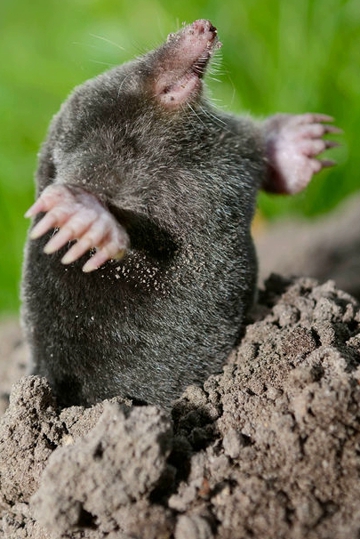
Mole

© tunedin123 | 123RF Stock Photo
(Image has been cropped.)

The word [mole] has utterly different meanings in chemistry, dermatology, and espionage.  Even if we suppose it makes sense to attribute a meaning to life, pondering “the” meaning of life may still be like pondering “the” color of the US flag, “the” color of an iridescent ribbon, or “the” meaning of [mole].

Like mathematical notations (and many hand gestures), words are arbitrary symbols with enough consensus about what they mean to support use in communication.  Who uses life to say what to whom?  Your life and mine are not arbitrary symbols used by a third party to communicate with a fourth party.  Numbers don’t have colors and don’t need them.  Words don’t have unique meanings and don’t need them.  Life doesn’t have or need anything like “the meaning” of a word.

I posted 4 imagined responses by an old Yankee to a novice philosopher’s bloviations; one of the responses is

Wehrds need meanings; life don’t.

§3: How to Live

Maybe some concerns about “the meaning of life” are poorly worded concerns about how to live fully and righteously.  Preferring the workable to the grandiose, I try to abide by a short list of simple rules:

  • Have some fun.
  • Do more good than harm.
  • Don’t sweat “the meaning” of it all.
– Gray button (upper left corner) reveals widgets, –
– above post (on phone) or beside it (on desktop). –
haiga, haiku, philosophy, photography, science

Two on Mortality in 3-5-3

IMG_4943_crop-3_840x484

~ Mortality #1 ~
\ Emergent
\ from dancing atoms,
\ life is short.
~ Mortality #2 ~
\ Let’s live life
\ with defiant joy,
\ all the way.

Carpe Diem Haiku Kai … #1850 dried grass

“Dried grass” in the challenge comes from Basho’s last haiku, written as he was dying.  My response imagines him rallying to console his grieving companions.

– Gray button (upper left corner) reveals widgets, –
– above post (on phone) or beside it (on desktop). –
haiga, haiku, philosophy, photography, tanka

Two Slim Chances

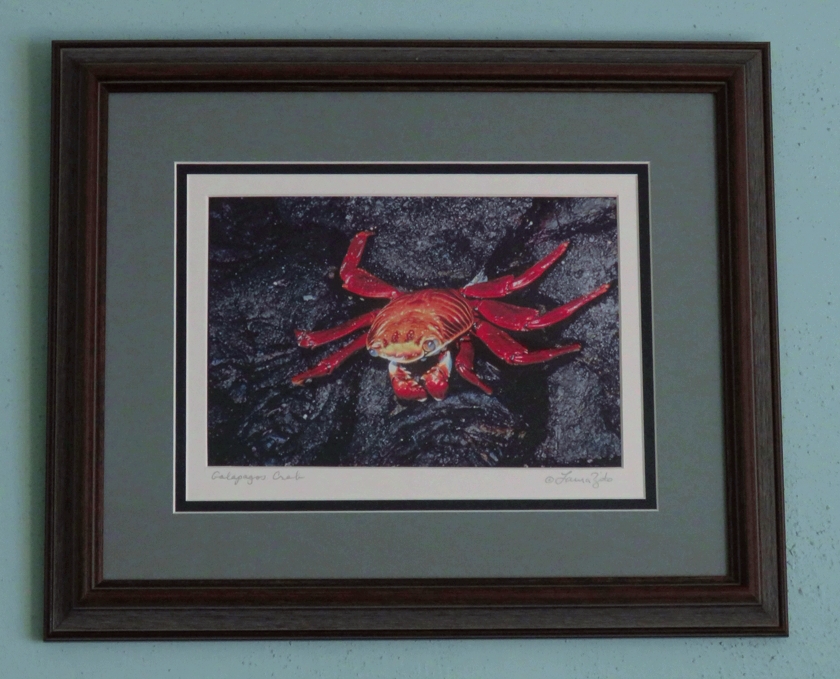
While I have never visited the Galapagos Islands, I treasure a framed print of a photo taken there by Laura Zito, who captured a bright red crab against glistening wet black rock.  What chance have I to see something close to home that looks much like that?  Very slim.  But still

Better Than No Chance at All
|Helicopter seed
|lands on shiny new asphalt.
|No chance to grow here.
|I walk away, then go back.
|I move it to damp bare dirt.

IMG_5145_rot-32.5_crop_840x676
IMG_5153_crop_840x679_WB

– Gray button (upper left corner) reveals widgets, –
– above post (on phone) or beside it (on desktop). –
haiku, mundane miracle, philosophy, photography

Mundane Miracle — Curl

What works for one seeker of enlightenment may or may not work for another.  If listening to JS Bach’s Mass in B Minor does not work, consider something quicker and quieter.  Pay really close attention to some of the mundane miracles of everyday life.
(BTW, the [Menu] button atop the vertical black bar reveals the widgets.)

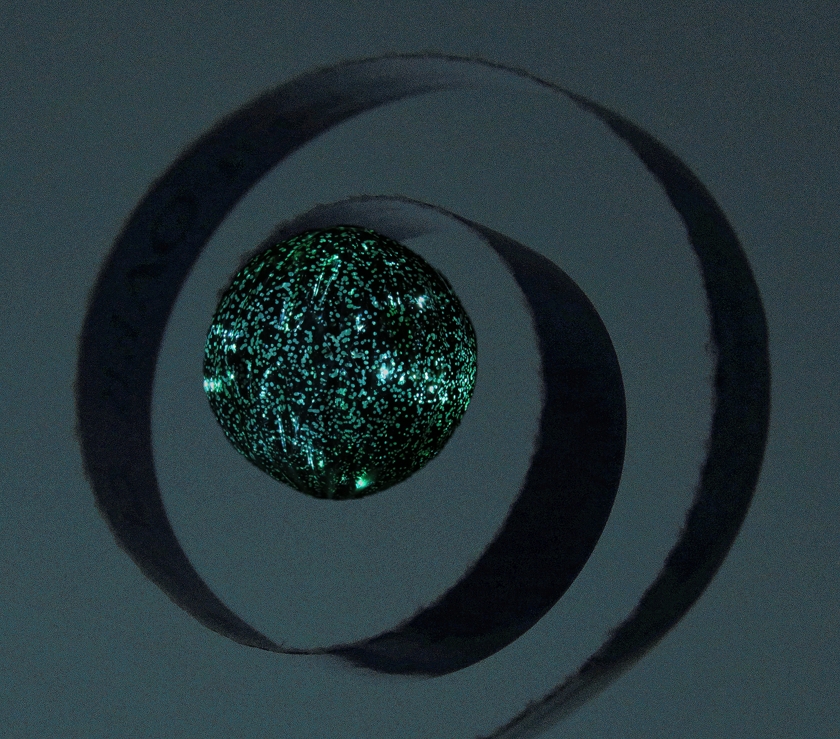
Portal ~ Pic and a Word Challenge #243

paper-curl_portal_840x739

One Way Among Many
|Stiff slick paper slides
|between thumb and blade to form
|a spiral portal.

Here are 2 quick questions for anybody inclined to think they have already paid close attention to the curling phenomenon:
        (1) Does the paper curl toward the thumb or the blade?
        (2) Why?

Confession: I could not remember which way it curled at the time I took the photo.  A few later repetitions answered (1) in the same way.  It curls toward the blade.  Dunno about (2).

language, philosophy, photography, science, seasons

Emergent Leaves and More

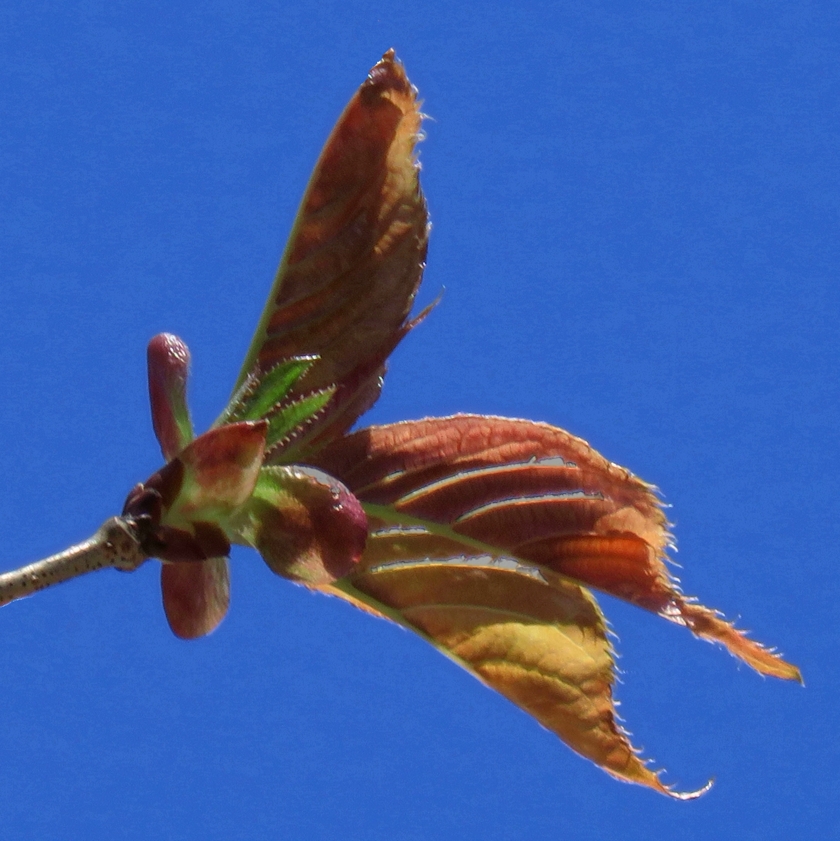
Much more.  Careful consideration of emergent things provides some hints about how to live fully and righteously on a little blue planet in a big oblivious universe.  Does that sound too grandiose?  Let’s start small, with some spring leaves and two ways to make adjectives.
(BTW, the [Menu] button atop the vertical black bar reveals the widgets.)

emergergent-sakura_crp-1_840x841

Turning Verbs into Adjectives

While we do it mostly by adding the suffix [-ing] (and maybe tweaking the spelling), we sometimes add [-ent] (or [-ant]) instead.  There is a subtle but important difference when we turn [emerge] into an adjective.  Leaves emerge and then go about the business of growing and photosynthesizing.  It would be a little better to say that my photo shows “emerging leaves” because there is no “and then” for emergent things.  They just are emergent.  What they emerge from is still there.

For example, look again at my photo, not as leaves but as an image.  It emerges from about 700,000 pixels encoded with about 480 KB of data in JPEG format.  That matters if I want to e-mail it to somebody who pays for data flow over a slow connection.  For many other purposes, to fret about the underlying pixels and bytes is a waste of effort.  The shapes and colors and composition are not in the pixels themselves.  They emerge from the way the pixels are arranged and interact with each other and the viewer.

My mild misuse of the [-ent] suffix for emerging leaves is a point of departure for considering bigger issues, not just a bow to the exact wording of Patrick Jennings’ challenge:

Emergent ~ Pic and a Word Challenge #232 – Pix to Words

Poetic Naturalism

Once we start looking for emergent things, we find that the world teems with them.  (Water, ice, and steam all emerge from crowds of the same kind of molecule.)  We find that fretting about “ultimate reality” may well be as pointless as trying to understand my photo by always diving down into those 480 KB and never looking at the emergent image.  While some contexts demand a deep dive, others demand a shallow one.

One of many places with examples and discussion of various emergent phenomena is Sean Carroll’s book The Big Picture, which somehow manages to be a good read (and a mostly easy one) despite dealing with deep stuff in science and philosophy while being fair to other viewpoints.

While nothing in science is nailed down as tightly as 3+2 = 5 in math, there is much evidence that we are in a tiny corner of a vast universe that goes its own way with no overall design or purpose or supernatural intervention.  Can we live fully and righteously in a cosmos that does not give a rat’s ass about beauty or goodness?  In much more detail than I can hope to put into a blog post, Carroll argues that we can.  Emergence is part of the story.

Tho a little queasy about Carroll’s use of the phrase [poetic naturalism] to name his upbeat attitude in the face of knowledge that would depress many people, I can’t think of a better name or a better attitude.

Don’t despair if love and justice seem as fanciful as unicorns when U consider only the underlying dance of atoms and molecules.  Love and justice may be real enough, but emergent.


fiction, humor, philosophy, science

A Tale of Two Kitties

In Dickens’ tale, Madame Defarge is obsessed with vengeance.  The characters in our tale have different obsessions.  One of them is with understanding the code used to knit the fabric of reality.
(BTW, the [Menu] button atop the vertical black bar reveals the widgets.)

When they called for weird stories to be submitted for Volume 2 of The Rabbit Hole, the editors suggested science and/or weather and/or entertainment as themes.  While the suggestion was not a requirement, many of the writers who responded did use those themes.  In particular, You’re Not Late has great synergy between weather and an aspect of science other than weather forecasting.  Maybe there are other great synergies; it will take me a while to read all the stories in RH-2.

Modern scientific theories are also stories, of a special kind.  Tho hard to read w/o wrangling equations, they are gloriously predictive and useful.  (U don’t need hard copy to read this post.)  They are also weird.  As the editors remark in the preface:

The stories are weird because life is weird; all these stories do is cross the boundary of our logic and assumptions, fetch a few samples from whatever lies beyond, and bring them back for you to see.  Just as explorers did in ages past, and scientists do today.
 

Back in 1935, the physicist Erwin Schrödinger told a story to illustrate the weirdness of quantum theory.  The story eventually became a celebrated meme, and here is yet another celebration:

Ode to Schrödinger’s Cat
|Schrödinger’s cat
|is both skinny and fat;
|both dead and alive
|(past age seventy five);
|both purring and hissing
|(while measurement’s missing);
|both mewing and yowling
|(while Einstein is howling).
|Schrödinger’s gone,
|but his cat carries on
|with a Cheshire cat grin
|at the pickle we’re in.

cheshire-cat

Hmmm.  Saying that the cat is “both dead and alive” is a common (and admittedly oversimplified) shorthand for the statistical limbo called “superposition of states” in quantum theory.  Here is a closer approximation to what the theory actually says:

If the box is opened now, there is a certain probability P_q (which we can approximate) that the cat will be observed to be dead, along with the complementary probability 1-P_q that the cat will be observed to be alive.  Before the box is opened, it makes no sense to say that the cat is “really” dead or alive.
 

Despite having a deterministic philosophy, Einstein had no qualms about common-sense probabilities:

The cat is really dead or alive, but we don’t know which.  From what we do know, we can compute an approximate probability P_c of the cat being dead now and an approximate probability 1-P_c of the cat being alive now.
 

Greenish-BunnyIs the clash between quantum theory and common sense just something for novice philosophers to argue about?  Nope.  To see why, we don’t need the nasty gadgets in Schrödinger’s story.  We need two kittens from the same litter, in separate boxes some distance apart.  We also — ah — ah — ACHOO!  The cat dander is ticking off my allergy.

Never mind.  There is a short humorous allegory about this stuff in my story Entanglements, with petting but no pets.  Spoiler alert: quantum theory wins.

Getting You’re Not Late and Entanglements and 27 other stories is easy.  Just buy RH-2.  To consider buying it from Amazon as either a printed book at $11.50 or an e-book at $2.99, click here.  To consider buying an e-book from other retailers at $2.99, click on the rabbit.

To see the Disney version of the Cheshire cat do its thing, U can get to a video on Facebook by clicking on the cat’s image here.  Clicking twice on the cat’s image there will start the video, but only buying RH-2 will get U to the 29 weird stories.

haibun, haiga, haiku, humor, philosophy, politics, seasons

Vampire Bunny at a Haiku Party

Follow tradition or push the envelope?  Normal or weird?  (Normalcy spiked with weirdness?)  Haiku or senryu?  This crowd does not fret about simplistic dichotomies.  Let’s get some saké and join the party.
– Gray button (upper left corner) reveals widgets, –
– above post (on phone) or beside it (on desktop). –


Haiku poems often want (and sometimes need) to interact with images or prose, as in haiga or haibun.  Here is a gathering of ten haiku that could stand alone if they had to.  (Some would rather not.)  They have been invited to come here and interact with just each other, while enjoying some good saké (or whatever).

momokawa_crop_vampire-bunny_840x684

Overlay © Incognito – Russian Federation | 123RF Stock Photo

A haiku inspired by an image may or may not speak to readers who have not seen the image.  It’s hard for the writer to make this call objectively.  That’s OK.  As Stephen Jay Gould often told readers of his articles in Natural History, perfect objectivity is a myth anyway.  (The path from my raw data to “facts” that matter to me depends on my cultural baggage and personal experience.)  Rather than pretend that my judgement calls are objective, I try to compensate for my biases.  In particular, some of my haiku were not invited to the party because they might be too dependent on their inspirations to stand alone.  That’s OK too.  Unlike me, they are not compulsively self-reliant.

Like some of the other guests, October was originally posted in a haiga or haibun context.  That’s why the title it wears as a name tag is also a link.  (When a pale yellow background indicates that several such guests arrived together from the same place, only one of them has a link.)  Click on a link to see the guest(s) interact with an image or some prose that adds to the experience of the haiku.

Seen in Spring
|Kelly green moss on
|rocks near the clear quiet stream
|with water striders 
|October
|Bright sun and cool air;
|azure skies and pumpkin pies.
|Leaves fall in glory. 
Who Miscounted?
|This so-called “haiku”
|ignores five-seven-five, so
|it’s not a haiku.
|Deciduous
|Lifeless?  No, leafless.
|Trees hold their breath all winter,
|exhale leaves in spring. 
This is Not Apollo 13
|Is failure an option?
|No, it is a given.
|But we will still try. 
|No Pots of Gold
|Seek ends of rainbows.
|You will not find them? Okay.
|The quest is enough. 
Fiscal Responsibility
|Debts rise; incomes fall.
|Hard times demand bold action:
|tax cuts for the rich! 
|Seize the Breeze
|Helicopter seeds
|fall from maples and travel
|far enough, this once. 
What’s for Lunch?
|Mosquitoes in flight
|are seen as meat on the hoof
|by a dragonfly. 
|Vampire Bunny
|With coprophagy
|as the alternative,
|you might suck blood too. 
humor, language, philosophy, photography

Don’t Sweat the Meaning of Life

Your life and mine are not arbitrary symbols used by a third party to communicate with a fourth party.  Don’t let sweating “the meaning of life” interfere with living.
(BTW, the [Menu] button atop the vertical black bar reveals the widgets.)

While pondering “the meaning of food” is rare, pondering “the meaning of life” is common.  Deservedly?  Buckle up and enjoy the ride.

§1: Colors

Meanings are tricky.  Colors provide a simpler way to explore some of the relevant ideas.

§1.1: What Color is the Number Six?

The question heading this subsection is nonsense.  Many different kinds of thing have colors, but numbers don’t.  Making sense is harder than just having sensible-looking syntax.

One of the ways that philosophy made substantial progress in the past century was the realization that some “deep” questions could be as nonsensical as the one heading of this subsection.  Determining which ones are really deep will take a while.  Nonsensical questions may sometimes be failed attempts to pose serious questions that would be more tractable with better wording, so some nonsense may deserve more sympathy than the heading of this subsection.

§1.2: What Color is the US Flag?

Flags do have colors, but the question heading this subsection is still nonsense.  The US flag is red, white, and blue.  While mostly red, the Chinese flag also has some yellow.  How many nations have flags of just one color?

Nobody is silly enough to speak of “the” color of a nation’s flag, but people often do fall into the trap of speaking of “the” thingamajig when there are in fact several relevant thingamajigs.  I posted 4 varied examples (and there are many more).

It does make sense to say that white is the color of the stars in the US flag, that green is the color of the fake foliage in my Xmas wreath, and so on.  But look at the ribbon on my wreath:

closer_crop_840x485

The color I see at any place on the ribbon is intricately context-dependent.  Where is the light coming from?  Where am I standing?  While the solid red ribbons on other wreaths are easier to describe, my iridescent ribbon is prettier to see.

§2: Words

Mole

© tunedin123 | 123RF Stock Photo
(Image has been cropped.)

The word mole has utterly different meanings in chemistry, dermatology, and espionage.  Even if we suppose it makes sense to attribute a meaning to life, pondering “the” meaning of life may still be like pondering “the” color of the US flag, “the” color of an iridescent ribbon, or “the” meaning of mole.

Like mathematical notations (and many hand gestures), words are arbitrary symbols with enough consensus about what they mean to support use in communication.  Who uses life to say what to whom?

I posted 4 imagined responses by an old Yankee to a novice philosopher’s bloviations; one of the responses is

Wehrds need meanings; life don’t.

§3: How to Live

Your life and mine are not arbitrary symbols used by a third party to communicate with a fourth party.  Maybe some concerns about “the meaning of life” are poorly worded concerns about how to live.  Preferring the workable to the grandiose, I go with a simple short list:

  • Try to have some fun.
  • Try to do more good than harm.
  • Don’t sweat “the meaning” of it all.
flowers, haiku, humor, love, philosophy, photography

Gift of Silence

The [Menu] button (atop the vertical black bar) reveals widgets like the Search box.  Typing just the [Enter] key into the Search box is a way to browse WordPress blogs.

Words ~ Pic and a Word Challenge

As Susie left home to start a new life with Dale, her mother watched and wondered.  Would the mixed marriage work?

Aware that sharing her worries would be unwelcome and unheeded, Mama let her words of warning remain unspoken and unheard.

susie-dale-mama_840x598

Wisely,  Mama kept silent despite having words to say.  Unwisely, some people run afoul of Wittgenstein’s Laws by breaking silence despite not having any sensible words to say.

Memo to Mystics
|Unless you can grab
|bubbles, you cannot put your
|wisdom into words.

soap-bubbles

growing old, haiku, humor, philosophy

Old Age is a Mixed Bag

Yet again, classical literature says something complex and important, while leaving much for later generations to discover and say.  For now, I will shut up after 2 haiku.
(BTW, the [Menu] button atop the vertical black bar reveals the widgets.)

Carpe Diem Weekend Meditation #61
a new feature for the weekend … introduction

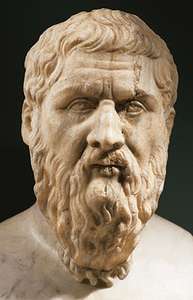
calls for Japanese-style poetry inspired by an excerpt from Plato.  (An excerpt from the excerpt appears below.)  Yet again, classical literature says something complex and important, while leaving much for later generations to discover and say.  For now, I will shut up after 2 haiku.

Plato-CDHK

“… the pleasures of youth and love are fled away: there was a good time once, but now that is gone, and life is no longer life.”

“… when the passions relax their hold, then, as Sophocles says, we are freed from the grasp not of one mad master only, but of many.”

“… for he who is of a calm and happy nature will hardly feel the pressure of age, but to him who is of an opposite disposition youth and age are equally a burden.”

“… I rather suspect that people … think that old age sits lightly upon you, not because of your happy disposition, but because you are rich, and wealth is well known to be a great comforter.”

Fond Memories
|Nostalgia for
|what never was (nor could have been):
|old man dreams of sex.
|
Still Standing
|Mellow curmudgeon
|shrugs off fate and stands proudly
|paradoxical.
humor, philosophy, photography

Novice Philosopher Meets Old Yankee

The novice bloviates.  Maybe people he has not met yet will try to set him straight.  They might say pretty much what the Yankee says, while making the points in ways that are gentler, longer, and subtler.  But not as funny.
(BTW, the [Menu] button atop the vertical black bar reveals the widgets.)

… Why are we here? …

‘Cuz wer nawt theyah.

… What is the meaning of life? …

Wehrds need meanings; life don’t.

What happens when an irrestible force meets an immovable object?

We lehrn who was lyin’: the fellah sellin’ a fawhrs or the fellah sellin’ an awbject.
Hmmm.  Coulda been both.

Certainty is not exclusive to math and logic.
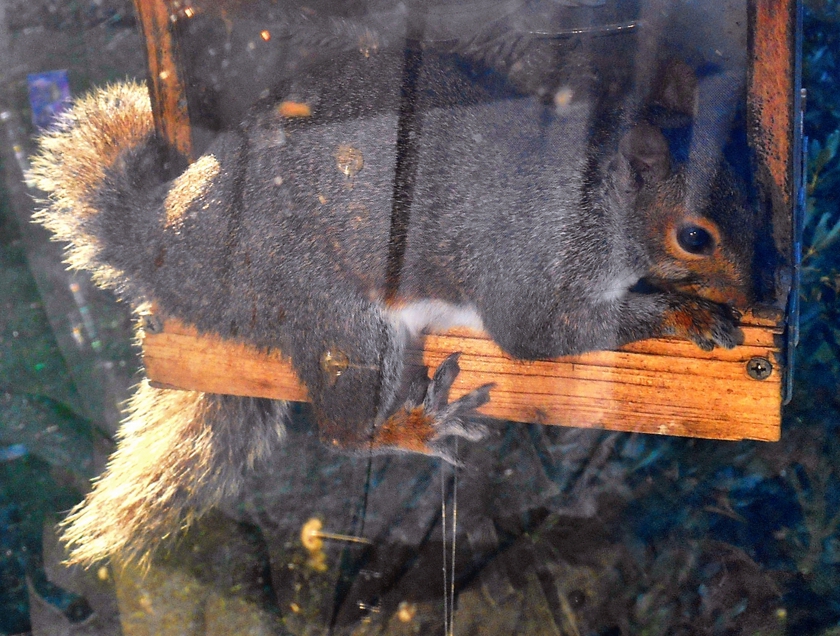
For example, no squirrel can get past the baffle on my bird feeder.

Ehyah??

squirrel_840x636