October bends w/o breaking.
2016 in the Hudson Valley
Wind and rain impaired
October’s color pageant.
Still the year’s best month.
(BTW, the [Menu] button atop the vertical black bar reveals the widgets.)
2016 in the Hudson Valley
Wind and rain impaired
October’s color pageant.
Still the year’s best month.
Deciduous
Lifeless? No, leafless.
Trees hold their breath all winter,
exhale leaves in spring.
Who’s Bhaskara? We will get to that question shortly. First, consider whatever gadget U are using to read this post. It depends on many things, discovered over many years by many people who (unlike many pols) preferred building up to tearing down. With many steps omitted (and “depends on” abbreviated to ←), a few of those dependencies go like this:
Your Gadget ← quantum physics ← coordinate systems ← Pythagoras’ Theorem
Back in high school, Pythagoras’ Theorem may have seemed like a little fact about right triangles that may have been mildly interesting but did not deserve the effort of slogging thru the book’s tedious proof. I could read the proof line by line, observe that it was valid, and be glad that I never needed to retrieve it for a test. Hardly anybody could remember it for more than a few minutes.
Pythagoras’ Theorem turned out to be essential to blogging (and much else), so it would be nice to have a proof that mere mortals could remember, appreciate, and be inspired by. Enter Bhaskara, 1114-1185.
Bhaskara replaced the usual picture (of 3 squares glued to the sides of 1 triangle) with a picture of 4 copies of the same triangle, arranged to form a big square with a little square inside it:

The proof is sometimes displayed more tersely, with just the figure. I prefer to write out a little algebra (while not belaboring why the angles do add up the way the figure suggests). Tho he did not have modern notation, Bhaskara did have an elegant way to provide more detail for the mathematically fastidious. He displayed another figure that also puts the 4 copies of the triangle inside a big square with sides a+b. In the other figure, the area not covered by copies of the triangle amounts to a²+ b² because it consists of 2 small squares. But the not-covered area amounts to c² in the figure displayed above, so we can conclude that
a²+ b² = c²
w/o bothering with algebra and how to compute areas of right triangles. We just need to bother with drawing both figures. Wanna try your hand at drawing the other figure? U can find the answer by following the link provided by Sieglinglungenlied in the comment section.
OK, I admit that having written a proof of mind-blowing elegance does not really qualify Bhaskara to be POTUS. Too bad that many people think mind-blowing arrogance can hack it.
Clicking on the “politics” category or tag in this post will display all my uses of acidic humor to cope with the current state of US politics. But acids are corrosive. Sometimes, I forgo acid and contemplate some of the enduring (so far) glories of modern Western civilization, one of which is that it is not exclusively Western. In particular, we got some elegant math from India and some elegant poetry forms from Japan.
One Way to Stay Sane in the Age of Trumpery
Cherish all that is
true and good and beautiful
(like Bhaskara’s proof).

© Wisconsinart | Dreamstime.com
As American politics in 2016 illustrates, Calliope’s portfolio is not as weird as I would wish. Neither is my title.
Stale Bread Can Wait
My muse is stingy (when implored)
or really bitchy (when ignored).
If I want to sing of croutons
(but her fancy turns to plutons),
I have just one way to go:
with the mighty magma flow.
As I discovered long ago when I tried to read an English translation of Goethe’s Faust, poetry in couplets tends to sound silly even when it is dead serious. Now that I have had my little respite from blank verse in haiku form, maybe I should go back to solemn austerity. Maybe.
What the World Needs
More silliness from
those who know they are silly;
less from the others.

Sadness
It is a liquid.
It wets the soul and somehow
never fully dries.

While I did not take the photos shown here, I did write the haiku.

Many amazing photos have been submitted to the Weather Channel’s It’s Amazing Out There / 2016 Photo Contest. The contest has both expert judging and voting for the “fan favorite” by anybody with a Facebook account. U can vote daily until 2016-08-26 and distribute those votes however U like. Having viewed only a few of the submissions, am I competent to recommend votes to other people? Not really, but Donald Trump has set the competence bar low enough to be cleared by a garden slug. Being a little more competent (and a lot more honest) than Trump, I will share my enthusiasms anyway, with cropped/resized versions of 2 submissions.
While I have been voting enthusiastically for Coming Storm by CJDraper (aka Dancing Echoes on WordPress), I also want to salute the fan favorite as of the last time I looked: Ozzie (a bald eagle) by Davedc. The latter already has plenty of well-deserved votes, so I wrote a haiku inspired by it.
Mythornithology
When we saw himself,
Narcissus forgot to drink.
Eagle had more sense.

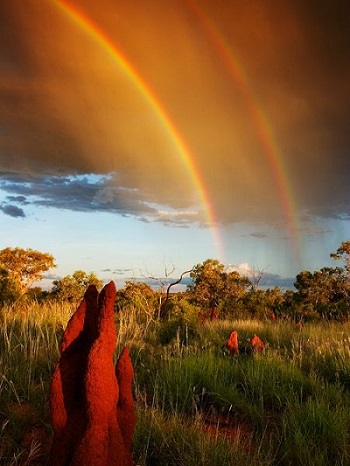
To illustrate my response to Carpe Diem # 1020 rainbow, I did a quick search that found more fine images of rainbows than I could view in a lifetime. The image used here jumped out because it has a vertical format, does not need the rainbow to grab me, and hints at a futile yearning. The termite mound in the foreground looks like a hand trying to grasp the rainbow.
Termites are much too busy building mounds and digesting cellulose to indulge in such yearnings. Humans are busy too, and many of us have some awareness of the geometric reasons that a rainbow is forever out of reach. We sometimes yearn anyway.
No Pots of Gold
Seek ends of rainbows.
You will not find them? Okay.
The quest is enough.
The image used here is a photo by Randy Olson that was available at the time of posting as computer desktop wallpaper from National Geographic.
Many of the haiku I like have 2 contrasting parts (called fragment and phrase by Jane Reichold) in a juxtaposition that may seem incongruous at first. (Much of the fun comes from realizing that the juxtaposition does make sense, perhaps because one part clarifies the other.) After quoting from Jane’s essay Fragment & Phrase Theory, Kristjaan Panneman asks readers of Carpe Diem Theme Week (6) 5 “Ask Jane …” to honor her memory with a haiku in this style. My attempt is a haiku with
Ad honorem: Jane Reichold, 1937-2016
It is as she said:
rules should not be carved in stone.
Bamboo bends with wind.

The image used in this post has been resized from the original by Skip Allen; U can see the original in full glory by clicking on the link in item #1 below. The original post using the image is gratefully reblogged (in effect) by item #2.
Soon after the wild daylilies have finished blooming, another flower in my yard turns to prophecy. The pale blue blossoms are long gone, but a few of the leaves on a few of the plants have another calling now. For about a day, they prophesy the next season.

Prophet for a Day
Wild geranium
(just one leaf for just one day)
turns in high summer.
This post’s haiku began as part of my comment on Sieglinglungenlied’s beautiful and creative post Partners, Flying through Clouds. I realized later that the haiku could live outside the comment with an appropriate title. (I like titles for haiku anyway.) Thank U, Sieglinglungenlied. Thanks are also owed to photographer Dan Hahn, with details at the end of this post.

Lovers Watching a Sunset
The clouds burn yellow,
smolder red, and fade to gray.
The love keeps burning.
It would have been nice to illustrate the poetry with a series of 3 images that show the same clouds at successive stages of a sunset: yellow; red; gray. Even if I shoot such a series in the future, I would never be able to get a series that includes the lovers. So I did an image search, found many fine images of sunsets being watched by lovers, and found an outstanding one by Dan Hahn that showed all 3 color stages, in different clouds at the same moment. Bingo.
The image as used in this post has been cropped to emphasize the clouds; U can see the original in full glory by clicking on the link in item #1 below. Haiku lovers will also enjoy item #2, and there are other treasures on Dan Hahn’s website. Prints can be bought.
In response to CARPE DIEM HAIKU KAI: Carpe Diem #989 Oak …
Gifts from an Old Oak
Acorn stew tonight?
No, let them feed squirrels or
grow to be old oaks.
Please read the fine contribution by Dancing Echoes to this episode.
At her throat, he pressed
The knife and told her to strip
She leaned on the blade
In response to Carpe Diem Utabukuro #12, I admire Poet Rummager’s haiku for 3 reasons.
Whether #1 also applies to my own grim haiku is for others to say; I do have #2 and #3.
Edge of Enlightenment
Behold the abyss
without flinching. If you can,
then you are at peace.

The haiku by Dancing Echoes that is effectively reblogged below is one that I admire because it deals so well with big concerns. While I do appreciate haiku about particular fleeting moments in nature, I also like to try summarizing a general discussion or attitude very briefly, with a haiku.

Both art and science
Plus a little bit of luck
Makes a good vintage
I will complete my response to Carpe Diem Utabukuro #12 with my own new haiku shortly, but first I want to admit that a zingy summary may be a serious oversimplification if taken too literally. With an understanding about wiggle room, a forthright oversimplification is sometimes better than an attempt to dot every i and cross every t.
My haiku is not quite so extremely oversimplified as it may seem. I am considering Buddhism only as the attitude toward life that I take to underlie the organized religion. Peel away the legends and rituals. Peel away the historical adaptations to local circumstances. What do I find after much peeling? I find green tea, the sound of one hand clapping, and a haiku.
Buddhism in 6 Words
Shit happens.
Keep calm;
be compassionate.

 I took my favorite photo of my late wife Edith in 1981, long before she showed symptoms of the disease that would dominate our lives in the current century. Alzheimer’s. I cared for her in our own home as long as possible; I visited often during her final years in a nursing home. This post is about one aspect of the endgame that may be helpful to others in a similar situation.
In Edith’s childhood home city, the Ohio River emerges from the confluence of smaller rivers. Three streams flow together at the end of this post. Please bear with me.
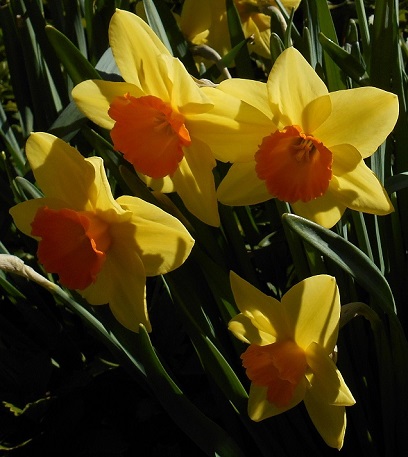
“Are you ready to bring Edith home now?” The funeral director’s question at the end of the calling hours brought me a sense of relief. She could come home at last, in our own car. While she waited for reunion with her favorite flowers in the spring of 2015, I began what eventually became a trilogy of haiku.
Widower’s Song #1
|No haiku can say
|how strange this is: her journey …
|ended before mine.
Widower’s Song #2
|Warm earth welcomed her,
|ashes among daffodils
|she planted and loved.
Widower’s Song #3
|Ghosts do not haunt me.
|Remembered joys can often
|overcome regrets.
In response to Sometimes Stellar Storyteller Six Word Story Challenge:
I scattered
her ashes
among daffodils.
Long ago, I drove/flew/drove to a motel in the town on the western edge of Rocky Mountain National Park in Colorado. Soon afterwards, I hiked into the park, admired an alpine lake, ate a trail lunch, and hiked out in a thunderstorm that mocked my “waterproof” boots. Nothing epic, but well beyond me now. That’s OK. I did it once (which was more than enough for the thunderstorm part).
Some people consider it a miracle when the government does something right. Over the years since that trip to Colorado, the EPA adopted (and enforced!) vehicle emissions standards. I can walk the roads near my house w/o being assaulted by trucks and school buses belching black diesel crud. Their exhaust is still smelly and unhealthy, but not bad enough to ruin a walk on a breezy day. So I can often walk about 1.5 miles to the far end of an artificial pond beside the road. An artificial pond ringed by hilly pasture land is not the same as a natural lake ringed by mountains, but water is water and blue sky is blue sky.


After a few rainy days, excess water in the pond rushes thru a culvert under the road and into the little brook that was dammed to create the pond. I can admire the exuberant splashing on the rocks in the brook w/o dwelling on the artificiality of the scene.


Sound of Sunlight
Rushing waters bring
joy to those who hear them sing
and see them sparkle.
Happy Heraclitus
(added 2018-06-07)
Life flows and splashes.
No things are permanent and
all things are precious.
“The purpose of our lives is to be happy.”
Being calm and compassionate is also important in Buddhism, so I have responded to
Carpe Diem Tokubetsudesu #72 Use that quote
by expanding the Dalai Lama’s quote about being happy into a haiku about being all 3. Rhododendrons originated in Asian mountains, so a photo with 3 clusters of their blossoms seems appropriate for illustrating the rather abstract haiku to follow.

Riff on a Quote from
Tenzin Gyatso (14th Dalai Lama)
Be calm and happy.
Give loving help to those
who are frantic or sad.


