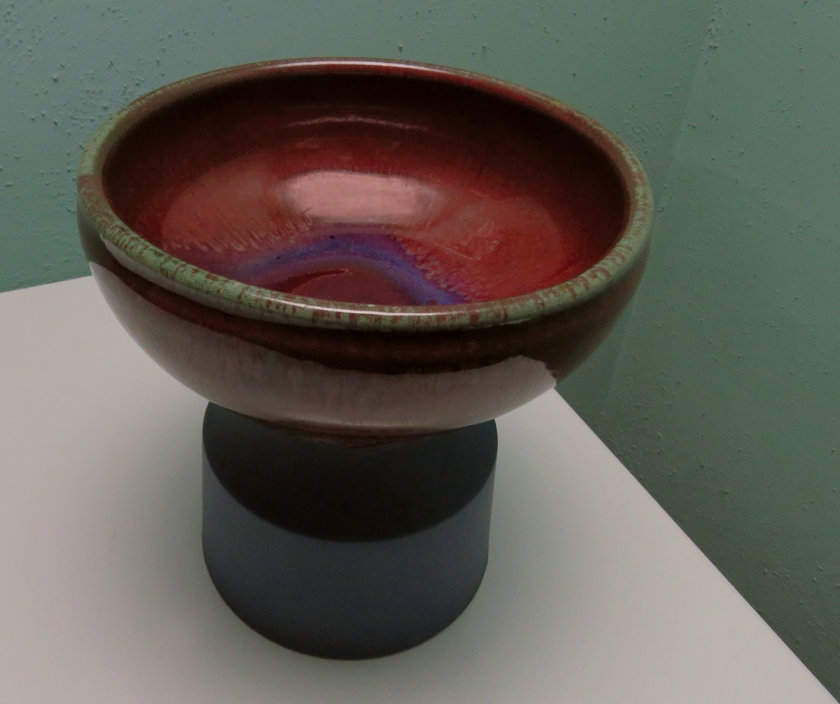
Gurērisu
Jump! Grab! Swing hips up!
Nimble ninja hogs the seeds.
Birds have a long wait.

Gurērisu
Jump! Grab! Swing hips up!
Nimble ninja hogs the seeds.
Birds have a long wait.

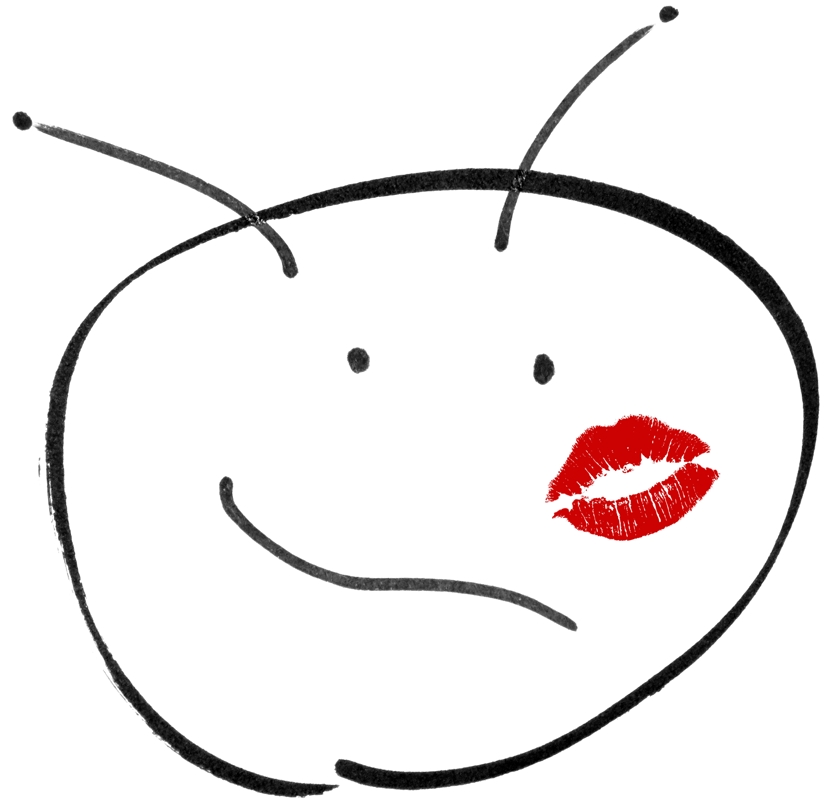
Kiss Overlay © OlyaTropinina | 123RF Stock Photo
Mission Accomplished?
Ant with wings staggers,
then dies. Did I see him smirk?
Had he banged a queen?
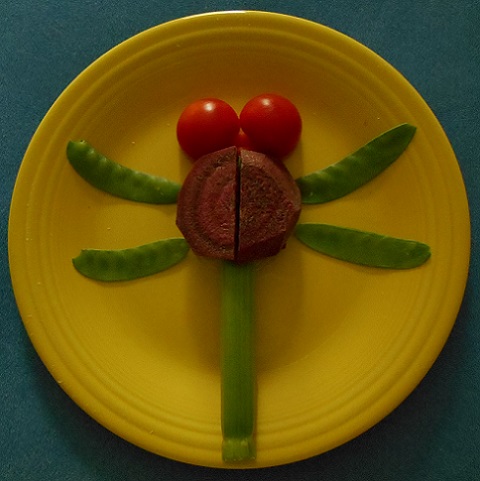
One day in 2015, I happened to arrange my lunch veggies so as to look a little like a dragonfly, with snow peas as wings. Hmmm. Maybe I could pull more veggies from the fridge and make an arrangement that looks a lot like a dragonfly to me. (No real dragonfly would be fooled.) This little project reminded me that a dragonfly is the enemy of my enemy, and thus my friend.
What’s for Lunch?
Mosquitoes in flight
are seen as meat on the hoof
by a dragonfly.
When they called for weird stories to be submitted for Volume 2 of The Rabbit Hole, the editors suggested science and/or weather and/or entertainment as themes. While the suggestion was not a requirement, many of the writers who responded did use those themes. In particular, You’re Not Late has great synergy between weather and an aspect of science other than weather forecasting. Maybe there are other great synergies; it will take me a while to read all the stories in RH-2.
Modern scientific theories are also stories, of a special kind. Tho hard to read w/o wrangling equations, they are gloriously predictive and useful. (U don’t need hard copy to read this post.) They are also weird. As the editors remark in the preface:
Back in 1935, the physicist Erwin Schrödinger told a story to illustrate the weirdness of quantum theory. The story eventually became a celebrated meme, and here is yet another celebration:
Ode to Schrödinger’s Cat
Schrödinger’s cat
is both skinny and fat;
both dead and alive
(past age seventy five);
both purring and hissing
(while measurement’s missing);
both mewing and yowling
(while Einstein is howling).
Schrödinger’s gone,
but his cat carries on
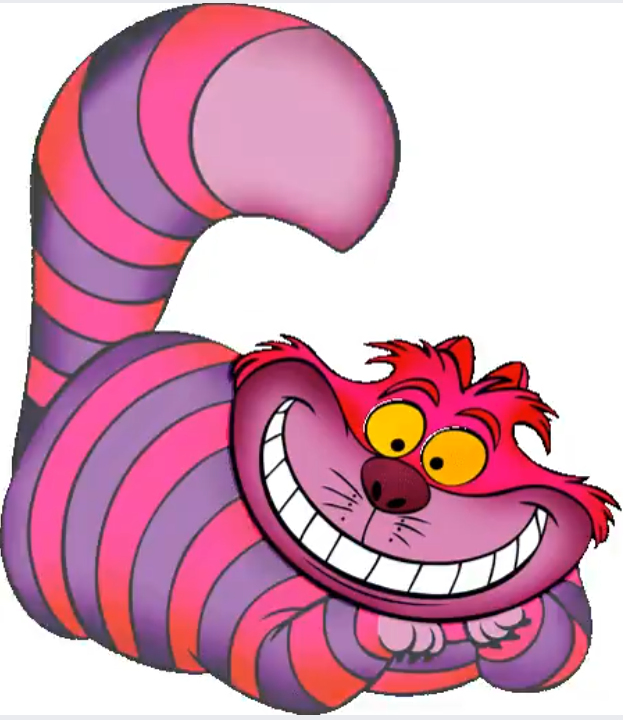
with a Cheshire cat grin
at the pickle we’re in.
Hmmm. Saying that the cat is “both dead and alive” is a common (and admittedly oversimplified) shorthand for the statistical limbo called “superposition of states” in quantum theory. Here is a closer approximation to what the theory actually says:
Despite having a deterministic philosophy, Einstein had no qualms about common-sense probabilities:
Is the clash between quantum theory and common sense just something for novice philosophers to argue about? Nope. To see why, we don’t need the nasty gadgets in Schrödinger’s story. We need two kittens from the same litter, in separate boxes some distance apart. We also — ah — ah — ACHOO! The cat dander is ticking off my allergy.
Never mind. There is a short humorous allegory about this stuff in my story Entanglements, with petting but no pets. Spoiler alert: quantum theory wins.
Getting You’re Not Late and Entanglements and 27 other stories is easy. Just buy RH-2. To consider buying it from Amazon as either a printed book at $11.50 or an e-book at $2.99, click here. To consider buying an e-book from other retailers at $2.99, click on the rabbit.
To see the Disney version of the Cheshire cat do its thing, U can get to a video on Facebook by clicking on the cat’s image here. Clicking twice on the cat’s image there will start the video, but only buying RH-2 will get U to the 29 weird stories.

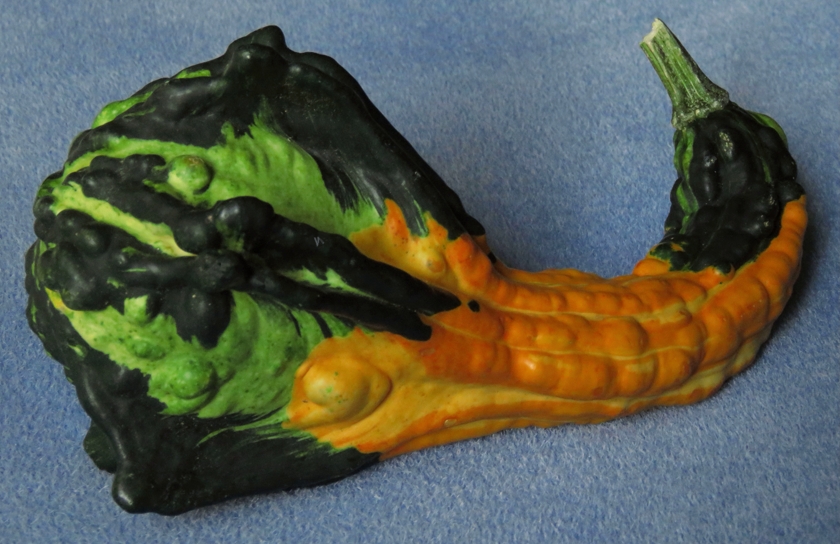
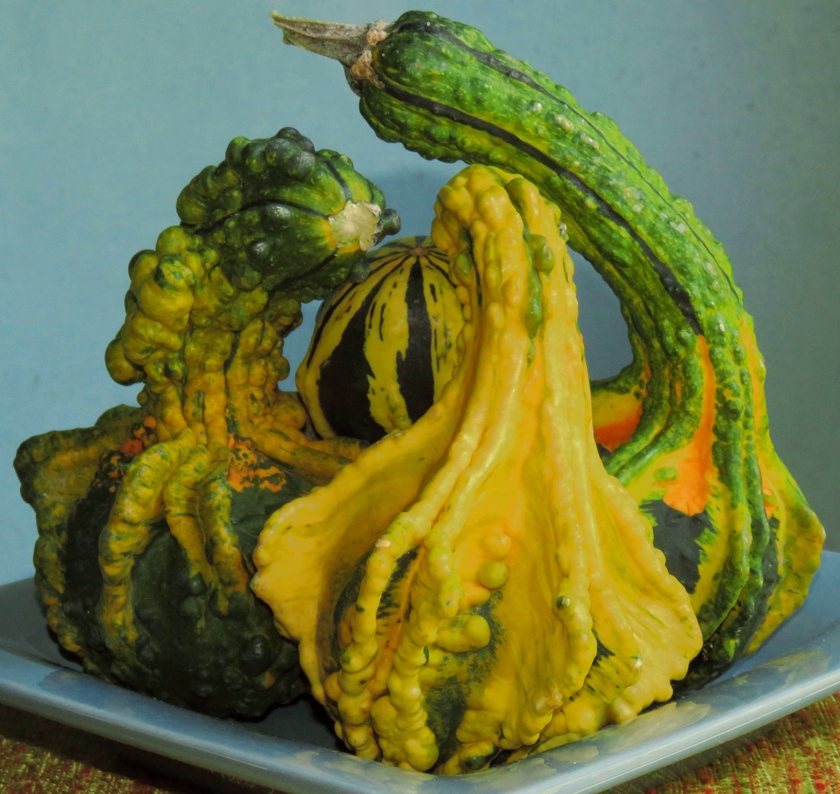
“Buy me!” says the wonderfully colored gourd. I refuse:
“No, I’ve already bought what I need for this year’s fall decorations. There’s no room for another gourd.”

“But I’m new and special. Look at the feathering between my greens.”

“OK.”
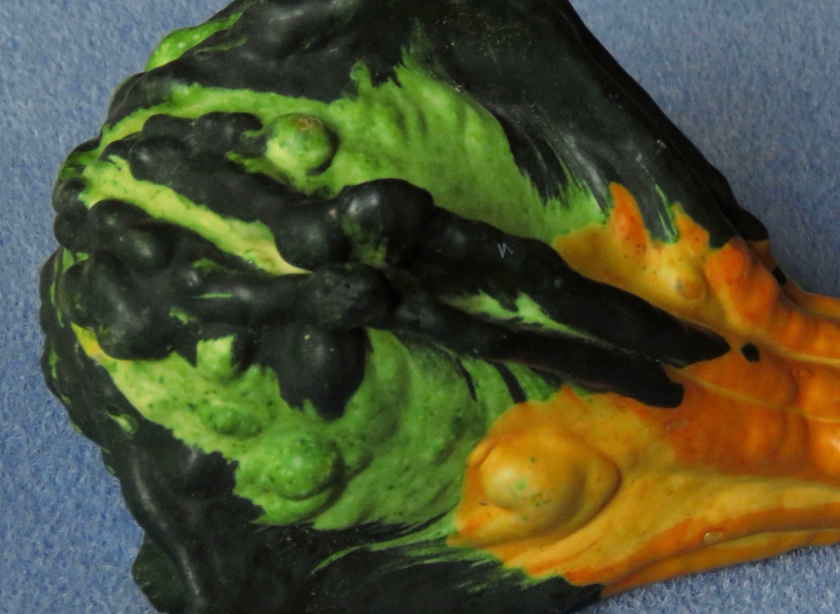
I put the gourd in the cart, check out, and drive home. As I unpack the groceries, I happen to set the new gourd down in a way that is vaguely reminiscent of a reclining nude. Then I recall a milestone in photographic history.
Edward Weston’s meticulous closeup photos of scores of common objects (notably bell peppers) are marvels of imagination and ingenuity. They also prompt one critic to remark that Weston’s peppers look like nudes while his nudes look like peppers.

Weston works in grayscale (aka “black and white”). The color of a pepper would only be a distraction anyway. While people have various skin colors, nobody’s skin is red or green.
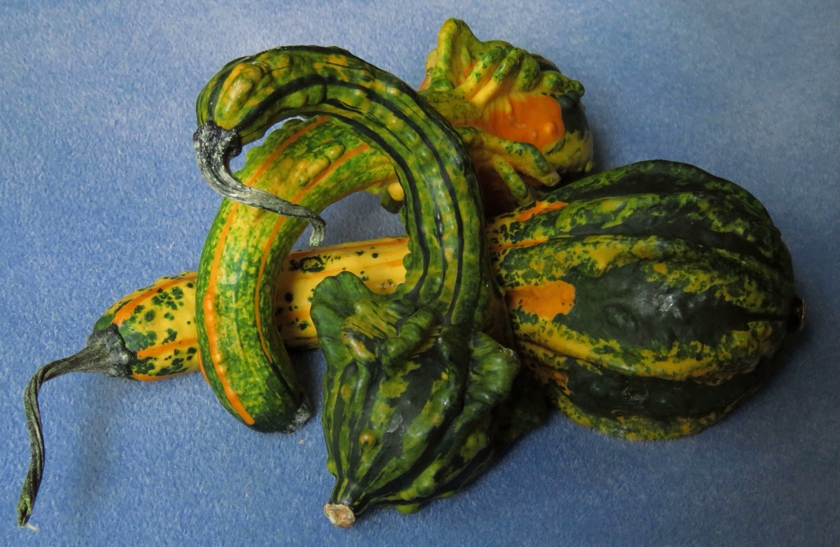
“Buy us!” say 3 colorful gourds. I refuse:
“No, I’ve already bought an extra gourd that I will use to salute Edward Weston.”
“Last year, U bought a total of 10. We’ll just bring it up to 8.”
“Last year’s gourds were smaller and came in bags of 5.”
“Weston bought more than 30 peppers.”
“But he could eat them when he was done shooting.”
“Puhleeze!”
“OK.”

I’m a pushover. ¯\_(ツ)_/¯
Remember when cameras used analog film, color darkroom work was sorcery, and color prints faded under museum lighting? Artistic photographers had to work in grayscale. Viewers did not pine for color in the masters’ photos.
Sadly, some photographers mistook a temporary necessity for a permanent virtue. Wanna create a colorful image? Buy some tubes of paint. Stick with grayscale for artistic photography.
The sweeping general assertion of grayscale’s intrinsic superiority was a gross insult to Eliot Porter (and to all who hiked the trails he blazed in color photography).
Some photos do look better in grayscale than in color. Maybe something with interesting contours and textures happens to have distracting colors. Grayscale is great for Weston’s peppers.
Sometimes progress replaces an old thing with a new one that is all-around better, as in the transition from analog film to digital pixels. The transition from obligatory grayscale to color (in varying degress of saturation) is a subtler kind of progress that adds choices. Lots of choices.
Photo editing software supports having some color classes or parts of an image be more saturated than others. Done casually and obtrusively, it can be gimmicky. Done carefully and subtly, it can work with other edits to greatly improve a photo. One of the contemporary photographers I admire steps thru instructive examples:
What I Am Working On: Building Blocks
What I Am Working On: Fiddling
If U choose to desaturate a photo (either partially or all the way to grayscale), I may disagree with that choice. I will still respect it, but only as a specific choice. What I won’t respect is a blanket assertion that photos “should” be in grayscale. Or in color. Or have shallow depth of focus. Or have everything in focus. Or whatever.
Here is one blanket pronouncement that I do respect, in photography and beyond:
Don’t hide behind sweeping generalities.
Own your choices.
While the juxtapositions collected by Mitch Teemley are all clever and funny, the ballerina/tulip photo is special. Because their stems keep growing and tend to flop over, tulips are tricky in flower arrangements. It’s one of life’s (littler) lemons. The ballerina/tulip photo makes lemonade.(BTW, the [Menu] button atop the vertical black bar reveals the widgets.)
(Click on any image to enlarge it, or to begin slide show)
For several years before and after 1960, I watched many episodes of the TV shows The Twilight Zone and Alfred Hitchcock Presents. The best of them were imaginative and well-crafted, not just weird or scary. Some episodes had ironic twists or clever ways of conveying hints about how to cope with a nasty world. Some endure on YouTube.
Memories of those old shows resurfaced when I read some of the shorter stories in The Rabbit Hole, Volume 2. (Will wait until I have the ink-on-paper version of RH-2 before reading the whole thing.) The ambiance and a few details in two stories were strong triggers: … Puppet Theater … for The Twilight Zone and Carpaccio for Alfred Hitchcock Presents.
Various kinds of humor often appeared in those old shows, and RH-2 continues that tradition. The humor in RH-2 can be cynical (as in A Towering Tale), dark (as in The Service Call), or light (as in The Apple Cosmos and Entanglements). In old shows and new book, the humor is more than just giggles at pratfalls.
Click here to find out how to preorder RH-2 at a discount from Amazon. (For other retailers, click on the image below.) Don’t worry if U miss the discount. Both the e-book and the printed book will still be quite affordable after the release on 2019-10-01, and there are plenty of other things to worry about.
Serendipity in 2019: I got this post’s image for The Twilight Zone from the web page announcing the show’s revival with streaming technology. But I settled for a discontinued tee shirt design that approximates my vague memory of the logo for Alfred Hitchcock Presents. Whatever works.
Zen lore includes some stories with endings of the form
At that moment, __________ attained enlightenment.
Fill in the blank with the name of somebody who studied Zen for some time and finally saw the light when his teacher said or did something outrageously weird.
While my story Satori from a Consulting Gig does not presuppose any knowledge of Zen lore, it does have a surprise ending (partly inspired by those Zen stories) with my own way to fill in the blank. Using the past tense in my story’s last sentence helps make the allusion to Zen lore clear to those who might care about it.
Did I choose to write my story in the past tense because I planned to end it that way? Not consciously. I just set out to write a short story. I’ll write some fiction. I’ll use the customary past tense. Doesn’t everybody?
Not quite. I got over 16 million hits when I googled
present tense vs past tense fiction
much later, in preparation for writing this post. Before discussing some pros and cons that are out there (and some that may be new), there is a little more to be said about my story’s tense situation.

© S. Silver | 123RF Stock Photo
My story was written for an anthology whose editors asked the contributors to supply blurbs. I wrote a blurb in the same tense as the story, then noticed that other contributors wrote blurbs in the present tense for stories in the past tense. Why? I found the inconsistency troubling.
Another contributor (Sue Ranscht) kindly remarked that the present tense “creates a punchier tease” in blurbs than the past tense does. Indeed. Why not make the actual story (not just the blurb) be as vivid and engrossing as it can possibly be? Unless there is a specific reason to use the past tense, why not write in the present tense?
Written in the present tense, my newer story Entanglements begins with
Squatting over the airport, a thunderstorm supercell demolishes …
Yes, the word demolishes might be misread as (a typo for) demolished. Yes, the reader might be a little disoriented at first. Worse, the reader might suspect that gimmicky writing is camoflage for weak content. Such concerns loom large in a thoughtful page that recommends using the past tense by default and the present in some special cases. We can agree on the bedrock principle that one size does not fit all, even as we disagree amicably on where to draw some lines and how strongly to weight some concerns. That’s a respite from the train wreck of contemporary politics.
Dunno how 16 million hits in my Google search compares with how often the present tense has actually been used in good stuff. As good uses accumulate, the prudential reasons for defaulting to the past tense will gradually weaken. Of course, there will always be people who believe that the earth is flat, the moon landings were faked, and
Thou shalt write fiction in the past tense.
came down from Mount Sinai with Moses.
Readers (and writers!) may not be native speakers of English. As with many other aspects of language, English is exuberantly irregular in how it forms the past tense. People learn the past tense of a verb later (and less thoroughly?) than they learn the present tense. Can U hear the rumble of an approaching storm?
When offline (or distrustful of Google Translate), Pierre consults his French/English dictionary. How can he say prendre in English? No problem. Just say take. But Pierre is writing in the customary past tense. Neglecting to look up take in the other half of the dictionary, he says taked where he should say took.
Consider 3 common ways that verbs ending in -it can form their past tenses: hit/hit, pit/pitted, and sit/sat. Quick now: knit/knit or knit/knitted? Shit/shit or shit/shat?
There are a few verbs with 2 ways to form the past: an irregular usual way and a regular way for a special usage:
This last nuance is subtle enough to trip up some native speakers.
Pierre is back. The draft of his story has a short paragraph about some taking that happened at an earlier time. Not fond of flashbacks, he has a good reason to put this paragraph as late as it is, not earlier in the narrative.
Sadder but wiser after being corrected by a ten-year old whose first language is English, Pierre refrains from writing had took for the past perfect for the verb take. He looks up the actual past participle and writes had taken.
Pierre’s pluperfect paragraph is grammatical but clunky. What to do? Rewrite the main narrative in the present tense and the clunky paragraph in the past. That will be a chore, but such a clear and distinct idea deserves the effort. Descartes would approve.
John has been writing screenplays that often use flashbacks. Now he wants to write a novel and still likes flashbacks. He realizes that readers would be confused if nothing but a paragraph break separates what the characters do and experience “now” (from their viewpoint) from the start or end of a flashback. There is a lot of sensible advice out there about things like narrative transitions to and from flashbacks, but John wants to stay closer to his cinematic roots. He uses the present tense for the main content and the past tense for the flashbacks. If he also switches to a noticeably different font for the flashbacks, that might be enough in most places (after narrative transitions for the first few flashbacks).
Jane has been writing historical fiction and using the past tense to make it look like history. Now she wants to write fiction with a first-person narrator and package it as a rather one-sided conversation with an implicit listener. She plans to keep the past tense for the main content and add some present-tense remarks, often in response to what the listener has presumably just said. The present-tense remarks will be frequent and incongruous. The narrator will tell a self-serving version of a sequence of events in the past tense while accidentally revealing the darker and/or funnier truth in the present tense.
I warned Jane that readers (especially impatient thick-headed guys like me) may just take the narrator to be ditzy and bail out early. But Jane is game to try. If she does make it work, I know a good place to submit her story.

The Rabbit Hole is a series of anthologies of weird stories, with a troika of editors. Volume 1 came out in 2018, Volume 2 is scheduled to come out on 2019-10-01, and the editors hope to continue annually. Maybe Jane can contribute to Volume 3.
My story Satori from a Consulting Gig in Volume 1 is just 2 pages long, so even those who dislike it may still be glad they bought the book for $2.99 as an e-book or $12.50 as an ink-on-paper book.
While every extended narrative in Volume 1 uses the customary past tense, Volume 2 will have at least two stories told in the present tense. No, the editors’ fondness for weird stories does not extend to a fondness for weird writing. As originally submitted for Volume 2, my story Entanglements did have some weird writing at the end that seemed unavoidable to me. One of the editors (Curtis Bausse) suggested a strategy for avoiding the unwanted weirdness, and the strategy worked. There was no fuss at all about my use of the present tense. That is as it should be.
Haiku poems often want (and sometimes need) to interact with images or prose, as in haiga or haibun. Here is a gathering of ten haiku that could stand alone if they had to. (Some would rather not.) They have been invited to come here and interact with just each other, while enjoying some good saké (or whatever).

Overlay © Incognito – Russian Federation | 123RF Stock Photo
A haiku inspired by an image may or may not speak to readers who have not seen the image. It’s hard for the writer to make this call objectively. That’s OK. As Stephen Jay Gould often told readers of his articles in Natural History, perfect objectivity is a myth anyway. (The path from my raw data to “facts” that matter to me depends on my cultural baggage and personal experience.) Rather than pretend that my judgement calls are objective, I try to compensate for my biases. In particular, some of my haiku were not invited to the party because they might be too dependent on their inspirations to stand alone. That’s OK too. Unlike me, they are not compulsively self-reliant.
Like some of the other guests, October was originally posted in a haiga or haibun context. That’s why the title it wears as a name tag is also a link. (When a pale yellow background indicates that several such guests arrived together from the same place, only one of them has a link.) Click on a link to see the guest(s) interact with an image or some prose that adds to the experience of the haiku.

© Betty Shelton | 123RF Stock Photo

© Dan Hahn
Sunset on the Next Day
The clouds burn yellow,
smolder red, and fade to gray.
The love keeps burning.
Rockets lit the sky last night;
more fireworks in bed tonight.

© Scott David Patterson | 123RF Stock Photo


Memorial Colors
Lavender salutes
red, white, and blue of our flag.
Pride and gratitude.
Red ~ Pic and a Word Challenge #187

Carpe Diem Weekend Meditation #81
Poetry Archive (5) loneliness or emptiness
Choose a haiku, tanka or other form of Japanese poetry from your archive and share it with us all. Tell us why you have chosen that poem … and create a new poem inspired on your choice.
A short sequence of 3-5-3 haiku dealt with emptiness for a challenge in another series. I like the way the first haiku sets up the second one, so the whole sequence is my archive choice. Can I write a new poem for the current challenge? Yes, and there is a reason to put it before the archive choice. The new poem is a 5-7-5 haiku:

© Igor Zakowski | 123RF Stock Photo
(Image has been cropped.)

I give to several charities that help hungry people in many places with a mix of short-term and long-term efforts. In particular, my next gift to CARE will be matched 5X. The matching grant offer on CARE.org/match will expire 2019-05-25. (A popup on CARE.org has another match that expires sooner, on 04-30.) If U can give more than whatever U may have already given to charities like CARE this year, now is a good time.
The cloud images in this post were in an earlier post (for a photography challenge) that emphasized synergy between pastel pink and green. Now I am responding to a haiku challenge with emphasis on synergy between poem and image in a modern haiga (with a photo as the image). Haiku #2 uses the modern kigo abalone.
To those who have not seen many nacreous clouds, the poems’ metaphors might seem far-fetched. Presenting the photos along with the poems they inspired may reassure readers willing to trust that the photographers refrained from deceptive editing. I took the calm photo; Sue Ranscht took the dramatic one.


© Sue Ranscht | Space, Time, and Raspberries