enlightenment, flowers, history, humor, language, photography

Lion’s Tooth

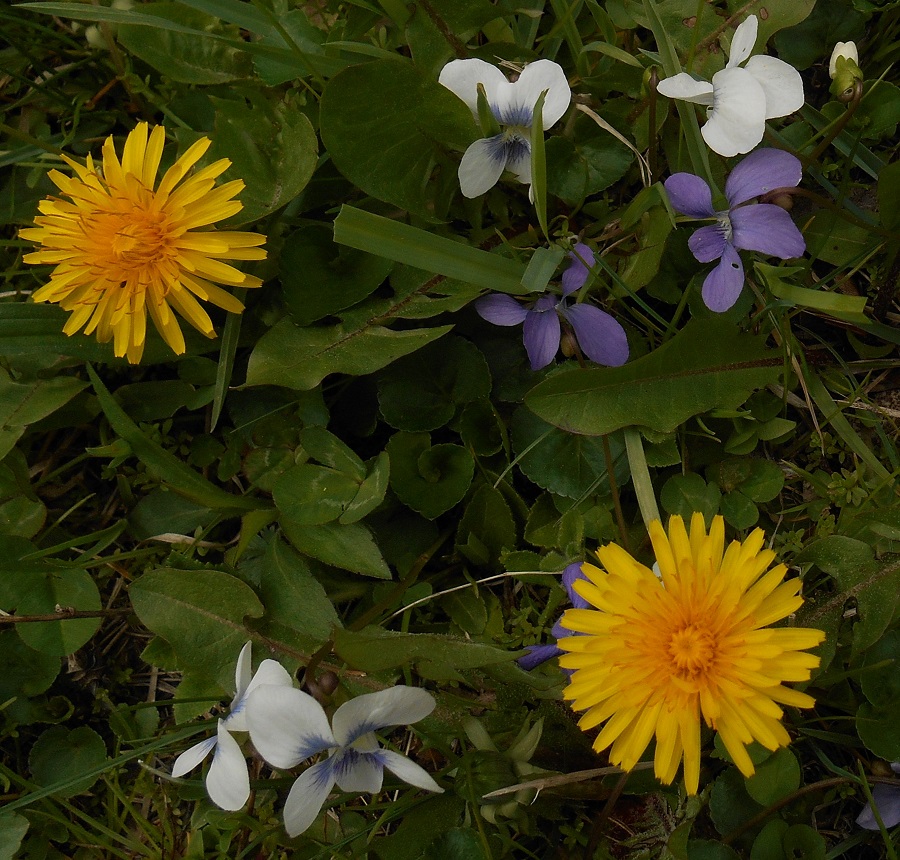
I like the scattered violets that appeared in my lawn some years ago.  In the spring I let the grass get high before I mow, so that the violets will have a good chance to set seed.  The delay also gives the dandelions a good chance to set seed.  Fine.

DandelionViolets

Would the dandelion have a better rep if we had translated (rather than anglicized) the Old French name?  Not likely.  Every flower is the same bright yellow, so there is no variation for plant breeders to coax toward white or red and then offer “Snow Ball Lion’s Tooth” or “Fire Ball Lion’s Tooth” in seed catalogs.  Any klutz can grow dandelions, so they give gardeners no bragging rights.

Nowadays the French have a derogatory-sounding name for dandelions.  Were the royal gardeners frustrated by the plant’s defiance of the oppressive formality of the plantings at Versailles?  The Germans have kept the good old phrase “lion’s tooth” (in their own language, of course), as have the Italians and the Spanish.  If it ain’t broke, don’t fix it.

When many people see a dandelion, they see a weed.  I don’t.  I see Löwenzahn, the Wagnerian Heldenblume that thrusts green and gold into the grayest and grimmest of our cityscapes.  I see Dent de Lion, the Enlightenment philosophe whose call for liberty and rationality rides the wind.
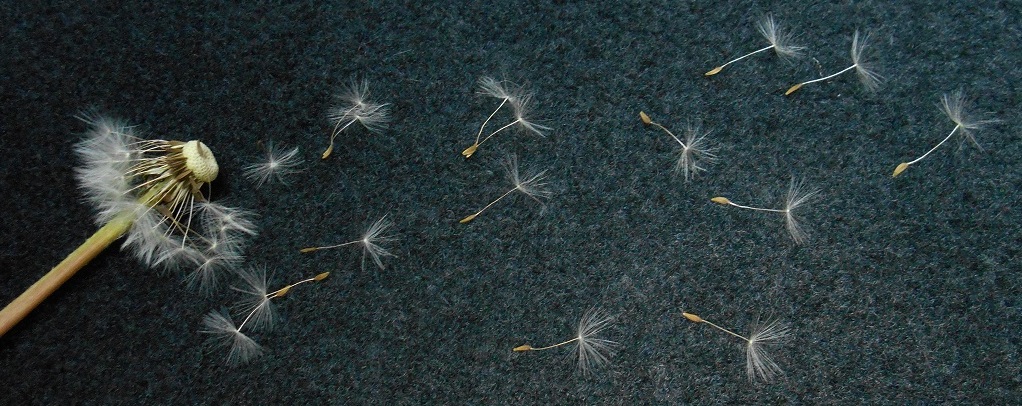
DandelionSeeds_few

I do pull weeds; I do not pull dandelions.

Flower of the Day – July 20, 2018 – Dandelion

– Gray button (upper left corner) reveals widgets, –
– above post (on phone) or beside it (on desktop). –
(reblog), humor, language, STEM

Narrative Starkness and Word of the Year

Kurt Brindley advocates “narrative starkness” that omits extraneous details about the characters in his fiction.  Apart from applauding Kurt’s starkness (and his ability to write humorous introductions for serious issues), the purpose of this post is to remark on a major difficulty with starkness and how the Word of the Year for 2015 may help.
(BTW, the [Menu] button atop the vertical black bar reveals the widgets.)

For reasons explained in the post excerpted below, Kurt Brindley advocates “narrative starkness” that omits extraneous details about the characters in his fiction.  Unless a character’s appearance (or gender or sexual orientation or …) matters to the plot, readers can imagine whatever they like.  Readers may later get a jolt if some details become relevant later and are different from their imaginings.  Maybe such a jolt will loosen the grip of a stereotype.

Apart from applauding Kurt’s starkness (and his ability to write humorous introductions for serious issues), the purpose of this post is to remark on a major difficulty with starkness and how the Word of the Year for 2015 may help.


My Uncolorful* Character(s)
Originally posted on
Kurt Brindley:

I don’t know about you, but as for me – unless it is absolutely critical to the movement of a story – I don’t need to always know every item in each room, or the style and brand of every shoe in the protagonist’s closet.

So it should come as no surprise then when I tell all you other reader dudes*** that I try to write my stories in the way that I prefer to read them: with limited and only absolutely necessary descriptive telling.

While I am very happy that DADT was finally axed and homosexuals are now allowed serve without any restrictions to their being, it was all of that nasty DADT stuff that became the impetus for me writing my novel.

And my goal in writing it was to force the reader to have to apply his or her own values, via perceptions and stereotypes, upon the characters in and events of the story.  Consequently, it was important for me as a writer to not tell the reader what I wanted them to think by way of character description, but to allow them to draw their own conclusions.

This equality stuff sure is a difficult nut to crack – witness the all-white Oscar nominees for this year’s Best and Supporting Actors/Actresses – and I’m not about to attempt to try and crack it here.

Except to say that screenwriters can certainly have a hand in keeping an open playing field for actors of all races and ethnicity by – you guessed it – laying off the descriptive details in their screenplays and leaving it up to the director to cast the best actor for the role based on the story’s content and need and not on the screenwriter’s biases.

*Yeah, I know “uncolorful” is not a real word, whatever a real word may be, but I it sounds less negative to me than “colorless” so, for what it’s worth, I’m going with it.

**gender specific

***non-gender specific

View original


Yes, “uncolorful” is awkward.  The aesthetic that urges omission of extraneous detail is well-established in STEM (as in “abstract algebra” or “Occam’s Razor”), but I cannot think of a good word or short phrase for wider advocacy of specifying only what really matters.  An “abstract” character is no more appealing than an “uncolorful” one.

It gets worse.  Writing smoothly and vividly but abstractly is tough.  George Orwell’s forever relevant 1946 essay Politics and the English Language includes a hilarious comparison between a memorable Bible passage and a translation into flabby blather that tries to make the general point w/o the concrete examples:

… the race is not to the swift, nor the battle to the strong, …; but time and chance happeneth to them all.

becomes

… success or failure in competitive activities exhibits no tendency to be commensurate with innate capacity, but … the unpredictable must invariably be taken into account.

In one way, a recent event may make narrative starkness a little easier.  The American Dialect Society’s Word of the Year award for 2015 went to “they” when used as a 3rd person singular pronoun that is gender-neutral.  I hope this usage sticks.

Suppose I want to write a story whose characters include a Navy sailor and a PhD scientist.  I could call them “Ensign Wood” and “Doctor Stone” to give them names that leave their genders unspecified.  But the old he-she-it gang gives me no appropriate pronoun to use.  Tho adequate in nonfiction writing, the clunky alternatives “he/she” or “(s)he” are hopeless in speech.  For my story, those pronouns may be making a misplaced fuss about being gender-neutral.  I can use “they” instead.  The ADS will have my back if grammar prigs attack.

It is nice to see that a humble pronoun has gotten the WOTY honor and may even help those who are fighting the good fight.  I have no appropriate haiku to end this post, but a limerick I read long ago does come to mind.

The function that’s nowhere defined
is an orange with only a rind.
But it turns up the hero
(like the null set and zero)
in many a proof you will find.

(reblog), language, mundane miracle, photography

The Transition to Created Light

The [Menu] button (atop the vertical black bar) reveals widgets like the Search box.  Typing just the [Enter] key into the Search box is a way to browse WordPress blogs.

A rose by any other name would smell as sweet, said the Big Bad Bard.  That is a good approximation; one striking exception is a photo by Elusive Trope that is effectively reblogged below.   (I say “effectively” because there were technical reasons to avoid the [Reblog] button in this case.)  A really good title can enhance work that is already good.  (Giving a nice name or title to junk may help sell it but will not dejunkify it.)  When Mark Twain likened the difference between “the right word” and a merely adequate word to the difference between the lightning and the lightning bug, he was stretching the point.  In the case of Elusive Trope’s photo, however, he nailed it.

Originally posted on Elusive Trope:

IMG_2459_picmonkeyed

The Transition to Created Light

View original (if link can be restored)

We look at the photo and see an austerely beautiful composition with strong colors.  One possible title (inspired by the actual title of Whistler’s famous painting of his mother) would be accurate but rather clunky and stuffy:

        Composition in Blue, Black, and Yellow: Light Fixture

Maybe we should use the time of day.  Saying just “Dusk” or “Twilight” would be accurate and mercifully brief, but those words have a sad or ominous connotation.  Our distant ancestors had good reason to fear nocturnal predators.  There is nothing sad or ominous in the light fixture’s defiance of the coming darkness.

Maybe we should be more specific about what is happening at dusk, with something close to the actual title:

        The Transition to Artificial Light

Adequate? Yes, but still not quite right.  The phrase “artificial light” has a milder version of the connotation of “artificial color” or “artificial flavor” as something to be confessed, not proclaimed.  Changing one word leads to the actual title used by Elusive Trope:

        The Transition to Created Light

Now the title reconnects us to the creativity of distant ancestors who invented campfires that discouraged their nocturnal predators.  Then there is the creativity of more recent ancestors who invented candles and lamps that let them mend their nets or write their thoughts during long dark evenings at high latitudes.  Still more recently, the creativity of people like Edison and Tesla made it so easy to light the darkness that nowadays we do it too much and appreciate it too little.  (The failing is ours, not theirs.)  Elusive Trope found the right word; we thrill to the lightning; Mark Twain’s ghost says “Told ya!” between puffs on his cigar.