haiku, history, humor, photography, science

Moving the Earth

Sometimes the Earth moves, quite apart from the constant motion in orbit around the Sun.  No, I am not using hyperbole to describe a big, screaming orgasm.  I am considering an even rarer event.
(BTW, the [Menu] button atop the vertical black bar reveals the widgets.)

Sometimes a really big idea challenges and ultimately transforms deeply held beliefs about the fundamental nature of human life.  Centuries ago, the idea that the Earth does indeed move around the Sun was such an idea.  Oh shit, we may not be at the center of the universe!  Astronomical humble pie from Copernicus has been pretty well digested; some people still cannot swallow humble pie that was pulled from the oven in 1858.

Already know what happened in 1858?  Please don’t leave.  I will keep it brief, keep it light, and put my own eccentric spin on the story.  (Honestly now, when was the last time U saw the phrase “big, screaming orgasm” in the 2nd sentence of a note on the history of science?)  Sources are thanked at the end of this post.

Back in 1858, there were no search boxes.  No Google.  No Wikipedia.  No e-mail!  Anything called a “manuscript” really was a collection of sheets of paper on which letters and symbols had been written by hand.  Want to show it to somebody U cannot visit?  Put it in the mail and hope it eventually arrives intact.  Want to have a backup copy in case it gets lost or damaged?  Write it out all over again before mailing.  No scanners.  No soft copy.  Yuck.

I am old enough to have lived and worked in a hard copy world, albeit with gadgets like electric typewriters that made it less painful than in 1858.  Collaborating with somebody several time zones away was agony in my early days and impossible in 1858.  In some important ways, doing science in my early days was more like it was in 1858 than it is now.  So I can imagine how Charles Darwin felt when he read the mail on 1858-06-18.

Correctly anticipating that his concept of evolution by natural selection would ignite a firestorm of controversy when published, Darwin had spent some of his time over the previous 20 years thinking about possible objections or misunderstandings, devising ways to answer or avoid them, and organizing a mountain of evidence.  Already an A-list biologist, Darwin was in no hurry and wanted to dot more i-s and cross more t-s before the firestorm.  Naturally, he wanted to wait a while before publishing his big idea.

The letter and manuscript that Darwin received on 1858-06-18 came from Alfred Wallace, a younger colleague then roughing it somewhere in one of the places that would now be called Indonesia or Malaysia or New Guinea.  Wallace sought advice about how to publish a new idea: evolution by natural selection.  Tho Wallace did not have a mountain of evidence, his pile was plenty high enough to justify publication.

Wallace earned his living by collecting natural history specimens for sale and was being hassled for the amount of time he devoted to nerdy “theorizing” when he should be killing things.  Naturally, he wanted to publish his big idea soon.  Naturally, he sought the opinion of a senior colleague with whom he had already exchanged a few letters on smaller matters.  He did not know (and could not know for months) that he had independently come up with the same big idea that Darwin had been quietly refining and supporting for years.

How could the differing priorities of Darwin and Wallace be reconciled?  How could Darwin respond to Wallace in a way that was fair to both of them and feasible in 1858?  No e-mail.  No conference calls.  Darwin consulted a few friends.  More than a century before the exhortation to

Let it all hang out!

enjoyed a vogue, they decided to do exactly that.  Those who attended the meeting of the Linnean Society of London on 1858-07-01 were treated to an explanation of the unusual situation, a reading of a summary of Darwin’s work, and a reading of Wallace’s paper.  Wallace was still in the boondocks and did not even know that his work (presented for him in his absence by one of Darwin’s friends) was sharing the spotlight on equal terms with Darwin’s.

Wallace did eventually return to England, make further contributions to biology, and enjoy a long friendship with Darwin.  Yes, they disagreed on some points.  Yes, creationists took such disagreements at the frontiers as an excuse to claim that the whole enterprise was “just a theory” with no greater plausibility than an extremely literal reading of Genesis as translated from a translation of the original ancient Hebrew.  But the Earth had begun to move again.  Oh shit, we may not be descendants of a pair of idle nudists who took advice from a snake!

Archimedes in 1858
|Darwin and Wallace
|found a lever long enough
|and a place to stand.

Greater Bird of Paradise

Sources

      • The brief biography of Wallace by Andrew Berry in the September 2015 issue of Natural History is very readable and provides some details I had not known.  No access to that issue of the magazine?  Pasting a few phrases into search boxes will compensate nowadays.  I have zoomed in on June/July of 1858 to elaborate on collaboration technologies (then and now), Darwin’s fairness predicament,  and why I applaud the way he resolved it.

    • Tim Laman’s many bird of paradise photos are featured in the September 2015 issue of Natural History.  The photos that appear here have been cropped to fit well on this page.  The originals (and many other splendid photos) can be seen on Tim Laman’s website.  Prints can be bought.

  • The concluding zinger about Adam and Eve is believed to be original; it is inspired by the edgy absurdist humor in Eric Wong’s blog.


 

haiku, humor

Pegasus

Tho childhood fantasies about flying horses are long gone, I can see the upside.  I have 2 favorites to share before my own take on Pegasus.
(BTW, the [Menu] button atop the vertical black bar reveals the widgets.)

In response to Carpe Diem #825 Pegasus:

I have 2 favorites to share before my own take on Pegasus: Chèvrefeuille’s beautiful Hippocrene-inspired image and Haiku Plate Special’s charming reminder of the way I and so many others were introduced to Pegasus.

© Chèvrefeuille
|after the rainstorm
|horses galloping through puddles
|droplets of poetry

© Haiku Plate Special
|winged horse
|flying through my childhood
|Mobil Gas

Tho childhood fantasies are long gone, I can be good-humored about practical matters.|

Pegasus
|Ever been shat on
|by a bird? Be glad there are
|no flying horses.

Pegasus_RM_450x450
Perhaps the image credit requested by the Rijksmuseum refers to a likeness of Persephone on the other side of a coin? Perhaps some copy-then-tweak editing did not go far enough? A magic spring with water that ensures complete editing would be a worthy companion to Hippocrene.
haiku, humor, photography

Various Viewpoints

To a female mosquito, I look like lunch: a big bag of nice warm blood.  From her viewpoint, my birdbath was a good place to lay eggs after lunch.  But then I rigged a hose to drip into it.  The drip also made the water better for washing down a bird’s caterpillar lunch.  I have another view of what makes a good lunch; my friend has yet another view.
(BTW, the [Menu] button atop the vertical black bar reveals the widgets.)

To a female mosquito, I look like lunch:  a big bag of nice warm blood.  The bag is annoyingly mobile, but she is also mobile and is quite good at using a mix of cues (chemical, thermal, and visual) to home in on the bag.  Then it will be time to lay eggs.  From her viewpoint, my birdbath was a good place for egg laying until I rigged a hose to drip into it.

birdbath-ripple_840x312
The dripping also keeps the birdbath full and makes it more attractive to the birds, who consider it a good place for a sip of water and sometimes a bath.  From the birds’ viewpoint, it never was a good place for egg laying.  I am glad that the mosquitoes have finally come around to the birds’ opinion.

Blood for lunch does not appeal to me.  Neither do caterpillars, so I do not compete with any past or present birdbath visitors for food.  I eat something healthy (from a human viewpoint) and finish off with something obscenely healthy: a few raw carrot sticks and then a few raw snow peas.  (That lets me get away w/o brushing my teeth after lunch.)  I also view the veggies as colorful objects to be arranged in a very temporary display on the plate before they become ugly mush that is mercifully out of sight.

A few days ago, I happened to arrange my lunch veggies so as to look a little like a dragonfly, with snow peas as wings.  Hmmm.  Maybe I could pull more veggies from the fridge and make an arrangement that looks a lot like a dragonfly to me. (No real dragonfly would be fooled.) This little project reminded me that a dragonfly is the enemy of my enemy, and thus my friend.

Dragonfly_480x481

What’s for Lunch?
|Mosquitoes in flight
|are seen as meat on the hoof
|by a dragonfly.

(reblog), haiku, humor, photography

A Falling Sound

(BTW, the [Menu] button atop the vertical black bar reveals the widgets.)

 
The photo by Dancing Echoes reblogged below has inspired another haiku.

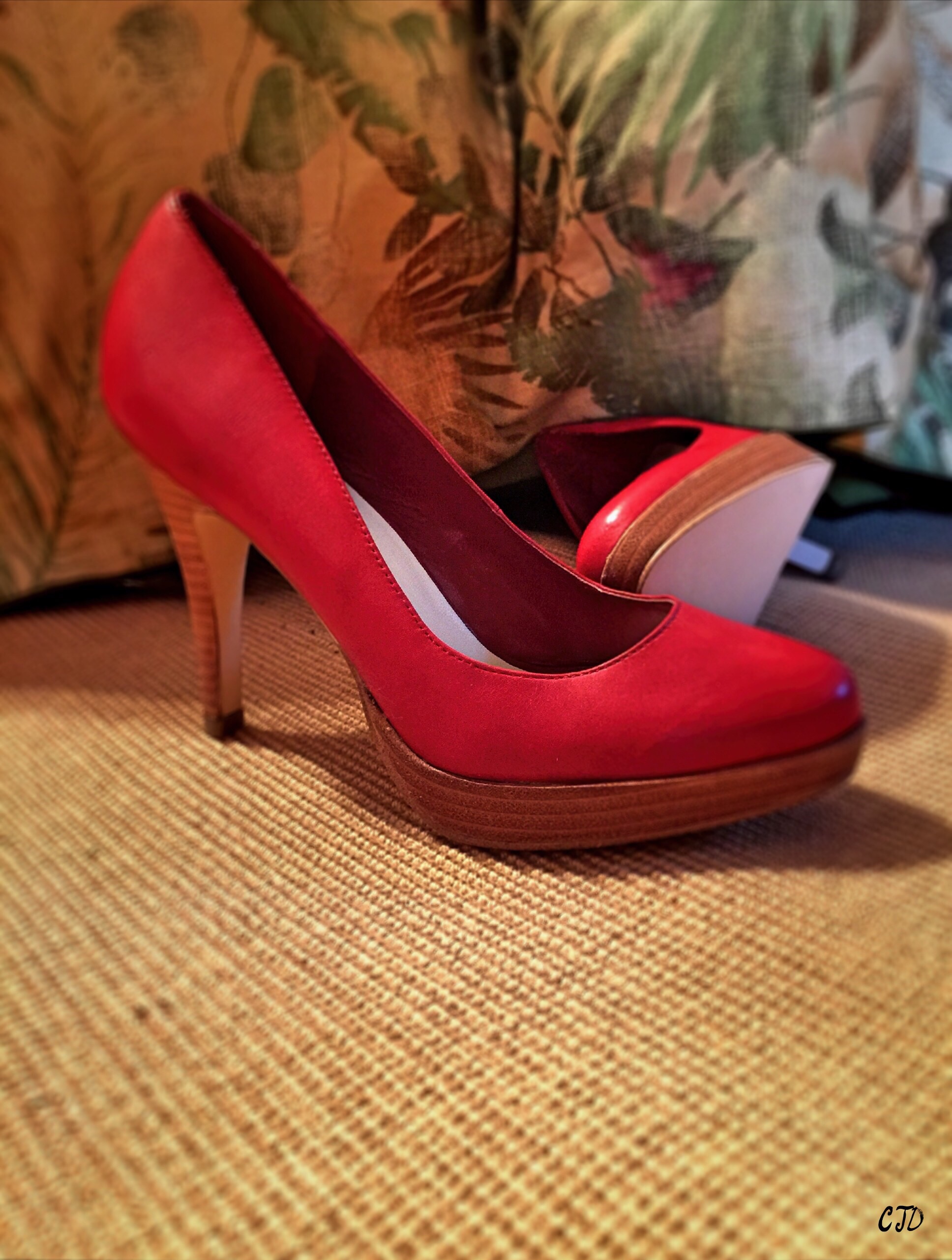
         A flipped coin may land
         on edge. Erect, her dropped shoe
         mimics his penis.

 
At my age, on the other hand, those high heels and narrow toes scream “Bunion City!”

Dancing Echoes's avatarDancing Echoes

image

Shoes dropping to floor
Quickened anticipation
Clothes fly in frenzy

In response to CARPE DEIM HAIKU KAI: On The Trail With Basho Encore 5 a falling sound

View original post

haiku, humor, politics

Fridge Follies

CrowdedKitchen_464x348

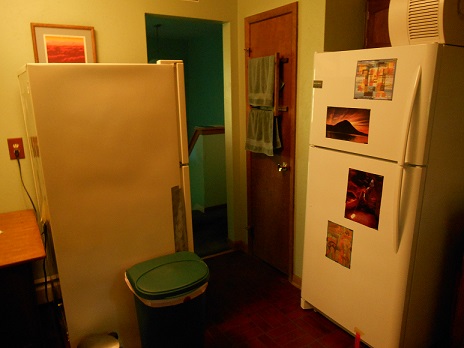
Why does the small kitchen in my very small household have 2 refrigerators?  The story begins in 2002, when the fridge now blocking the view of a framed print was delivered.  The 1985 fridge it replaced had the condenser tubing on the back, readily accessible for an annual cleaning.  I was surprised to find that the tubing was hidden on the bottom of the then-new fridge.  I was also surprised to find that the then-new user’s guide said

There is no need for routine condenser cleaning in normal home operating environments.

A few months later, I was not at all surprised to find that the guide’s assurance was bullshit.

Section 1: Noble Intentions

I have a good collection of brushes and crevice tools for my vacuum cleaner, but most of the condenser tubing was still uncleanable.  Some people dare to empty a fridge, tip it over, unscrew any bottom cover, and vacuum the hidden tubing.  I estimated the likelihood that such a saga would accomplish much for my extremely convoluted tubing to be less than the likelihood that I would crush a toe while fumbling with the heavy fridge.  So I left the fridge upright and improvised filtration of much of the air being sucked past the tubing by a fan.  I changed the filter monthly and was pleased that it intercepted much of the incoming dust.  But not all of it.

When new, the 2002 fridge was fairly efficient.  The rated energy consumption (514 kWh/yr) was decent (and much better than the 874 kWh/yr of the significantly smaller 1985 fridge it replaced).  While the gradual buildup of dust on the condenser tubing implied a gradual decrease in efficiency, the fridge was still working.  Old Yankees do not replace old stuff that does work well enough with new stuff that might (or might not!) work better.

Several things changed in 2015.  I happened to put my hand on the top of the fridge, near the freezer door.  It was uncomfortably warm, almost hot.  The heater that prevents the door from freezing shut had become overenthusiastic.  More energy wasted.  Some newer fridges have LED lights to avoid unwanted heat.  The electric company has a nice rebate offer: they will pick up a working old fridge for recycling and give me a little $ for it.  I could get an up-to-date fridge with pristine condenser tubing, verify that it works, move into it at leisure, and only then have the 2002 fridge hauled away.  I plan to stay in my house long enough that the 2002 fridge could not go the distance, but not long enough to need yet another fridge purchase after buying one in 2015.  May as well do it with dignity now, when nothing much has hit the fan recently.

So I saddled myself with 2 problems: choosing a new 2015 fridge and temporarily squeezing it into my small kitchen along with the old 2002 fridge.

Section 2: The Agony of Choice

Comparing 2015 with 2002, I found that choosing a fridge is both easier and harder.  Lots of pertinent info (and some misinfo) is online, and my current internet connection is fast enough to access it.  On the other hand, there has been a luxuriant profusion of brands, configurations, and features.  Had to wade thru all of that to find a top-freezer fridge of moderate size with half-width cantilever shelves, LED lighting, and no ice maker.  Why no ice maker?  My kitchen’s plumbing only supplies water to the sink and the dishwasher, and remodeling is not on the horizon.  I need the space an ice maker would occupy for ice trays.  That is no hardship for me, as I am old enough to remember rigid metal trays that stuck to my fingers when the water had frozen and had Rube Goldberg arrangements of louvers and levers for forming and releasing the ice cubes.  The arrangements pinched my fingers and sent much of the ice flying across the room as little shards.  So I am quite content to use modern 1-piece plastic trays that almost always release the cubes intact when gently twisted.

Yes, the big stores have websites with options for filtering searches.  The behavior of those options reminded me of the disclaimer that sometimes appears when movie credits roll:

«Any resemblance between the filtering specified by the user
and the filtering actually performed is purely coincidental.»

One day when my errands took me nearby anyway, I decided to look at fridges in an actual brick-and-mortar store.  I found a phalanx of stainless steel behemoths with bottom freezers, French doors, thru-the-door controlled substance dispensers, and so on.  What sustains the French door craze?  Yes, some people need them because they have really weird kitchens with door-swing limitations.  (Maybe there are also some people who can remember which side of the fridge has the mayonnaise jar and want to hi-5 themselves after opening only the appropriate door?)  Anyway, there were a few token fridges with my basic configuration.  They also had full-width shelves, each with too few height choices. Feh.

Back to the web.  I eventually got past the behemoths and the cheapies.  I eventually got past the ambiguities and contradictions in the specs posted on store websites.  I settled on a fridge configured much like my old one but more efficient (rated at 471 kWh/yr).  Neglecting to visit the manufacturer’s own website and confirm all the specs there (cue the horror movie music), I placed an order and scheduled delivery.

Section 3: We All Live in a Yellow Submarine

KitchenCorner_387x516

My camera’s white balance is flaky; the kitchen is not really that yellow.  Being in it, however, is much like being in a submarine.  Everything is shoved up against something, with barely enough room to move around.  This is only temporary.

Does the title of this section sound familiar?  In the 1960-s, I thought the popularity of The Beatles was only temporary.

Eager to have my own place after some dismal rental experiences, I knowingly bought a badly designed and badly built house in 1972.  It was only temporary, a way to get off the rental treadmill for a few years while looking around for something better.  I am still in that house.

My track record in predicting how long situations will last is not good, but hope springs eternal.  (I did have enough foresight to ensure that I could still cook in my submarine kitchen.)  This is only temporary.  Can repeating a dubious mantra often enough make it true?  Should we ask the pols who postulate that tax cuts stimulate enough economic growth to pay for themselves?

Delivery day!  I showed the crew the odyssey required to get from the front door to a kitchen doorway that is wide enough, in my badly designed house.  The new fridge agreed with my tape measure and settled into place w/o incident.  I tipped the crew, admired the new fridge briefly, and settled down to a snack in the adjoining room.

BANG! CLANK! CRACKLE! BANG!

The sound character was like that of ice cracking when a fridge does its defrost routine after a heavy buildup.  The sound volume implied that a hostile navy had located the yellow submarine and had good aim with depth charges.  I ran into the kitchen in time to verify that the noise was coming from the new fridge.  Then it stopped.  The fridge was running quietly.  Apart from a little muffled rattling now and then, it has been quiet ever since.

I know what happens when an appliance (or a car or a body part) misbehaves erratically and the worried owner consults a pro.  I sympathize with the reluctance of pros to diagnose an unrepeatable symptom on the basis of a layman’s verbal description.

It’s working fine now.  Call us if it acts up again.  Goodbye.

So I resolved to extend the temporary squeezing of 2 fridges into 1 kitchen for a few more days, keep using the old fridge, and listen for nasty noises from the new one.

Section 4: The Ice Maker Cometh

Reasonably confident that the new fridge was OK, I turned it off and gave it time to warm up before playing with the shelves to approximate the arrangement in the old fridge.

I opened the freezer door and found — (cue the horror movie music, louder this time) — an ice maker!  This hulking monster could supply enough ice to host a cocktail party for an army, but only if it had a water supply.  Dry as the Namib Desert on a fogless day, the monster sullenly hogged much of the precious freezer space.  The new fridge devotes a smaller fraction of its space to the freezer than the old fridge does, and I had recently bought ridiculously many pints of frozen yogurt because the market was discontinuing a flavor I liked and discounting the remaining inventory.  I had to evict the monster despite the risk of quibbles about “tampering” if I ever needed warranty service.

The screws attaching the ice maker to the freezer wall were readily accessible.  Then there was the electical connection.  Like the connections in cars, it was a plug-socket arrangement, latched shut and secured in place by springy prongs that could be released by pressing gently with a small flat-bladed screwdriver in exactly the right place.  After some looking and cautious probing that did no damage, I found the place and disconnected the monster.  That left 4 metal contacts open in the socket, hoping to get connected again but willing to accept condensation and a chance to short out in revenge for being abandoned.  So I covered the socket with duct tape and protected the tape with some bubble wrap and more duct tape.

Freezer_390x293

The freezer of the old fridge still holds a few things that I have not been able to fit into the new one’s freezer.  Otherwise, I did eventually move everything from old to new and no longer guess wrong about which fridge holds what.  I should be able to adjust my freezer usage to the current reality and am otherwise pleased with the new fridge.  Maybe the electric company’s rebate offer for the old fridge will still be in effect when I am finally ready to use it.

Section 5:  Directions for Further Research 😉

LabGadgets_688x349

During installation of improvised external air filtration for the 2015 refrigerator, examination of the hidden condenser tubing revealed a configuration differing from that of the 2002 refrigerator.   It is hypothesized that the 2015 configuration will be more amenable to cleaning than the 2002 configuration, albeit still less amenable than was the 1985 configuration.   This hypothesis will be tested when sufficient dust has accumulated.

A concluding haiku about refrigerators is not available at present.   In the interest of timely publication, this  post concludes with haiku pertinent to auxiliary considerations discussed in Sections 3 and 4, respectively.

Fiscal Responsibility

Debts rise; incomes fall.
Hard times demand bold action:
tax cuts for the rich!

Silver Savior

The crowning glory
of our civilization
is, of course, duct tape.

haiku, humor, math, philosophy, science

Could a Long Fly Ball Hit a Flying Horse?

This is one of the few times I need to put some fiction into my blog, so I will change font for a little while.

Plato

Sometimes it is hard to be fair to Plato.  He is basically a good guy, but his politics are bullshit.  That “philosopher-king” notion is so self-serving.  Then there is that cave shtick.  Most people know that philosophers can be a little klutzy in everyday life.  We give them some slack and don’t make a big deal of it.  But Plato says the wannabe king has been looking at ultimate reality and absolute truth (and maybe a pretty girl sunbathing?) in bright daylight, so he stumbles in the cave that passes for the real world among ordinary Joes.  After his eyes adapt to the dim light, he will govern just fine.  No way.

Feeling mellow enough to ignore Plato’s politics, I invited him over to watch a baseball game on TV.  He was surprised that the pitcher threw a ball rather than a discus or a javelin, and that nobody was naked.  But he is a smart guy and soon understood the duel between the pitcher and the batter.  He noticed the (4 balls or 3 strikes) rule for ending an at-bat and said something about the ratio 4:3 in music by The Pythagoreans.  Are they a band I don’t know about?  He broke into a big grin when a batter sent a long fly ball arcing high above the field.  Tho he knows zip about physics, he hangs out with Euclid and knows a parabola when he sees one.


To Plato, the path of the fly ball in the grungy everyday world is an imperfect realization of the timeless perfection of an ideal parabolic form.  To me, the description of the path as a parabola is a good approximation that ignores air resistance and wind.  Ignoring those things is OK in an introductory physics course.  It is not OK in a baseball game.

Pegasus_RM_450x450

Using the parabola to describe the fly ball oversimplifies a staggeringly complex everyday world that emerges from a staggeringly weird tarantella of elementary particles.  Our use of the parabola is fundamentally a story we tell ourselves.  Unlike the story of Pegasus the flying horse, it has been corrected, refined, and integrated with many other stories by scientific processes.  The notion of a flying horse is appealing (to people who have not been hit by a bird splat).  The parabolic story is ultimately more satisfying, as part of something gloriously predictive and useful (despite not being much help to the outfielder running to catch the fly ball).

Pegasus himself is as limited in time and space as the Pegasus story: an idea created by some people at some time and place, elaborated and spread by other people at other times and places.  The Pegasus story will vanish and its starring horse will vanish with it, if we succeed in our current efforts to make the Earth uninhabitable long before we can go elsewhere.  Would the parabolic story vanish also?  That is a question for another time.  The mathematical cast of characters in the parabolic story, on the other hand, is special.  Very special.

Plato’s Challenge
|Three plus two was five
|before any mind could know.
|Where do numbers live?

My snapshots of Plato and of Pegasus could not get thru the time warp, but I did some cropping of public domain images with good likenesses.

(BTW, the [Menu] button atop the vertical black bar reveals the widgets.)
haiku, humor, philosophy

Games, Beauty, and Overreach

The list of games is long and diverse (peekaboo; scrabble; solitaire; …).  What do all those “games” have in common?  In defiance of centuries of tradition dating back to Plato and Aristotle, the philosopher Ludwig Wittgenstein proposed a radical answer in the 20-th century: not much.
(BTW, the [Menu] button atop the vertical black bar reveals the widgets.)

As readers of my previous post may have guessed, obeying the 5-7-5 Rule has become something of a game for me.  When I began writing this post, I had written about 50 haiku, all of them (5-7-5)-compliant.  I hoped to extend my streak to at least 56 because Joe DiMaggio’s epic hitting streak lasted for 56 consecutive baseball games in 1941.

Wait a minute.  My (5-7-5)-compliance is a game; DiMaggio’s profession was the game of baseball.  The list of games is long and diverse (peekaboo; scrabble; solitaire; …).  What do all those “games” have in common?  In defiance of centuries of tradition dating back to Plato and Aristotle, the philosopher Ludwig Wittgenstein proposed a radical answer in the 20-th century:

Zilch.

(We can leave some wiggle room for something bland and inconsequential about amusing activities, often but not necessarily competitive.)  Looking long and hard at the word “game” in all its sprawling diversity, Wittgenstein observed that there are many is-a-lot-like relationships among games, such as

Hockey is a lot like soccer.

To a nonfan like me, hockey and lacrosse and soccer are all essentially the same game, with obvious minor differences.  Remove the goalie and U get basketball.  Football is somewhat like such games and also somewhat like baseball.  Card games are like each other in various ways.  One may well be able to get from one game to another by several is-a-lot-like steps, but is-a-lot-like relationships are not transitive.  After more than a few of such steps, it is no surprise if nothing worth fussing about is shared.

Wittgenstein did not stop with games.  Philosophers have often sought to find and formulate what is common to all the activities or things that may rightly be called “good” or “beautiful” (or whatever uplifting adjective U want), with the presumption that something nontrivial and enlightening might be said.  Tho Wittgenstein did not actually prove that quest to be hopeless, he did show that the burden of proof is heavier on somebody who thinks

What is beauty?

makes sense than on somebody who just says

I can’t define it, but I know it when I see it.

Images of beautiful people and places abound.  Sculptors create beautiful objects; composers write beautiful music.  In math, a beautiful proof of the Pythagorean Theorem was created by replacing the usual picture (of 3 squares glued to the sides of 1 triangle) with a picture of 4 copies of the same triangle, arranged to form 2 squares:

Pythagoras
(a+b
=
4 · ( ½ · a · b) + c²

Intellectually, I agree with Wittgenstein.  Pachelbel’s canon and the 2-squares proof are both beautiful, we already knew that, and philosophy has nothing to add.  I just want to remark that the urge to understand the world in terms of general principles works rather well when science encourages sobriety, by testing predictions about little things before trusting grandiose pronouncements about big things.

Emotionally, I sense something more likable than mere hubris in those who overreach, something akin to the spirit of people in New Orleans who tough out hurricanes or return after them.

This is Not Apollo 13
|Is failure an option?
|No, it is a given.
|But we will still try.
No Pots of Gold
|Seek ends of rainbows.
|You will not find them? Okay.
|The quest is enough.
haiku, humor

On Rules: Moral Hazard; 5-7-5; …

A discussion of the Moral Hazard Rule could bog down in controversy.  So I will discuss something simpler and less important by itself, but good for illustrating the vital difference between respecting a rule and worshiping it.
(BTW, the [Menu] button atop the vertical black bar reveals the widgets.)

The difference between respecting a rule and worshiping it can be vital, as with economists’ Moral Hazard Rule against bailouts and the like.  A discussion of the Moral Hazard Rule could bog down in controversy over who is to blame for a mess, who is suffering, who has a hidden agenda, and so on.  So I will discuss something simpler and less important by itself, but good for illustrating that vital difference.  Please remember that difference the next time U hear somebody who worships a rule arguing with somebody who ignores it.  Maybe each of them is partly right and partly wrong.

The 5-7-5 Rule says that a haiku is a 3-line poem in blank verse, where the lines have syllable counts of 5, 7, and 5.  Tho he was razzed intensely at the time, Bill Clinton had a point when he fussed about what “is” means.  Does the rule say how the word “haiku” is (or should be) used?  By whom?  Does the rule specify the essence of haikuness?  My own attitude is both traditional and pragmatic, more nuanced than I can express in 3 lines.

I first encountered the 5-7-5 Rule as a junior in college, back when students used typewriters and people with scholarly aspirations kept bibliographic info on 3×5 cards.  (Yes, that long ago.)  A friend was interested in Japanese culture, but not so interested as to learn the language.  He was enthusiastic about some short Japanese poems that, as translated into English, were limp and vague.  Poetry is notoriously difficult to translate, and my friend explained that these translations had the special burden of being translations of haiku, using the 5-7-5 Rule to define a word that was new to me.  My friend said he was settling for bad poems in English that began as good ones in Japanese, and that people cannot write haiku in English anyway, in part because we do not have Japanese calligraphy.  I took the purported impossibility as a challenge.

After some scribbling and counting, I put a 3×5 card in my typewriter, banged on a few keys, and silently handed the card to my friend.

The card had 3 lines:
|Haiku written on
|a typewriter: ultimate
|incongruity.

We shared a laugh and I kept the card.

In the course of about 50 years, I eventually wrote about 50 haiku, all conforming to the 5-7-5 Rule.  While thinking about ways I might publish some of my haiku, I did some web browsing and found many haiku that I liked, including

© Alexis Rotella
|Just friends: …
|he watches my gauze dress
|blowing on the line.

I barely noticed the violation of 5-7-5 and did not mind it at all.  Some time later, Lew Gardner sent me a handout from the haiku class he teaches, with examples that included Just friends: … and

© Anita Virgil
|walking the snow-crust
|  not sinking
| sinking

Now the violation of 5-7-5 is integral to the imagery!

Anybody who gripes about the foregoing violations of 5-7-5 is just being churlish.  Anybody who is oblivious to 5-7-5 is missing much of the fun in a successful translation of one of Basho Matsuo’s haiku:

© Harry Behn
|An old silent pond…
|A frog jumps into the pond,
|splash! Silence again.

I needed strict observance of 5-7-5 to prove a point long ago, but the 5-5-5 of my last borrowing from Lew’s handout is close enough to support a funnier joke with a haiku that refers to itself.  I salute whoever topped my first effort with the classic

© Unknown
|You have just started
|reading the haiku
|that you just finished.

Far from being hidebound about tradition, I often write on oddball topics, always provide titles, and sometimes write 3 lines that would be unintelligible w/o stage setting by the title.  But I also honor tradition with a serious effort at abiding by 5-7-5.  So far, I have almost always been happier with the result (of all the heating and hammering that effort entailed) than with the looser early version that I brought to my wordsmith’s forge.

Abiding by 5-7-5 has been helpful to me; I recommend giving it a try.  The precision of 5-7-5 is also appealing, and I deeply appreciate the importance of precise definitions in math.  I also know that poetry ain’t math.

Who Miscounted?
|This so-called “haiku”
|ignores five-seven-five, so
|it’s not a haiku.

haiku, humor, music, philosophy

Wordless Wisdom

Can there be such a thing?  Tho unable to offer a strong argument, I believe so.  (There definitely can be wordless knowledge.)  The notion of wordless wisdom is not preposterous, despite the conditioning we inherited from Socrates.
(BTW, the [Menu] button atop the vertical black bar reveals the widgets.)

Let’s start with something easier than wisdom.  The canonical example of wordless knowledge is how to ride a bicycle.  There is much that can be said about riding a bike, but how to do it cannot be put into words and/or formulas.  Millions of children know how to ride their bikes w/o knowing anything about the underlying physics.  On the other hand, one can have the physics down cold and still not know how to ride.  Many kinds of knowledge can and should be written down, but definitely not all.

Verbal and nonverbal knowledge can work together, which is the main reason that baseball teams have hitting coaches and pitching coaches.  To keep this post simple, I will ignore that possibility for wisdom.  Sometimes it is better to be simplistic (with an understanding about wiggle room) rather than precise (but ponderous).

The notion of wordless wisdom is not preposterous, despite the conditioning we inherited from Socrates asking people to tell him what virtue is and then being dissatisfied when the only verbiage they can supply is a list of a few virtues, with or w/o “and so on” after the specifics.

I am among the many people whose response to some great pieces of music goes beyond ordinary enjoyment.  The last movement of Beethoven’s last piano sonata seems to hint at something important (as well as beautiful) that resists verbalization.  Maybe it is just subjective; other music lovers have differing lists of transcendent works.  Maybe putting “just” in front of “subjective” is unwise.

If the foregoing sounds addled, let me proclaim my (slightly qualified) devotion to Wittgenstein’s Laws:

  1. What can be said at all can be said clearly.
  2. Whereof one cannot speak, thereof one must be silent.

My only reservation about #1 is a request for a footnote remarking that clarity often does not come easily.  With #2, I see a little wiggle room in interpreting “be silent” (or “schweigen” in the original German text).  Does it rule out images?  Instrumental music?  Singing in a language the listener does not understand?  Fortunately for me, I do not understand enough Latin to get distracted by the words in sacred music and thereby risk misunderstanding the nonverbal wisdom it conveys.

Hildegard of Bingen, 1098-1179
|Mystic visions or
|migraine headaches? Whatever.
|Her music lives on!

Memo to Mystics
|Unless you can grab
|bubbles, you cannot put your
|wisdom into words.

soap-bubbles
haiku, humor, philosophy

Trojan Horse in Bagelology

Those who read this long post thru to the end will be rewarded with a secret for avoiding green fuzz.

Despite being bagel-deprived, ancient Greek philosophers posed deep questions and pondered partial answers in ways that still deserve attention.  In particular, one of them showed how slippery is the notion of truth by considering the Liar Paradox:

This statement is not true.

To give a short name to the statement just quoted, I will call it LP. If LP is true, then it is false, which implies that it is true, and so on.  It is like a puppy chasing its tail.  Very annoying to anybody who agrees with what another ancient Greek philosopher said about the excluded middle.  Yes, there many utterances that are not statements and so are neither true nor false.  But the duck test says that LP is a statement.

For millenia, the usual way to dodge the Liar Paradox has been to abstain from self-referential language.  Tho I may talk about myself, I never talk about myself talking about myself.  Except in previous sentence.  Avoiding LP-ish talk is harder than just avoiding the exact words of LP itself.  How much harder?  Apart from some temporary scares that I will ignore in this post, everybody thought it was only a little harder.  Until 1931.

Suppose we are willing to pause in our search for all the answers to all the questions; we restrict our attention to some narrow subject and restrict our language to statements about that subject.  We can agree to talk only about bagels for a while.  We want to use language expressive enough to say interesting things about bagels, but not so expressive that we blunder into LP land.  Maybe, if we are both careful and lucky, we can console ourselves for talking about so little by celebrating success in saying so much about it.  Maybe we can discover a Grand Unified Theory of Bagels that encompasses the truth, the whole truth, and nothing but the truth (so long as we speak in a restricted language that can still say a lot about bagels).  Welcome to bagelology.

Suppose we have already agreed on the syntax and semantics of statements in bagelology.  What next?  We might make a list of some important things we already know about bagels.  For now, it does not matter whether we got this knowledge from empirical observation or divine revelation.  I will call these statements the “axioms” of bagelology.  The axioms are all well and good, but we want new knowledge.  One way to get new knowledge is by logical deduction, which ancient Greeks also pioneered.  (No, they did not do it all.)  So we get up to speed about rules of inference and agree that whatever can deduced from the axioms is a “theorem” of bagelology.  Logic has its pros and cons; a big pro is the way we can keep adding to whatever we have.  We can toss yesterday’s theorems in with the axioms and bake (i.e., deduce) more theorems today, along with some bagels.

After baking a new batch of theorems every day for many days, we have a substantial body of knowledge.  Of course it is still incomplete.  Somebody writes down a statement about bagels and asks if it is true.  Dunno.  Neither the statement nor its negation appears in our growing inventory of theorems that have already been baked.  Maybe the next batch of theorems will answer the question.  Maybe not.  We can still hope that our Grand Unified Theory of Bagels is “complete” in the weaker sense that someday the answer will appear.  Just keep on baking.

There is not much to be said about bagels without talking about flour.  Come to think of it, we also need to count bagels and price them.  We need to talk about numbers.  Nothing fancy; just plain old integer arithmetic.  Throw it all in.  Bagels; flour; ovens; numbers — we still have a shot at a complete theory, which eventually decides whether any given bagelogical statement is true or false.

Oops.  The greatest logician in history was not an ancient Greek.  He was Kurt Gödel, who showed that bagelology (and anything else that uses the axiom/theorem paradigm) cannot be both complete and expressive enough to support arithmetic.  Yes, he dropped that bomb in 1931, long before we wrote down our axioms.  He did not need to know them.  He knew that we would be in trouble as soon as he knew that we would count and calculate.  Arithmetic is a Trojan horse.

There is still a trivial way to make every true bagelogical statement appear eventually in a batch of theorems.  An inconsistent theory that just asserts everything will do the job.  Every  statement appears eventually, and each true statement may appear either before or after the false one that denies it.  An inconsistent theory tells us nothing and is useless, except in politics.

No matter how cleverly we set up bagelology, there are true statements that are not theorems, unless bagelology is either inconsistent or too weak to support arithmetic.  Really.  Gödel proved this with a combination of deep insight, technical virtuousity, and a little help from an ancient Greek.  He showed how to seduce bagelology into talking about itself implicitly (despite that pledge of abstinence from self-reference) and then into saying something much like LP:

This statement is not a theorem in this system.

Having shed a few tears for completeness and saluted great thinkers (both ancient and modern), we can go on living.  If we do set up bagelology well, it may be consistent and informative, revealing much that is true (and maybe also good and beautiful) but not at all obvious from a glance at the axioms.  There will always be truths that are not theorems, and we may sometimes discover a few of them by other means.  We can advance bagelology by adding those discoveries to the older axioms; we should never declare victory and carve the current set of axioms in stone.

BTW, I know there is a difference between supporting arithmetic and just using some of it as a black box.  If U know enough mathematical logic to exploit that difference in a Houdini escape from incompleteness for bagelology, then I salute U and hope U still enjoyed my whimsical way of summarizing one of Gödel’s discoveries for those who do not already know and admire it.

Now it is time for something that really is about bagels.  If U believed what U read on package labels and in food columns, U can improve your own version of bagelology by replacing that old axiom about storing things at room temperature (or in a cool, dry place) with Rosen’s Rule:

It is OK to refrigerate bagels.  Likewise for bread.

Once a bagel is no longer warm from the oven, it needs to be toasted before being eaten.  A bagel pulled from the frige recently takes a little longer to toast; the result is ever so slightly chewier than with room temperature storage.  More than a week after purchase, a wrapped bagel or bagged loaf of bread in the frige is still good.  Tho it may not be quite so good as when first brought home, it does not sport the green fuzz that adorns the poor schmuck stored the conventional way for more than a few days.

A small household that dislikes green fuzz can still buy baked goods in convenient quantities w/o being forced to pig out or throw out.  While the toaster does its job, U can read a haiku that talks about itself:

Basho Meets Gödel

Haiku written on
a typewriter: ultimate
incongruity.
haiku, humor, politics

Oxymoronic Selfie

The [Menu] button (atop the vertical black bar) reveals widgets like the Search box.  Typing just the [Enter] key into the Search box is a way to browse WordPress blogs.

Yes, the title of this blog is an oxymoron.  (More on oxymorons shortly.)  This blog will touch on many things in life and language, but only when I think I have something to add to whatever has already been said.  I will try to be humorous w/o being too flippant and serious w/o being too solemn.  Some posts will end with haiku poems, as this one does.

Oxymorons can be a quick and colorful way to designate something with an unusual (but not really contradictory) mix of characteristics.  In American politics in the 1850-s, Stephen A Douglas was called the “Little Giant” because he was both short and influential.  Some other examples:  equal and opposite; fried ice cream; libertarian paternalism; love-hate relationship; passive-aggressive; tough love; virtual reality.

Tho I cannot be mellow and curmudgeonly simultaneously, I can shift quickly from one to the other when considering different aspects of something.  Before giving an example, let me issue two disclaimers:  I am not in the shall/will crowd and do not fit neatly into any common political category.  I do not hassle people who violate silly rules invented long ago by prigs with too much free time.  When I gripe about a misuse of language, it is because I see a substantial hindrance to communication.  When I take an example from politics, it is not part of a rant that has already been repeated thousands of times.

Living languages do change, often getting better and sometimes getting worse.  One change for the worse that may be happening now is the use of “legitimate” as a synonym for “genuine” or “actual” (in addition to its legitimate uses).  This usage is not in my printed dictionary from 2005 or in the online Wictionary entry last updated in 2014, but I have heard it ominously often.  In 2012, Senate candidate Todd Akin was vilified as a cruel misogynist for using the oxymoronic phrase “legitimate rape” (which illustrates why misusing “legitimate” is such a bad idea).  My initial reaction to the oxymoron by itself was mellow:  Akin is just a linguistic slob who said “legitimate” when he meant “genuine” during his pseudoscientific riff on whether a rape that causes a pregnancy could really be a rape.

On the other hand, I am old enough to remember when willful ignorance or distortion of relevant facts was frowned upon.  It did happen (perhaps more often than a curmudgeon’s memory of the good old days will admit).  Among legislators, it tended to come only from certain people on certain subjects.  Akin’s reliance on a physiological fantasy to avoid dealing with the implications of a policy position struck me as emblematic of a serious general decline in intellectual honesty.  Nowadays, pols and pundits launch outrageous factoids faster than fact checkers can sink them.  Harrumph!  So I contributed what little I could to the campaign of Akin’s opponent.  Tho I still do not believe Akin really meant what his oxymoron said, I am glad he is not in the US Senate.  Truth matters.

Still Standing
|Mellow curmudgeon
|shrugs off fate and stands proudly
|paradoxical.