Widower’s Song #4: This Urn
It held her ashes,
waiting until daffodils
came for them in spring.
Then it held one last bouquet
of her favorite flowers.

– above post (on phone) or beside it (on desktop). –

Widower’s Song #4: This Urn
It held her ashes,
waiting until daffodils
came for them in spring.
Then it held one last bouquet
of her favorite flowers.

Shoreline ~ Pic and a Word Challenge #220

Is the sea at Capri’s shoreline still as clear now as it was when I was there in 1977? I hope so.

While we’re on the subject of clarity, let’s note that it is not clear whether the eponymous goats really did live on ancient Capri. But it is clear that the island sited precursors of Mar-a-Lago for Imperial Rome’s fat tyrants.
From the outside, the Blue Grotto (Tiberius’ private pool) looks much like the (other?) grotto in my photo. The view from inside is entirely different.
A cave entrance right at the shoreline can sometimes work magic.

Blue Grotto (Capri) [edited image]
Capri Shoreline, Long Ago
Goats traverse cliffs while
pink whale swims in blue grotto.
Naked emperor.

© Patrick Jennings | Dig ~ Pic and a Word Challenge #219
Low Tide at Seaside Creek Beach
To dig for clams is why
we are here, beneath this sky.
No clams? No problem!
The first is for anybody who noticed that changing the haiku’s initial line
To dig for clams … ⇒ Clam digging …
would make the haiku comply with the 5-7-5 rule. The second is for anybody who noticed that the version of the initial line with 6 syllables has a better rhythm. The actual editing change was from 5 syllables to 6. Does that seem like an odd direction to move?
The outside story says that a haiku “is” a 3-line poem in blank verse with syllable counts 5, 7, and 5. While this story is oversimplified, it is still a good place to start. (Some haiku poets disagree.) The inside story is more complex. Various poets bend or break various rules at various times for various (and often good) reasons. Tho messier, the inside story is ultimately the better one. Just ask the clam digger who went home with an empty bucket but a full heart.
Carpe Diem #1805 Introducing our new Theme … Love month
The lightly edited screenshot ending this post links to a performance by the Norwegian Chamber Orchestra. They love this music, and it shows. Near the end of the last movement, they even dance. When was the last time U saw classical musicians dance while performing?
No Trolls Here
Free from penguin suits
and long gowns that wipe the floor,
love and skill combine.
They rescue Grieg’s Holberg Suite
from bland transits thru the notes.
Volumes 1 and 2 of The Rabbit Hole have many good stories and some gems. Links to those volumes are in the call for submissions for Volume 3, which I will just call “RH-3” below. Here is an excerpt:
This year marks a new departure, in which we explore how ‘weird’ fits into a genre. And we’re kicking off with ‘romance’. Do your aliens fall in love? Is your young hero consumed, swallowed and digested by desire? Does your ageing husband bring his passion back to life only to find it’s not what he thought it would be? The possibilities are endless.
Perhaps you never read romance. Perhaps you’ve never written it. So much the better! Who knows what lies outside the box? • • •
I’ll stop there. You’ve got the idea. In fact I’m sure you’ve got plenty, and you don’t need me to give you more. Simply bear in mind that ‘weird’ doesn’t always mean outlandish – it can be subtle, discreet, even furtive. Witty too, or burlesque – we’re always open to humour. Or even, at a stretch, humor. We look forward to discovering whatever means you choose to warp, subvert, disfigure, disguise or otherwise befuddle the concept of romance.

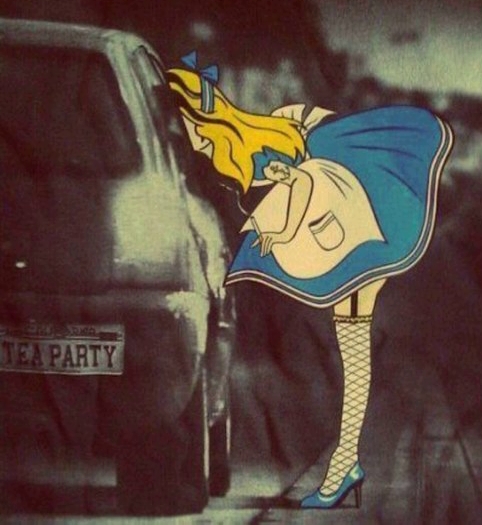
Image cropped from meme as posted 2015-10-07 by TheAnswerWasAlwaysMoreLube
I know. A red light district is a weird place to look for romance. Maybe U can make it work for RH-3. Maybe a closer look at the image will suggest something else to try.
The line formed by Alice’s straight spine meets the line formed by her legs somewhere under that flouncy skirt. Nobody on Earth has such long thighs. Hmmm. Maybe Alice is a Martian spy, practicing her skills before trying to seduce Earthian leaders into betraying our planet. (They already do that, but not in ways that would benefit Martian colonists.) Maybe interplanetary espionage will be kerbolixed by interplanetary romance when Alice moves on to the corridors of power.
I can’t think of a good way to use the idea of Alice as a Martian spy with a conflict between love and duty. (It would not suffice to write a hackneyed conflict story and tack on some extraneous weirdness about how an Earthian and a Martian get it on.) It is unlikely that RH-3 will include anything by me. That’s no great loss, but it gets worse. The medium with a laptop turned out to be a fraud, so RH-3 is also unlikely to include Lewis Carroll’s posthumously written Alice in Amsterdam. Unless U can step up.
A ghostly translucent squid seems to hover in midair between the viewer and nesting herons. No, I did not combine a heron image with a squid image in my photo editor.

The photo is of a page from National Wildlife magazine, taped to window glass and lit from the outside. (The page blocks a reflection of the sun from a neighbor’s window.) The squid looks a good deal closer than the herons despite being farther away, but only by the thickness of the page. The illusion in real life is just like the illusion in the photo.
The photo below illustrates a haiku about a bright full moon shining thru autumn leaves. Is it really the moon or just a flood light? Neither.

The photo was taken by daylight. The sun was above and behind me, but the light was dappled by unseen leaves (between me and the sun) before reaching the leaves I photographed. I was hoping for some chiaroscuro and got more than expected by sheer dumb luck. Most of the photographed leaves were in shade. Thanks to some unusually reflective green leaves that were in bright sun behind the colored ones, those colored leaves seem to be transmitting light from behind them when they are actually reflecting light from in front of them (and behind me).
The photos displayed above were chosen from among several exposure settings, then edited only by cropping. More extensive editing may be needed to create other illusions or to compensate for differences between how cameras and eyes see things. In particular, consider the challenge that inspired this post:
Illusions ~ Pic and a Word Challenge #213
Here are smaller versions of the images displayed in the challenge:
Desaturating a deliberately underexposed photo turned day into night. At any single exposure setting, a photo of the contrasty daylight scene would be either washed out in light areas or blacked out in dark areas. (Maybe both.) Editing merged several exposures to approximate how the scene looked to human eyes. Visit the challenge for more details on HDR editing and a fine haiku with no technical prerequisites.

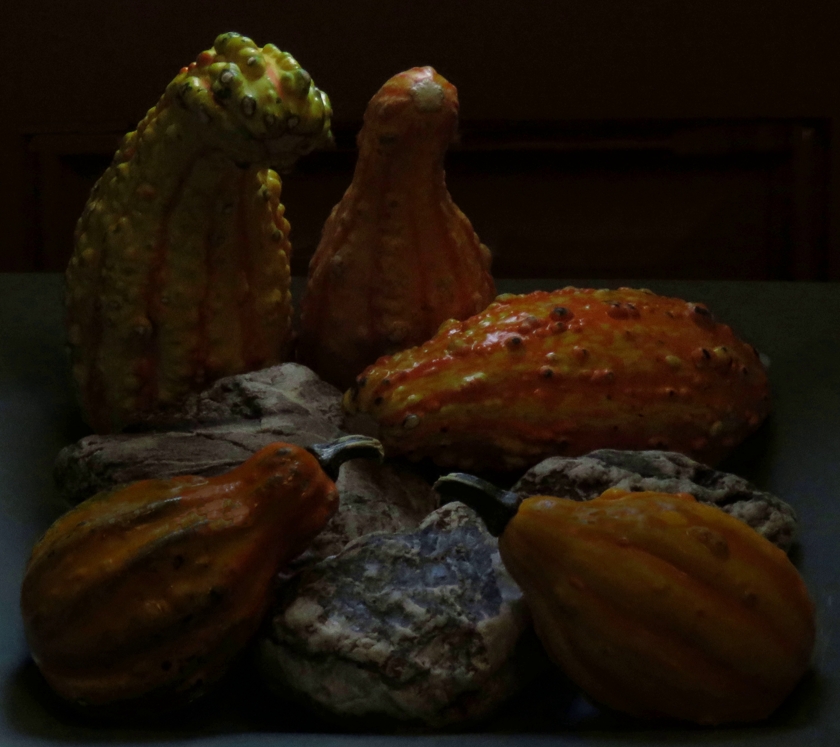
I took the original photo on 2019-02-25 after noticing that my display of 5 gourds and a few rocks looked a little like a Nativity display. (I edited the photo to have more of the chiaroscuro in some old Nativity paintings.) The gourds were the survivors from the 10 gourds I had bought on 2018-09-24, still looking good after 154 days. Those gourds were like the temple’s oil supply in the Hanukkah story.
Sure, it’s unlikely that gourds will last 154 days. But unlikely things do sometimes happen. Don’t bet on when or where.
and take it in stride if the New Year brings U yet another illustration of the statistical truism


Claude Monet’s paintings of Rouen Cathedral are well-known. Tho built for utilitarian rather than devotional purposes, the lighthouse at Amphitrite Point (on the coast of British Columbia) has much in common with the Rouen Cathedral. Each tries to guide the viewer to some form of safety. Each looks different at various times (and from various vantage points). Each has had its beautiful variety captured by a great artist.

© Patrick Jennings | Pix to Words | Amphitrite Lighthouse
Click on the image credit for access to Patrick Jennings’ other photos of the Amphitrite Lighthouse. Each image is accompanied by poetry. The prose poem posted with this image is an evocative dialog between the “Great Light” of the setting sun and the “little light at Amphitrite” (who gets the last word). Hmmm. “Little light at Amphitrite” could have a nice rhythm and an internal rhyme.
While the name of the eponymous Greek goddess is pronounced like [am-fi-tright-ee], it is OK to pronounce the place name like [am-fi-tright]. (Amid wind and waves, saying the [-ee] would sound rather twee.) Why do I care? Consider the tune of the Xmas carol O little town of Bethlehem. As with Greensleaves or Glorious things of thee are spoken, a great musical foundation can support many lyrical superstructures.
O little light at Amphitrite,
how bright we see thee glow.
The sea can smash a boat on rocks,
as all good sailors know.
But sailors steer with confidence
they will not drown just yet.
Thy beacon guides them safely home
no worse than cold and wet.
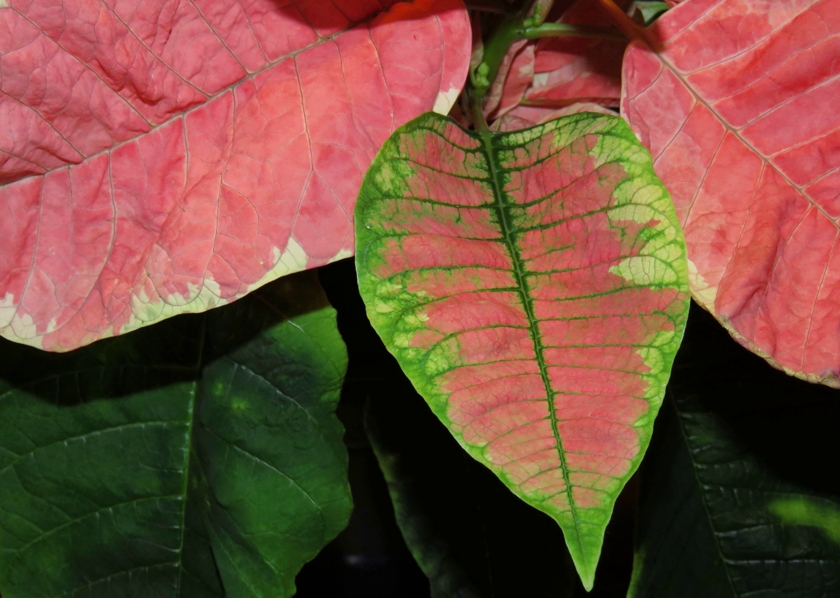
While shopping for food on the Monday before Thanksgiving Day in 2019, I noticed an especially good poinsettia with the salmon pink leaves edged in pale yellow that I like. Too early for a Xmas decoration? Yeah, but this plant’s not so glaringly out of season as the older choices of bright red or stark white.

In the morning on Thanksgiving Day itself, the plant looked even better and insisted on being photographed. Between shots, I noticed ways that the plant fits in with giving thanks after all.


Yes, I am posting this small Thanksgiving celebration a little late. One reason is that I let things rest a while and then edit again before publishing. The other reason is that the wheels turn slowly at my age. That they still turn is yet another reason to give thanks.
Carpe Diem #1781 The Quest For A New Masterpiece Continues … colorful autumn

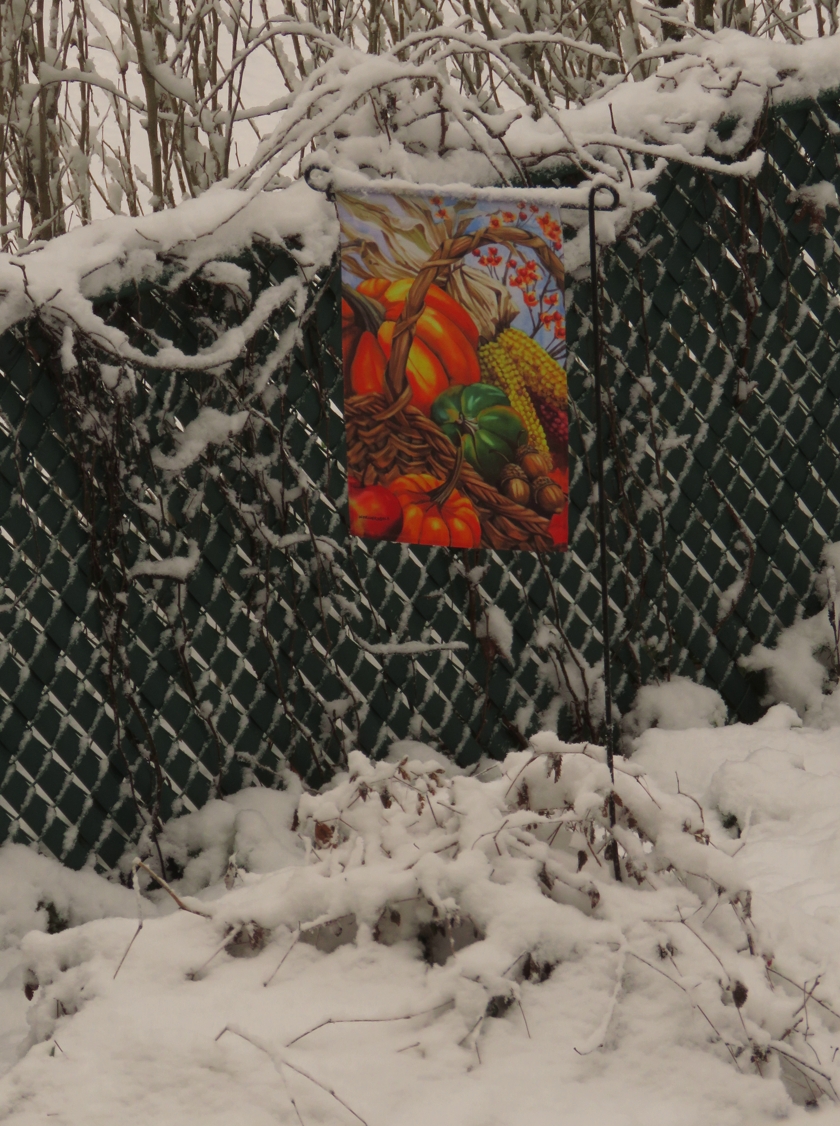
Between Seasons #1
Lost autumn colors,
but garden flag remembers.
Snow on power lines.

The rules and examples for this challenge allow marking the cut with punctuation and tweaking the cut when swapping the initial and final lines. Let’s do that.

Between Seasons #2
Snow on power lines.
But garden flag remembers
lost autumn colors.

Management consultant Frank Dow showed no surprise at the new client’s evident desire for a genuine consultation rather than a canned endorsement of plans already made. Though unusual, the client’s sincerity was still less surprising than the client’s identity. The client was God. Dow listened intently as God began to describe His problem:
“Forget any twaddle you may have heard about omnipotence and omniscience. The universe is too immense and diverse to be micromanaged, even by Me. Roughly speaking, I built a big machine and let it run. But it’s not boringly deterministic. The universe is all about probabilities.”
As God continued, the proud-parent joy in his voice was clear:
“The probability that a randomly chosen planet will be suitable for life to appear at all is tiny. The probability that creatures with any ability to understand and appreciate the universe will evolve is tinier still, but not exactly zero. On the other hand, there are a lot of planets in the universe. There’s no need to crunch the numbers right now. The bottom line is that a few planets luck out. On your little blue planet, life thrived and your species evolved advanced abilities to observe and learn, to imagine and reason, to build bridges and write poems.”
With joy replaced by sadness and frustration now, God explained what He hoped Dow could provide:
“While I mostly let things run, I am not absolutely hands-off when a planet has intelligent life that blunders into being cruel or stupid. I nudge them in good directions by inspiring a few of them. In your planet’s case, I have had a little success and a lot of failure. I keep it simple and age appropriate, but they oversimplify half of what I tell them and obfuscate the rest. The Golden Rule gets through as something to proclaim but not as something to practice. Absurdly, much of what they think has been revealed to them is just their own bigotry and bullshit. The way they distort My message is so alien to the corporate culture here that nobody has a clue about how to handle it. As someone who is closer to the problem without being part of it, you may be able to help us.”
Given a temporary office with read access to the case histories (and full access to a plentiful supply of coffee and nutritious snacks), Dow went to work. A recurrent pattern emerged:
Inspirations that did not fizzle attracted disciples, often with authoritarian personalities. Authoritarian disciples misinterpreted God’s nudges and stridently claimed they could speak for God on all kinds of topics, now and forever. Many of those who were strident were also willing to coerce people they could not convince. Many of those who were willing to coerce were also willing to kill people they could not coerce.
Poring over the case histories was depressing, but Dow kept at it (with the able assistance of good coffee and good snacks). Eventually, he was ready to offer God a suggestion:
“I believe there is a personnel issue here. You have been inspiring people who mean well but score high on credulity and low on humor. Maybe it would help to go outside the box. For example, You could inspire a nerdy atheist who digs sacred music and pushes the envelope of haiku poetry.”
God was skeptical: “Does anybody like that exist?”
Frank Dow smiled the enigmatic Mona Lisa smile that sometimes appeared when he was moonlighting as a Zen master. He leaned forward and spoke softly: “Does anybody like You exist?”
At that moment, God attained enlightenment.
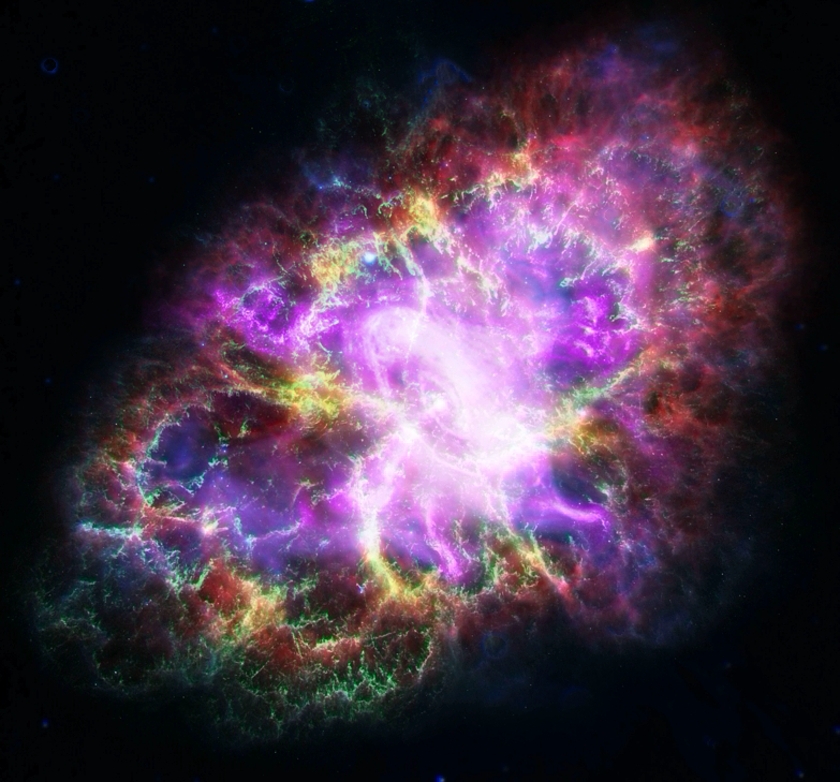
How to illustrate the concept of satori? For this post, I cropped a NASA image of the Crab Nebula and told the Retouching tab in my photo editor that each star was a blemish to be removed. If there is intelligent life on any planets orbiting those stars, I hope that nobody will be mad at me for dissing their sun. Oh well, it’s a big universe. I will be long gone before they have a chance to find out.
In its present form, this post’s story first appeared in Volume 1 of The Rabbit Hole, an annual anthology of weird stories. None of the stories there are illustrated, and I had no good ideas for an illustration anyway. How I came to write a story about God hiring a consultant whose recommendations are outside the box is yet another story, somewhat weird but entirely true.
Fall Frolic #1
Dancing on the breeze,
ignorant of gravity:
red leaf in blue sky.
My haiku has “#1” in its title to distinguish it from a similar haiku Fall Frolic #2. I prefer #1. Why bother with #2 at all? The answer to that question helps answer some others.
Fall Frolic #1 implicitly poses a riddle, then provides the answer. Who is the ignorant dancer? More subtly, why is (s)he said to be dancing “on” (not “in” or “with”) the breeze? The basic structure is the same as in Jane Reichold’s classic

Haiku © Jane Reichold superimposed on
Photo © Vladlena Azima | ShutterStock
Now consider swapping the initial and final lines of my riddle haiku:
Fall Frolic #2
Red leaf in blue sky,
ignorant of gravity:
dancing on the breeze.
While #2 describes the same scene #1, it lacks the suspense and resolution of the riddle structure. While both versions work, #1 works better. I still owe U an explanation: why bother with #2 at all?
The first draft for what eventually became #1 had initial and final lines that were very close to the corresponding lines in #2. The middle line had an entirely different way of hinting that the leaf’s freedom is a temporary illusion, between being stuck on the tree and stuck on the ground. The first draft’s hint would have been too obscure w/o either an appropriate picture or the explicit scene setting done by the initial line in #2.
Already unhappy with the first draft’s middle line, I swapped initial and final lines on a whim. The resulting riddle structure was motivation to get serious about clarifying the middle line.
Some haiku poets strive to have the initial and final lines be interchangeable. Unless I am responding to a challenge calling for haiku that work just as well when the initial and final lines are swapped, I usually do not consider swapping. Too gimmicky and arcane. But a swap while revising might help answer the eternal writers’ questions
Am I saying what I want to say?
Am I saying it clearly?


Gurērisu
Jump! Grab! Swing hips up!
Nimble ninja hogs the seeds.
Birds have a long wait.

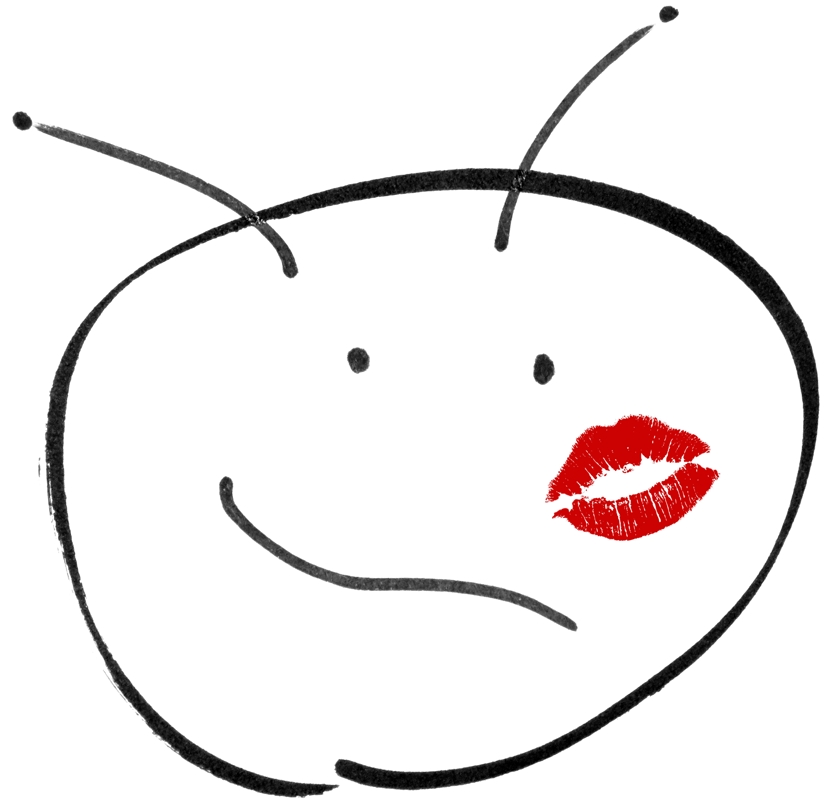
Kiss Overlay © OlyaTropinina | 123RF Stock Photo
Mission Accomplished?
Ant with wings staggers,
then dies. Did I see him smirk?
Had he banged a queen?
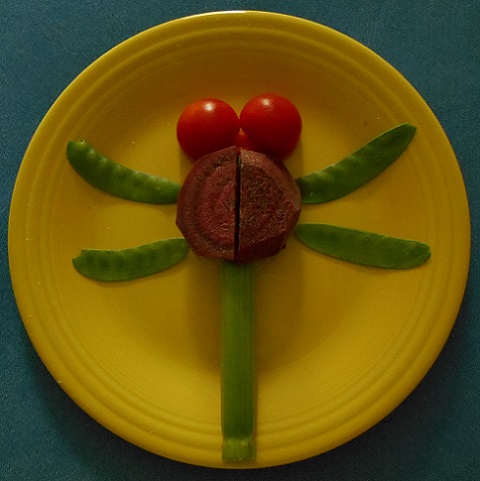
One day in 2015, I happened to arrange my lunch veggies so as to look a little like a dragonfly, with snow peas as wings. Hmmm. Maybe I could pull more veggies from the fridge and make an arrangement that looks a lot like a dragonfly to me. (No real dragonfly would be fooled.) This little project reminded me that a dragonfly is the enemy of my enemy, and thus my friend.
What’s for Lunch?
Mosquitoes in flight
are seen as meat on the hoof
by a dragonfly.
When they called for weird stories to be submitted for Volume 2 of The Rabbit Hole, the editors suggested science and/or weather and/or entertainment as themes. While the suggestion was not a requirement, many of the writers who responded did use those themes. In particular, You’re Not Late has great synergy between weather and an aspect of science other than weather forecasting. Maybe there are other great synergies; it will take me a while to read all the stories in RH-2.
Modern scientific theories are also stories, of a special kind. Tho hard to read w/o wrangling equations, they are gloriously predictive and useful. (U don’t need hard copy to read this post.) They are also weird. As the editors remark in the preface:
Back in 1935, the physicist Erwin Schrödinger told a story to illustrate the weirdness of quantum theory. The story eventually became a celebrated meme, and here is yet another celebration:
Ode to Schrödinger’s Cat
Schrödinger’s cat
is both skinny and fat;
both dead and alive
(past age seventy five);
both purring and hissing
(while measurement’s missing);
both mewing and yowling
(while Einstein is howling).
Schrödinger’s gone,
but his cat carries on
with a Cheshire cat grin
at the pickle we’re in.
Hmmm. Saying that the cat is “both dead and alive” is a common (and admittedly oversimplified) shorthand for the statistical limbo called “superposition of states” in quantum theory. Here is a closer approximation to what the theory actually says:
Despite having a deterministic philosophy, Einstein had no qualms about common-sense probabilities:
Is the clash between quantum theory and common sense just something for novice philosophers to argue about? Nope. To see why, we don’t need the nasty gadgets in Schrödinger’s story. We need two kittens from the same litter, in separate boxes some distance apart. We also — ah — ah — ACHOO! The cat dander is ticking off my allergy.
Never mind. There is a short humorous allegory about this stuff in my story Entanglements, with petting but no pets. Spoiler alert: quantum theory wins.
Getting You’re Not Late and Entanglements and 27 other stories is easy. Just buy RH-2. To consider buying it from Amazon as either a printed book at $11.50 or an e-book at $2.99, click here. To consider buying an e-book from other retailers at $2.99, click on the rabbit.
To see the Disney version of the Cheshire cat do its thing, U can get to a video on Facebook by clicking on the cat’s image here. Clicking twice on the cat’s image there will start the video, but only buying RH-2 will get U to the 29 weird stories.