My house was built with heat by circulating hot water and tankless household hot water provided by a coil of tubing in the oil-fired boiler. Over time, I came to use a heat pump powered by renewable electricity for normal heating. The old system still provided backup heating and household hot water. Replace it with an electric water heater? That would be a project, and there was always something more urgent.
In 2023, the routine annual service for the oil-fired system was not so routine. Old corrosion caused more alarm to the technician than in past years. The technician found a new leak at the base of the thermal expansion tank: glistening moisture, not old dry rust. That tank was original equipment, as were rusty pipes around it that could be broken by an attempt to replace only the tank. Time for a major upgrade?
No more grandfathering. I decided not to do the kind of upgrade to an oil-fired system that would be illegal if done after 2026 in my state. I contacted a home services company with a broader range of products, including electric water heaters. They suggested I consider getting a hybrid electric heat pump water heater (let’s call it HEHPWH for short), where “hybrid electric” refers to having old-fashioned electric resistance heating elements as well as heat pump technology. The HP in HEHPWH would qualify for a tax credit and a utility rebate, while the HE would provide backup if the heat pump went down or could not keep up with demand. Details on the HP incentives are at the end of this post.
I pondered 4 estimates: 2 for HEHPWH and 2 for electric-only. Why 2 of each? While a 50 gallon tank should be enough for a small household, I was skeptical and wanted to consider a larger tank also. I got estimates for both 50 and 80 gallons. Like any rule of thumb, the popular “50 for a small household” deserves respect but not mindless adherence. Maybe some of the reasons to doubt the rule in my specific case will also apply to yours.
- I come by skepticism honestly. When I was a teenager, there was an effort to make electric water heating thriftier with some gimmick I don’t remember, long before heat pumps. My father pressed the contractor who wanted to sell him a nifty thrifty heater. Would it be adequate for 2 adults and 2 kids? The contractor assured us that his family got along fine with the same heater. “I have 6 kids.” So far as I can recall, there were only 2 points of unanimous agreement in the history of my disputatious family, both involving the nifty thrifty heater.
After getting the estimate: This is worth a try.
After a week of actual use: This is a bummer. - Households differ in more ways than size. For some, a shower is 5 or 6 minutes in the morning, after the water heater has had all night to recover from the previous day. For me, a shower is 10 or 12 minutes in the evening, sometimes soon after running the dishwasher. I’m too old to stay up late waiting for the water heater to recover. And so on.
- Does “50 for a small household” predate the introduction of HEHPWH-s? The electric-only capacity question was whether the heater could keep up with demand. Now there is another question: can it do so mostly with the heat pump alone, w/o using the electric resistance heating elements? (The heat pump alone is efficient but slow.) If 2 gallons of cold water come into the tank because dishwashing took 2 gallons of hot water out, the temperature in an 80-gallon tank gets dinged less than the temperature in a 50-gallon tank. Dunno enough about actual usage and how the computer in the HEHPWH makes decisions to be sure, but I am confident that bigger is better for my typical usage patterns. Dunno how much better.
In the end, it was a Pascal’s Wager situation. While 50 might well be enough, I would be extremely unhappy if I went with it and it wasn’t. While 80 might well be overkill, it would do the job and would cost more but not break the bank. I went with 80, and the installation on 2023-07-10 was as smooth as anything that complex can be.
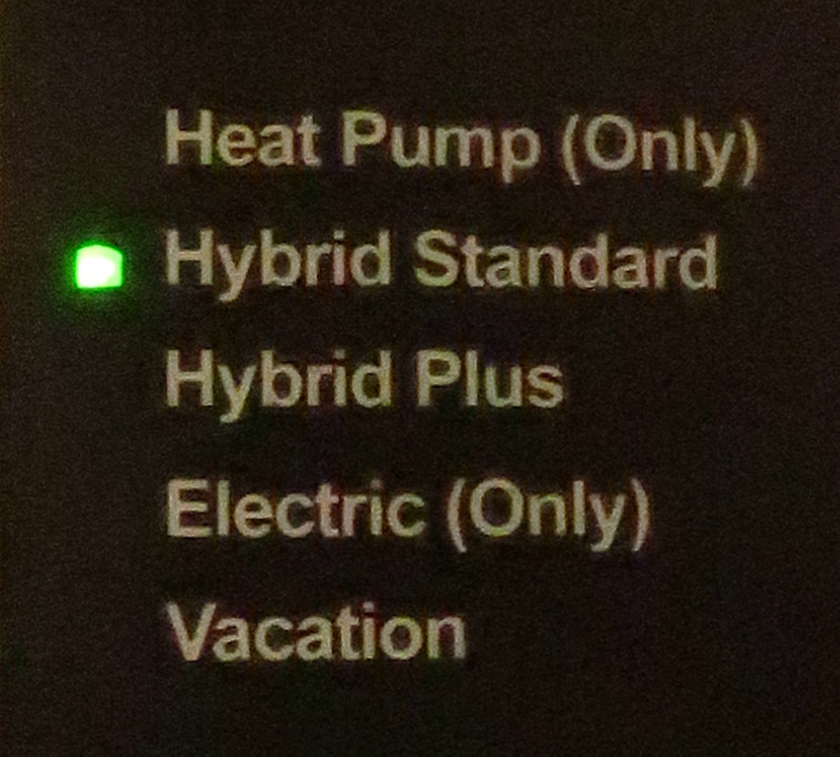
Ordinarily, the LED for standard hybrid operating mode is the only one on because that is the mode I selected. (The LED for the selected mode is always on.) If the computer decides the heat pump needs help from the electric resistance heating elements, the electric-only LED flickers. Of course, it flickered while a whole tank of fresh cold water was being heated. That should happen at most once a year. In normal use, I have never seen it flicker.
The IRS tax credit for my HEHPWH is 30% of cost (topped at $2000) for an Energy Star heat pump water heater (if bought by 2032-12-31). In 2023 only, there is also a $1000 rebate from my electricity delivery company. Maybe yours too. Whatever size works for U, these are strong incentives. In particular, an electric-only water heater of the same size would have cost me $147 more than the net cost of my HEHPWH, after the credit and rebate.
– above post (on phone) or beside it (on desktop). –
 Mellow Curmudgeon
Thanks
LikeLiked by 2 people
I admire your well-reasoned and researched approach to decision-making.
LikeLiked by 1 person
Thanks. The decision-making in this case was an outlier. My usual is paralysis by analysis, with episodes of gullible impulsiveness. 😉
LikeLiked by 1 person
I wish you were around when I try to make these decisions. I bought a house with two water heaters because the previous owner decided more was better. Now I get to replace to at a time whenever one breaks down.
LikeLiked by 2 people
Maybe a plumber could improve the situation by putting the heaters in parallel, each with its own shutoff valves. If one goes bad, U could turn it off and close its valves, then replace it at leisure. If U go this route, get lever valves. They are easier to adjust than twist valves and let U see at a glance whether they are open or closed.
LikeLiked by 1 person